


Andrew Dale/Shutterstock
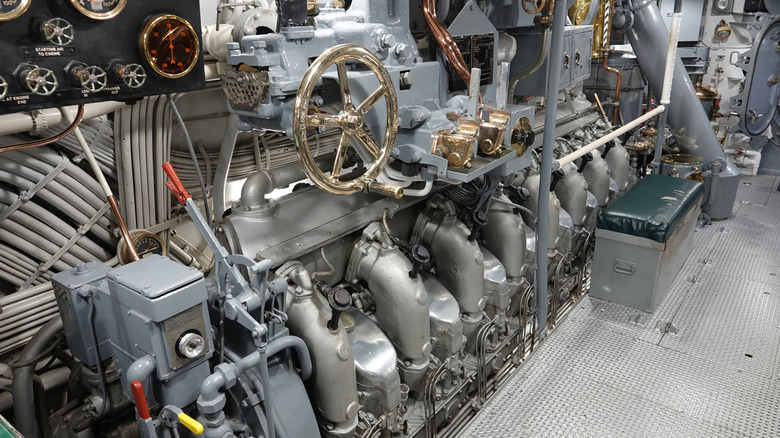
Within a diesel engine’s cylinder, compressed air elevates the temperature to ignite expelled fuel, and the ensuing power propels pistons that drive the vehicle’s primary gears. Essential to this combustion process is oxygen, which is plentiful in the air surrounding us. This mechanism functions adequately for trucks, machinery, and other terrestrial vehicles that can access the natural oxygen present in the atmosphere. Yet, how does this process operate beneath the surface? More explicitly, how do diesel submarines obtain sufficient oxygen to ignite fuel underwater?
The concise response is that a submarine’s diesel engines do not operate at all when the vessel is submerged. Conventional submarines function as hybrid units employing both diesel and electric energy. While on the surface, they utilize diesel engines to drive the propellers and generators that recharge their batteries. However, once the submarine descends, those diesel engines are rendered inactive. Instead, their batteries drive electric motors, which are more efficient and silent; their noiseless operation allows submarines to remain undetected underwater. Conversely, diesel submarines are limited to short durations underwater — they must resurface to engage the diesel engine and recharge the batteries. In contrast to diesel-electric submarines, nuclear-powered submarines hold greater advantages specifically because their nuclear reactors are independent of oxygen, enabling them to remain submerged for extended periods.