

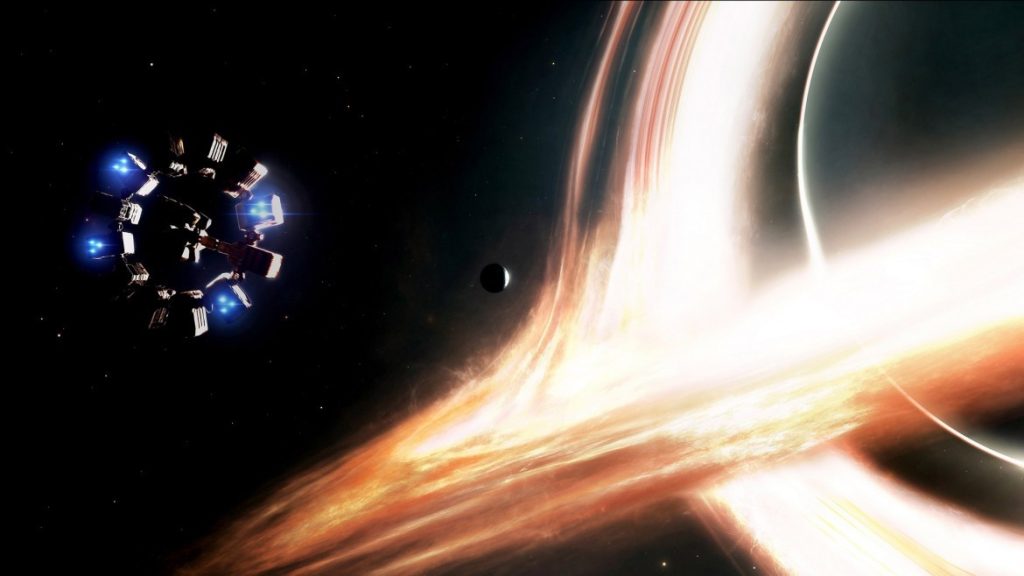
“Oppenheimer” (2023) might have secured Christopher Nolan a well-earned Oscar for Best Director, but “Interstellar” (2014) can be seen as an even more remarkable creation by Nolan, an ambitious science fiction film that remains anchored in real science while exploring one of humanity’s most fundamental emotions: love. The blend of impressive visuals, an enchanting score, and numerous unforeseen twists renders “Interstellar” an essential viewing experience, one that invites multiple rewatching after the first viewing. This could be attributed to the fact that “Interstellar” conveys a plausible narrative. The Earth is gradually perishing, and humanity’s hope for survival lies light-years away, in the proximity of Gargantua, a colossal black hole that serves as one of the film’s most breathtaking locations. It appears that Nolan’s representation of Gargantua was remarkably precise. A group of researchers succeeded in capturing the first image of a black hole in 2019, with the indistinct picture presenting a strikingly akin appearance.
Nolan worked with relativity specialist Kip Thorne, who played a key role in the production of “Interstellar.” The scientist provided guidance throughout the process, from scripting to editing, to guarantee that the audience would have a scientific experience that felt authentic. The Gargantua black hole stands out as one of the primary science fiction themes Nolan introduces in “Interstellar,” grounded in current scientific understanding. Some of that science is elucidated during the film, allowing the audience to easily comprehend ideas like time and gravity.
Time is a vital element propelling the narrative. The protagonist, Cooper, played by Matthew McConaughey, undertakes the space mission to rescue Earth, fully aware that he will lose years with his children — and potentially never come back. The events occurring close to the black hole, where time flows significantly slower than on Earth, ultimately shatter Cooper’s heart. The enormity of Gargantua appears unavoidable.
How did researchers manage to photograph a black hole?
The scientifically validated visual effects earned “Interstellar” an Oscar in 2015. However, while Nolan’s film led us to believe that black holes resembled the Gargantua design, we had no means to ascertain the accuracy of this portrayal. Gargantua appeared plausible, but it was still merely a concept created for cinematic purposes. It wasn’t until 2019 that the Event Horizon Telescope initiative produced the first indistinct image of the Messier 87 (M87) black hole, which was published by The New York Times. As shown in the clip above, the black hole does not precisely mirror the stunning Gargantua but does bear a striking resemblance. At its core, there exists a circle (sphere) devoid of light, representing the black hole. Surrounding the dark core is an orange circle, the accretion disk, composed of light and luminous gases.
M87 is a galaxy located in the Virgo constellation, approximately 55 million light-years from Earth. The black hole within it is several billion times more massive than the sun, as reported by The Times. It is also “emitting a violent jet of energy some 5,000 light-years into space.” This energy, along with the light and gas, facilitates the imaging process. The astronomers at the Harvard-Smithsonian Center utilized a telescope network equivalent to the size of Earth to capture the image. This is the Event Horizon Telescope, comprised of eight radio observatories situated on six mountains across four continents. The project began in April 2017, when the observatories monitored the target for ten days.
The Event Horizon team invested two years analyzing the collected data. The data was so substantial that scientists couldn’t transfer it over the internet. Instead, they transported hard drives back and forth to consolidate the information. Four independent teams then collaborated on the data to avoid bias.
A monumental discovery for mankind
“Interstellar” scientific consultant Kip Thorne received the Nobel Prize in 2017 for his discovery of gravitational waves resulting from colliding black holes. In 2019, The Times highlighted Thorne’s admiration for the black hole imagery. “It is wonderful to see the nearly circular shadow of the black hole,” the astrophysicist conveyed in an email to the publication. “There can be no doubt this really is a black hole at the center of M87, with no signs of deviations from general relativity.”
This initial image does not merely confirm Einstein’s theories about relativity and black holes. It also implies that Nolan made the correct decision to rely on scientific principles to portray the haunting Gargantua (as seen in the brief “Interstellar” clip above). More significantly, the image assists astronomers in advancing their research on black holes. According to The Times, scientists managed to ascertain the size of the black hole and estimate its mass at 6.5 billion solar masses, or considerably heavier than prior predictions.
While a sequel to “Interstellar” seems improbable, the Event Horizon team is likely to generate similar black hole images in the future. M87 was merely the beginning. A black hole at the