
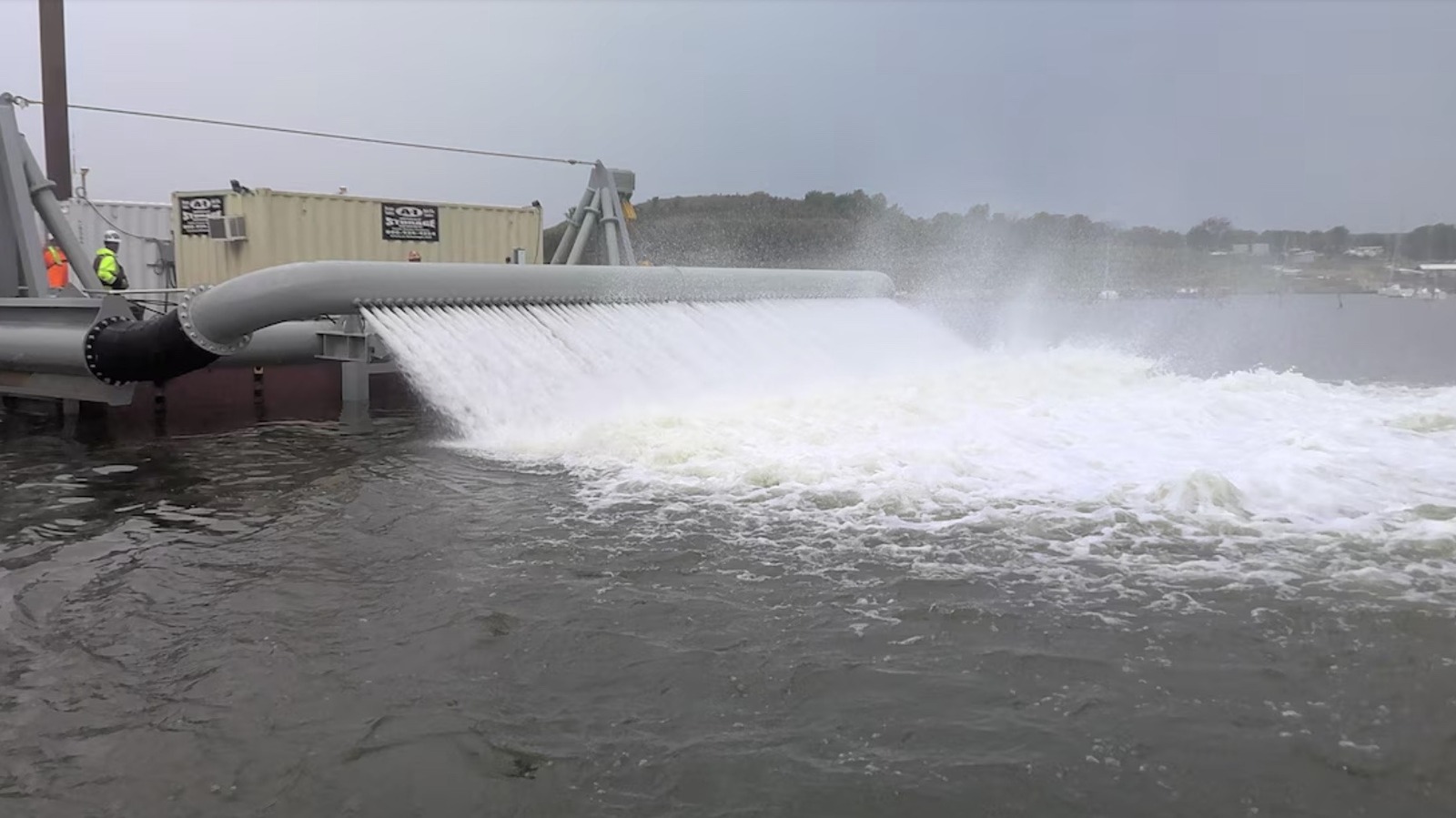

As the title suggests, Kansas’ Tuttle Creek Lake — which is, in fact, a man-made reservoir established under the Flood Control Act of 1938 — is primarily composed of, well, a significant amount of water. This hasn’t prevented the U.S. Army Corps of Engineers (USACE) from embarking on a project that essentially involves reintroducing water back into the lake using a specially outfitted barge. Naturally, this may lead to some misunderstanding.
A report from USACE reveals that, in partnership with the Kansas Water Office, the corps is examining whether a technique known as Water Injection Dredging (WID) can tackle a sedimentation issue that has caused the reservoir to gradually diminish over the years. If successful, this could provide an eco-friendly means to enhance the utility of an essential resource without exhausting it.
Most importantly, the WID approach is not particularly demanding in terms of resources. It effectively utilizes the native water from the reservoir to potentially rejuvenate its overall supply over time.
A novel dredging technique could combat sediment using water
Tuttle Creek Lake currently acts as a water source and flood control system for nearly half of Kansas residents. It also facilitates numerous water-related recreational activities. Regrettably, over decades, around 438 million cubic yards of sediment have settled within the reservoir, considerably restricting its overall surface area. Estimates suggest that, without intervention, in approximately 50 years, Tuttle Creek Lake could be around 75% sediment; leaving merely a quarter of its original capacity for use.
WID may present a remedy. The process entails outfitting a barge with a jet bar that takes water sourced from the reservoir and essentially re-injects the water back into the lake. Theoretically, the water jets will elevate the sediment from the surface, enabling gravity to transport the sediment downstream and out of the reservoir.
USACE and the Kansas Water Office plan to examine the impacts at a principal dredging site located within four miles of the reservoir’s dam, where they will use the WID method to dredge both the lake’s floodplain and its channel. They will also conduct testing at a secondary site further from the dam, where only the channel will be dredged. USACE states it will undertake environmental monitoring of the reservoir and adjacent bodies of water (such as the Big Blue River and Kansas River) to evaluate any ecological effects of the project.
Reintroducing a lake’s own water could conserve a natural asset
If everything proceeds as intended, USACE and the Kansas Water Office are set to commence the Tuttle Creek Lake WID testing with an initial phase scheduled from September 17 to September 27, 2026. This test aims to be the first of three evaluation periods. Depending on the outcomes, the initiative may act as a “proof of concept” for future endeavors at other reservoirs and lakes.
Granted, in a time when some scientists and governments are actually trying to manipulate the weather, a distinctive solution for reservoir sedimentation may not immediately seem like an exciting technological breakthrough. However, it’s essential to contemplate the ramifications of a project like this. With alterations to the equilibrium of the global water cycle leading to possible water shortages, any safe and effective approach that optimizes our current water resources is worth pursuing. Alongside innovations like “farming fog,” WID may assist us in maximizing a crucial natural resource.