
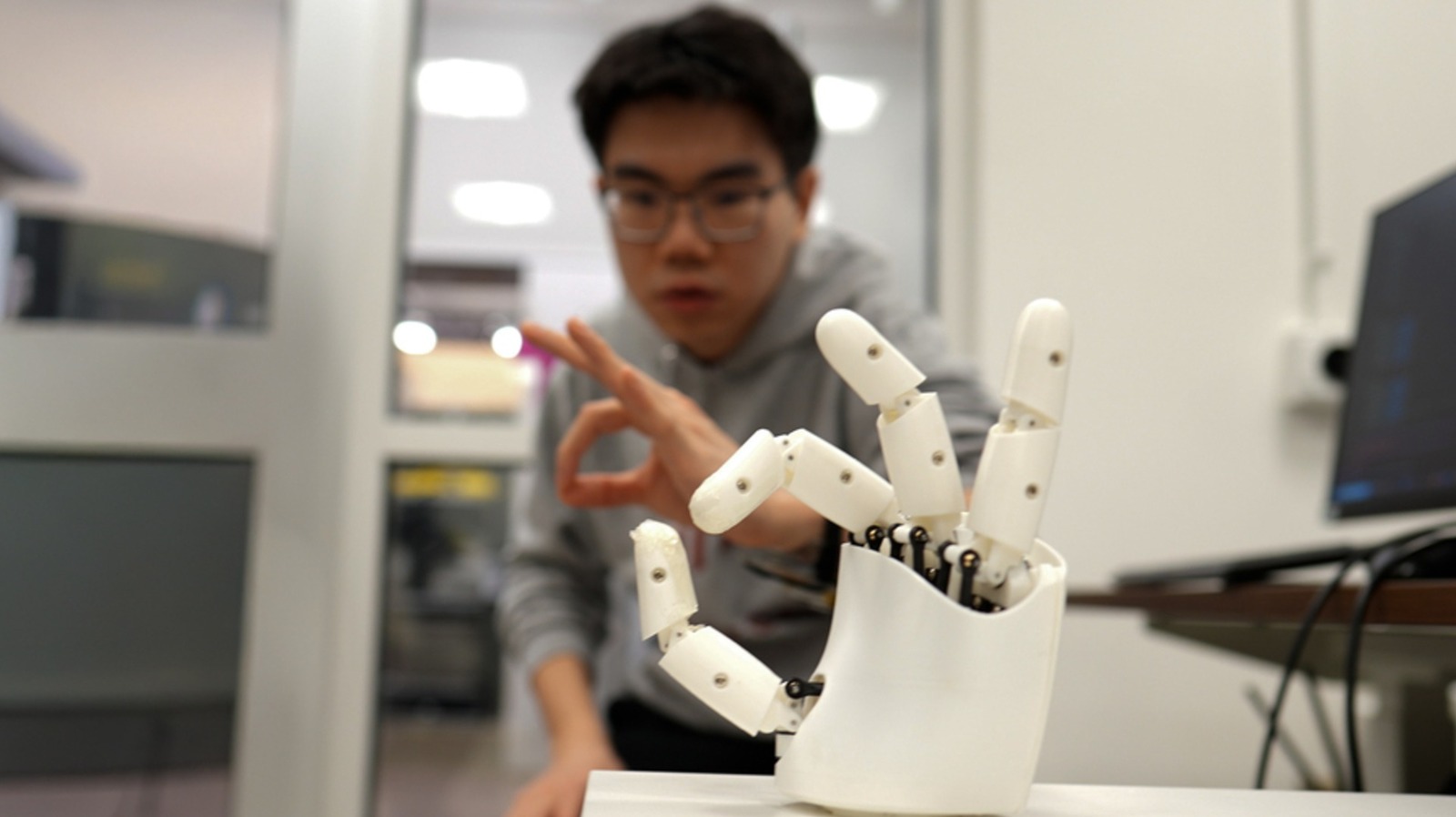

As technology advances, researchers gradually close the distance between prosthetics and natural limbs: Experts have created a prosthetic hand that enables users to perceive temperatures and bionic legs that operate via brain impulses. Now, a recent innovation advances robotic hands closer to replicating the complex movements of the palm and fingers.
In March, a group of engineers at MIT disclosed a unique wristband that monitors muscle movements and sends signals that enable a robotic hand to replicate the user’s actions. This groundbreaking device utilizes ultrasound technology to track muscles, tendons, and ligaments in the wrist and employs an AI algorithm to convert those signals for a robotic hand in less than 120 milliseconds. This technological pairing is said to be proficient enough for a human to make a commercially available robotic prosthetic play the piano and adapt to the user’s hand movements.
The wristband’s capabilities extend beyond the physical realm. Researchers indicate that this device can link to a virtual setting and utilize hand motions for in-app operations. For example, an individual can enlarge and reduce virtual items simply by pinching and releasing their fingers, mimicking the action of zooming in and out on a tablet screen. Envision a future where, instead of using controllers, you simply wear advanced wristbands to navigate various VR applications and games. It sounds quite immersive.
The wristband can act as a training tool for robots
The ultrasound wristband that interacts with the robotic hand is based on technology that, despite being compact, isn’t featherlight. Users need to bear the combined weight of a smartwatch and a smartphone on their wrist, and researchers aspire to miniaturize the device in the future. Nonetheless, they aim to promote it beyond just individuals who have lost their hands or seek novel ways to engage with virtual items.
The MIT team that developed the wristband believes the device could serve as an essential resource in the humanoid robotics sector. They think the AI and wristband could assist in training these robots for various tasks requiring fine motor skills, like surgical operations. To realize this ambition, researchers would need to compile an extensive library of scans featuring diverse hand sizes and finger shapes executing a range of gestures.
Some individuals predict that the future will bring humanoid robots that coexist with our smart homes, and while many of these could be operated remotely by unfamiliar individuals, MIT’s wristband could play a crucial role in both situations. If the robots are autonomous, training data from the wristbands could ensure that caregiver androids interact with your property delicately, and if they are operated remotely, the wristbands could provide real-time hand accuracy.