

The U.S. military is perpetually seeking methods to outpace technological advancements, especially as drones, robotics, and artificial intelligence disrupt warfare with remarkable velocity. A recent advancement stems from a military challenge that resembles a trendy reality television program rather than a conventional government request for proposal (RFP). Conceived by Secretary of the Army Daniel Driscoll, Dragon’s Lair is an annual event where soldiers present solutions to typical battlefield issues to a panel of judges, akin to “Shark Tank.” Launched by the U.S. Army and made accessible to all U.S. military branches and units in 2021, the panel features both civilian and military specialists.
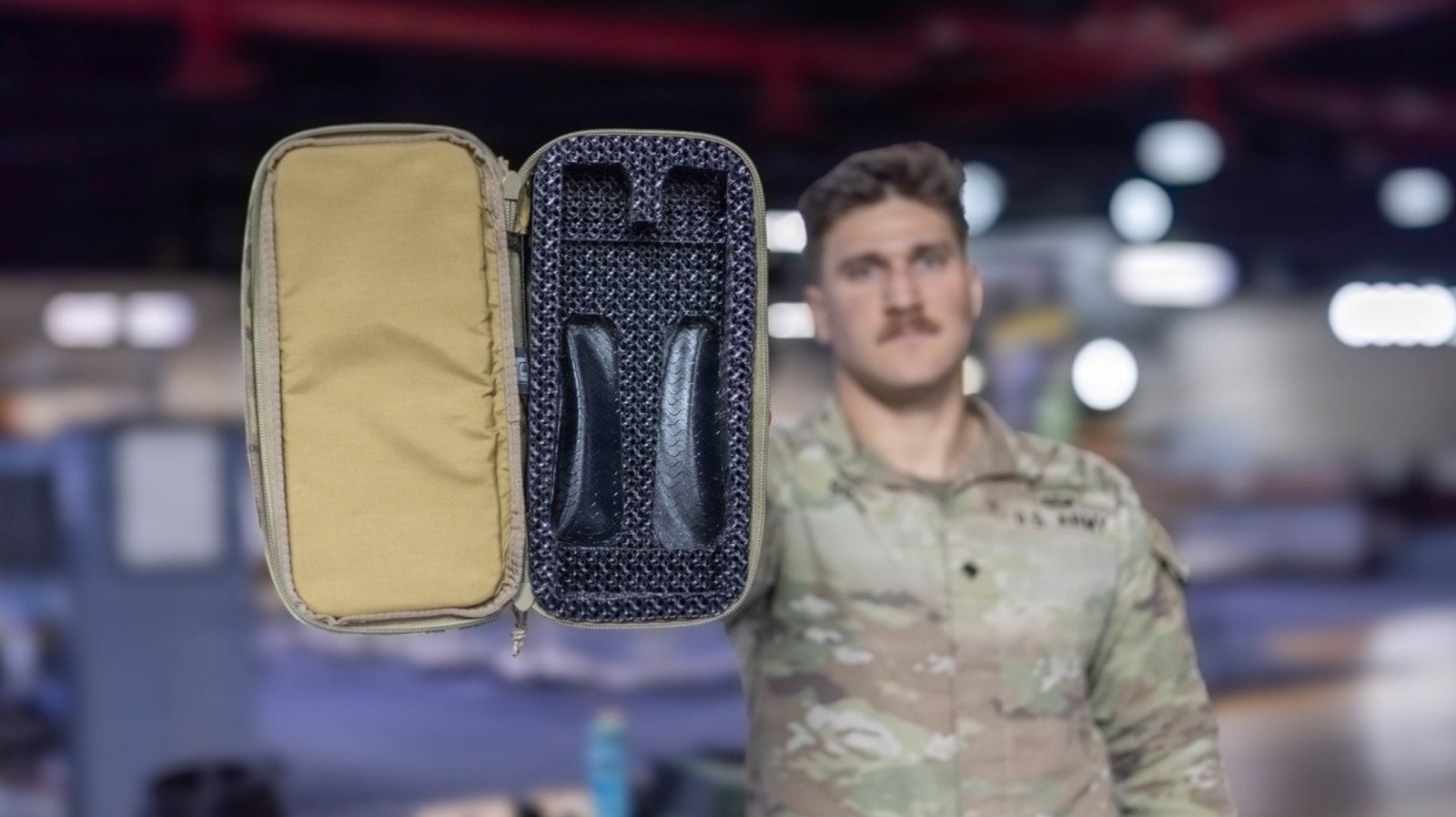
Dragon’s Lair provided the U.S. Army with a method for transporting its rapid deployment Unmanned Armed Vehicles (UAVs). Known as the Modular Drone Case, this product is a lightweight and robust container crafted to carry various drones for air and land operations. Created by Spc. Alexander Soto and Sgt. Talen Valerio from the 82nd Airborne Division, the case secured second place at Dragon’s Lair XI, the June 2025 edition of the Army’s “Shark Tank”-inspired competition.
The case illustrates the production cycle fundamental to the Army’s Transformation Initiative. In an open letter, Driscoll stated that the effort aims to redefine how the military will “fight, train, organize, and procure equipment.” Initiated in May 2025, the Army intends to “provide essential warfighting capabilities, enhance our force structure, and eradicate waste and outdated programs.” Although not groundbreaking at first glance, the Modular Drone Case exemplifies the initiative’s fostering of innovation driven by soldiers. So far, the Army has not disclosed whether the case will be deployed at the DOD’s new drone testing facility in the near future.
From pitch to production
The concept for the modular drone case was inspired by Spc. Alexander Soto’s observations of drones being damaged during deployment. As a paratrooper, Soto recognized that drones frequently sustained damage during airborne drops or field training. He discovered a need for soldiers to have a secure way to transport sensitive equipment in a sturdy, mobile case small enough to fit in a backpack. According to an announcement praising Soto and Valerio’s proposal, the case facilitates rapid deployment during ground, vehicular, and airborne missions, serving as a “versatile, field-adapted solution” designed for “optimal payload efficiency and field mobility.”
After winning second place at the June 2025 conference, the design team worked alongside Staff Sgt. Larry Dockins from the Airborne Innovation Lab to create the prototype for the carrying case. The outcome was a lightweight, resilient product compatible with multiple UAVs. Dockins noted that the case could significantly impact the military’s drone operations. “Any solution that enhances a warfighter’s lethality counts as a successful solution for us,” Dockins mentioned in the U.S. Army press release announcing the case’s production. “Developing a device that reduces weight could determine victory or defeat on the battlefield.”
The competition’s winners, U.S. Army SFC Jesus Naranjo and 1LT William Rambin, presented an 81mm Mortar Quick Emplacement Mount that enables soldiers to store and deploy mortars from Infantry Squad Vehicles. Previously, infantry troops primarily depended on improvised techniques to quickly deploy mortars in dynamic, high-stakes environments. Another noteworthy innovation introduced at the event was a headset capable of detecting electromagnetic frequencies.
The Army’s innovative forward approach
Despite its battlefield potential being impressive, the true achievement of the Modular Drone Case lies in its expedited development process. More than merely a product of the military’s Shark Tank adaptation, the case stands as a successful pilot initiative of the Joint Innovation Outposts’ accelerated procurement model. Established in January of this year, the JIOP aims to streamline the Pentagon’s procurement practices, offering key partners a quicker timeline leading up to production. Led by Lt. Gen. James Gavin, the JIOP was pivotal in advancing the modular case from concept to production in merely three months.
Such endeavors represent the military’s effort to expedite internal innovation timelines to remain competitive amid unprecedented change. As advancements in artificial intelligence and robotics reshape the battlefield’s scale, scope, and nature, the Pentagon must embrace novel strategies to keep up with diverse challenges. Reforms concerning the Army’s Acquisition Program and the launch of the branch’s “flagship innovation engine,” known as FUZE, further highlight this approach.
How the Modular Drone Case stands against more extravagant drone-centric innovations, such as transforming Apache helicopters into drone-destroying machines, remains to be determined. In its essence, the case demonstrates the Army’s capability to swiftly tackle challenges and signifies the success of Dragon’s Lair. The challenges that might arise in the future are yet to be seen.