
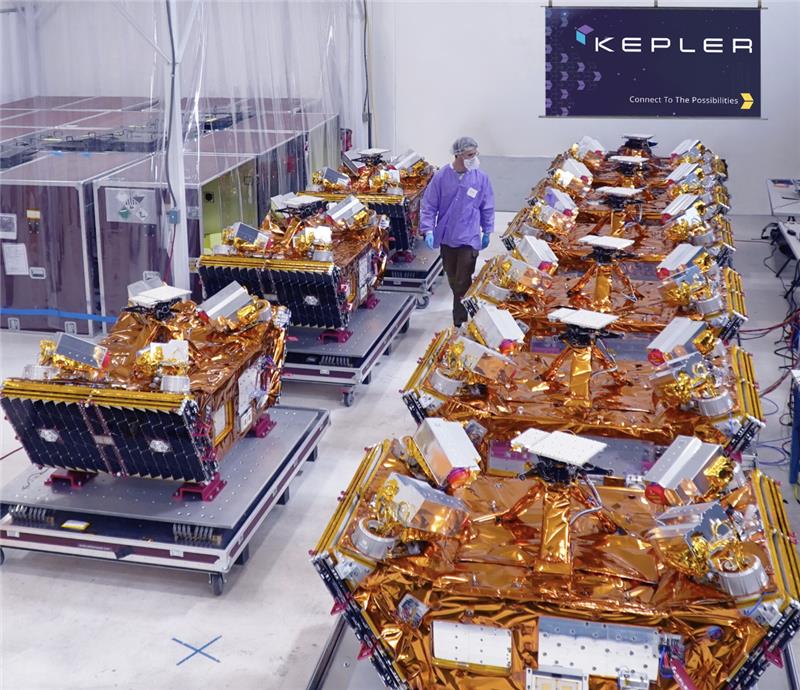

As excitement around space-based data centers grows, the number of GPUs in space remains limited. However, this is starting to change, and the business of orbital computing is taking shape. Canada’s Kepler Communications currently operates the largest compute cluster in orbit, launched in January. It consists of 40 Nvidia Orin edge processors across 10 operational satellites, all interconnected via laser communication links.
Kepler has 18 customers and recently announced a new partnership with Sophia Space, a startup aiming to test its unique orbital computer software on Kepler’s satellite constellation. Large-scale space data centers like those envisioned by SpaceX or Blue Origin are not expected until the 2030s. Initially, orbit-based data processing will enhance the abilities of space-based sensors used by private companies and government entities.
Kepler’s CEO Mina Mitry states that the company views itself as a provider of infrastructure for space applications, offering network services to satellites or aircraft. Meanwhile, Sophia is developing passively-cooled space computers to overcome the challenge of preventing processor overheating without heavy, costly cooling systems.
In their collaboration, Sophia plans to upload its operating system to a Kepler satellite and deploy it across six GPUs on two spacecraft. This is comparable to operations in terrestrial data centers and marks a first in orbital computing. The successful demonstration of their software in orbit is vital for Sophia before its planned satellite launch in late 2027.
Through this partnership, Kepler aims to showcase the potential of its network, which currently processes data uploaded from the ground or collected on its spacecraft. As the sector develops, Kepler anticipates collaborating with third-party satellites to offer networking and processing services. Companies are already planning assets based on this model, which benefits processing power-hungry sensors such as synthetic aperture radar, integral to the U.S. military’s missile defense systems. Kepler has successfully demonstrated a space-to-air laser link for the U.S. government.
This edge processing—managing data where it’s collected for faster response—will be the initial value of orbital data centers. This approach distinguishes Kepler and Sophia from established space entities like SpaceX and Blue Origin and startups like Starcloud and Aetherflux, which are focusing on large-scale data centers.
Mitry emphasizes the importance of distributed GPUs for inference rather than a single GPU for training, optimizing power usage. Proving these technologies in orbit could pave the way for significant changes. Sophia’s CEO Rob DeMillo notes recent regulations that inhibit data center construction on Earth and suggests that these restrictions make space-based alternatives more attractive. “There’s no more data centers in this country,” DeMillo remarked, hinting at a new era on the horizon.