
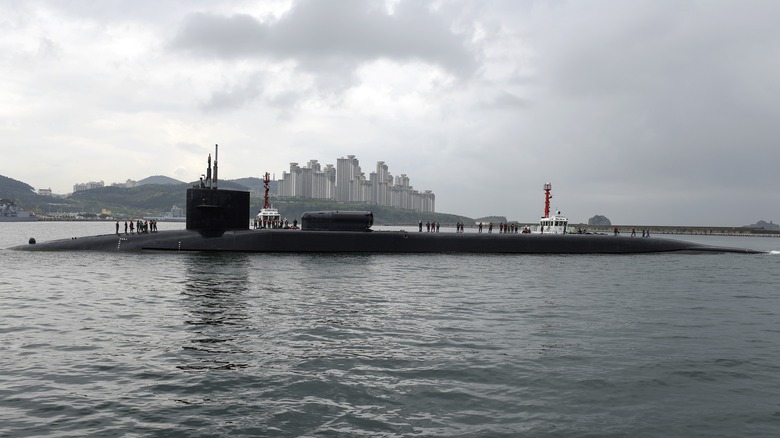

charge your mobile device on a daily basis, while your automobile requires refueling or a battery maintenance every few days. Yet, you don’t need to disassemble the gadget or vehicle when you attach it to a power source or replenish the fuel tank. Conversely, supplying fuel to a nuclear submarine is a complex undertaking that spans years, akin to the refueling of a nuclear aircraft carrier. However, unlike carriers that may undergo the Refueling and Complex Overhaul (RCOH) process for up to six years, a nuclear submarine typically completes its Engineered Refueling Overhaul (ERO) process in a shorter duration. This task can be accomplished in two to three years, provided that unforeseen events do not introduce additional delays. In addition to the safe extraction of the nuclear core from the submarine and the installation of a new core that will power the vessel for another couple of decades, the engineers also conduct the overhaul process aimed at updating the equipment to modern standards.
Taking a submarine offline for several years might appear to be a security concern, but the U.S. Navy operates 71 submarines across various classes. Every one of them is powered by nuclear reactors capable of functioning for decades. Additionally, new submarines are continually being constructed. Lastly, not every submarine class currently in service necessitates refueling. Virginia-class and Columbia-class designs are equipped with nuclear cores designed to last for the full lifespan of the vessel, approximately 33 years and 43 years, respectively. It is the Ohio and Los Angeles class models that will require mid-life ERO processes.