


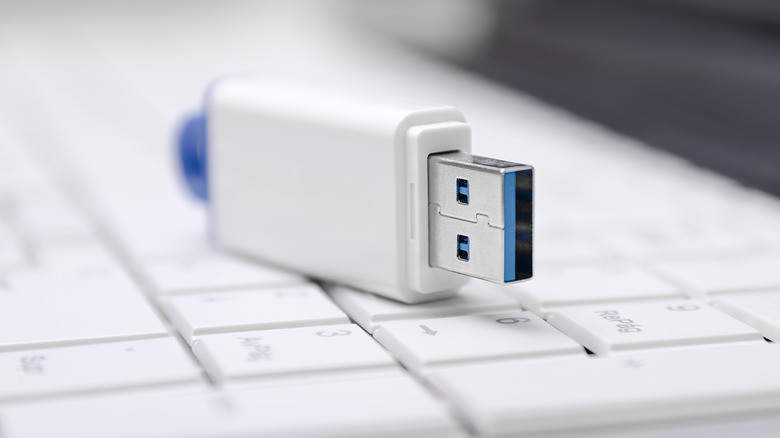
fotofrancis/Shutterstock
In the past, USB flash drives represented the simplest method for transferring files between computers and various devices. Almost everyone owned one, whether for data storage, file transfers, or as a straightforward backup option. However, in recent years, they have diminished in significance, as superior alternatives have become mainstream. Users now predominantly depend on cloud storage to maintain and synchronize files, providing immediate access across devices. Even for local backups, portable solid-state drives have taken precedence.
Nevertheless, flash drives did not become obsolete instantly. They faced challenges that were never effectively resolved, particularly concerning storage capacity, speed, and compatibility. Frequently utilized flash drives typically offer 64 to 128GB, which can be filled quickly for many users. For those with higher capacities, such as 1 to 2TB, transfer speed remains a notable limitation. Furthermore, in the last decade, numerous PC manufacturers have reduced their reliance on traditional USB-A ports in favor of USB-C ports, resulting in compatibility complications for USB-A flash drives. Thus, even if you possess a USB flash drive, its utility is not what it was a few years back.