
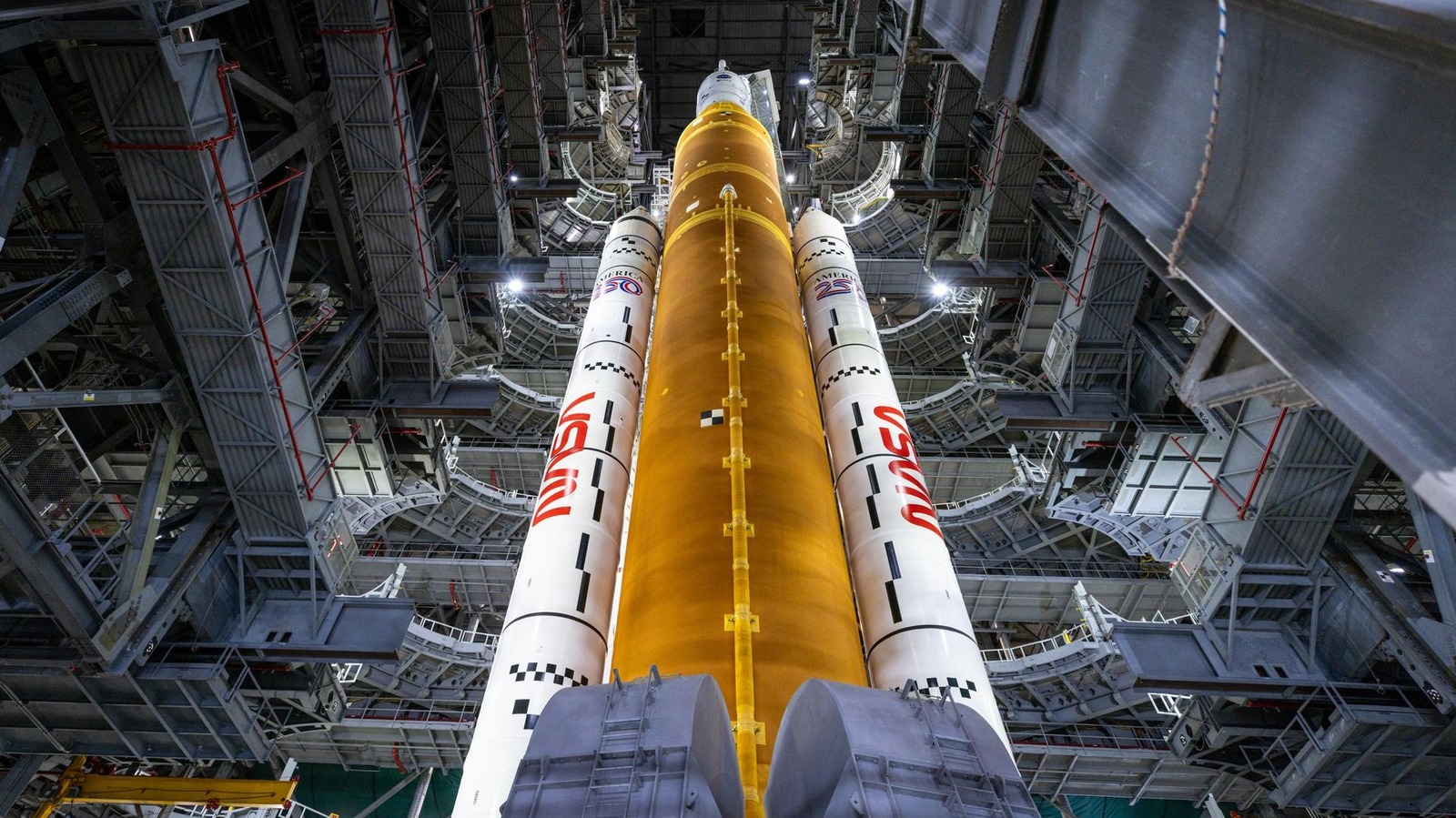

Artemis II is prepared for its monumental lunar expedition. The colossal rocket and Orion spacecraft are currently located at Launch Complex 39B after a lengthy, four-mile trek from the assembly facility, where they completed final inspections. This was not NASA’s initial rollout for the Artemis II mission, but the agency is optimistic it will be the final one. Mission organizers are aiming for an April 1, 2026 launch window. Once ignition occurs, it will take approximately three minutes to reach NASA’s designated boundary of space, and about eight minutes to enter orbit.
The launch demands 8.8 million pounds of thrust, equivalent to the output of 326 F-16 fighter jet engines. Approximately one minute into the ascent, the rocket reduces its throttle for approximately 25 seconds at Max Q, the point of peak aerodynamic pressure, as it navigates through the thick lower atmosphere. Once it breaks through, Orion will continue to gain speed, reaching nearly 3,200 miles per hour. At around 2:09 into the flight, the solid rocket boosters will separate before Orion attains the boundary of space.
How quickly Artemis II ascends to space post-liftoff
The subsequent phase activates the power of the shuttle era. Four RS-25 engines, refurbished from the shuttle program, will propel the spacecraft to 17,500 mph, the minimum velocity required to achieve a stable orbit around Earth. This phase extends from the edge of space into orbit, nearly 100 miles above Earth. The majority of the thrust is directed forward rather than upward.
As the crew experiences microgravity just eight minutes into their 10-day adventure, the RS-25 engines will cease operation, causing the crew to become weightless. The spacecraft will glide in orbit for about 24 hours, awaiting the exact moment when Orion’s Orbital Maneuvering System Engine (OMS-E) executes the translunar injection (TLI) burn that propels Orion towards the moon.
The crew will journey over 230,000 miles to the moon, taking approximately three to four days to achieve its orbit. The Artemis II mission does not involve landing. Instead, the crew will remain about 4,000 to 6,000 miles above the lunar surface as NASA aims to evaluate whether Orion can adequately support a crew in deep space, while simultaneously allowing them to practice navigation and control systems. After orbiting the moon, Orion will return home, splashing down in the Pacific Ocean near San Diego roughly ten days post-liftoff.
The significance of Artemis II
NASA has had to postpone the mission multiple times to ensure the spacecraft remains intact and functional during its initial phases. The latest Artemis II delay was due to a helium pressurization complication. There is a great deal at stake since Orion will transport four astronauts around the moon for the first time since 1972. Onboard Orion are Christina Koch, Victor Glover, and Jeremy Hansen, who will be the first woman, first person of color, and first Canadian, respectively, to reach the vicinity of the moon. NASA veteran Reid Wiseman will be in command.
The rocket utilizes engines from the space shuttle program, but they will facilitate achieving something those shuttles never accomplished: Accelerating to speeds of nearly 25,000 mph upon returning from the moon. Artemis II will represent a significant advancement in maintaining a human presence on the moon. Currently, it remains uncertain when — or if — the subsequent mission, Artemis III, will transport humans to the moon. NASA announced a delay of the planned journey in early March 2026 due to challenges with Artemis II.