
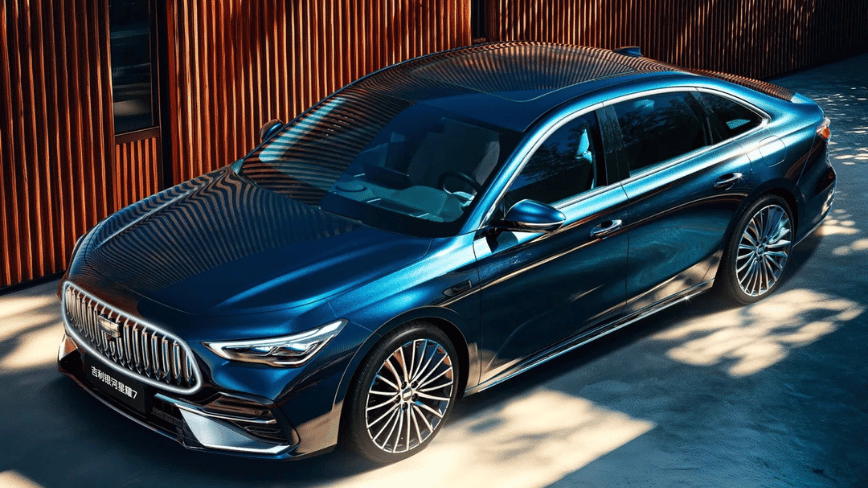

Geely, the owner of Volvo, Polestar, Lotus, and Zeekr, has unveiled the EX5, a battery-electric SUV starting at 109,800 yuan (~$15,300) featuring massaging seats, a 1,000-watt sound system, and up to 610 kilometers of range. Already sold in 35 countries, this model is the most exported BEV A-class crossover in China, offering advanced features at a price much lower than the cheapest European EVs.
Geely’s EX5, an all-electric SUV, begins at 109,800 yuan (~$15,300), offering massaging seats, a 1,000-watt sound system, and up to 610 kilometers of range. Available in 35 countries, it challenges European and American automakers’ pricing strategies.
The EX5 isn’t a concept or a future promise. It’s currently on sale and is the most exported battery-electric A-class crossover from China. For a price point that offers a well-equipped supermini in Western markets, Geely delivers features typically reserved for higher-priced European models.
**What you get for $15,300**
The base EX5 includes a 60.2 kWh lithium iron phosphate battery delivering 530 kilometers range on the Chinese CLTC cycle, with a 215 horsepower front-mounted motor. An extended-range version with a 68.4 kWh battery offers 610 kilometers for about $1,000 more. Despite anticipated reductions under European WLTP testing, the real-world range exceeds 400 kilometers.
The interior’s luxury stems from its five-plus-one layer cushion design and available massage features in top-spec models. Higher trims come standard with a 1,000-watt sound system. Reviewers find the materials and fit exceed the price point, with Top Gear highlighting the “luxurious, relaxing ride” it provides.
Reviewers have noted some drawbacks regarding infotainment software localization for non-Chinese markets and driving dynamics aimed at comfort over engagement, but complaints remain minimal given the vehicle’s price range.
**The Geely machine**
Geely’s pricing is achievable due to its manufacturing and supply chain scale, making it the second-largest auto brand in China by 2025 and leading in January 2026, surpassing Volkswagen, Toyota, and BYD in deliveries.
Geely’s portfolio addresses multiple segments: Galaxy brand caters to mainstream EVs and hybrids, Zeekr targets the premium market, Lynk and Co occupies middle ground, Volvo and Polestar serve luxury sectors, and Lotus focuses on performance. The EX5, positioned at the accessible end of the Geely brand, aims to boost international sales.
Geely is advancing technology across its range. In April 2026, it revealed an i-HEV hybrid system achieving 48.4% thermal efficiency. The system’s debut in the Xingrui sedan reports a consumption rate of 3.98 liters per 100 kilometers under WLTC testing. Although the EX5 is fully electric, Geely’s capabilities in both battery-electric and hybrid innovations provide flexibility that pure-EV startups lack. China’s dominance in EV production results from such industrial depth.
**The European question**
The EX5 has already reached Belgium and the Netherlands, accompanying the Starray EM-i plug-in hybrid, with wider European availability forthcoming. For European automakers, the EX5 exemplifies the competitive threat a Chinese EV poses, offering quality at a price that significantly undercuts European counterparts.
EU tariffs on Chinese EVs, introduced in 2024, add cost yet fail to close the pricing gap. Even with a 20% tariff, the EX5 remains more affordable compared to models like the Volkswagen ID.3 or Renault Megane E-Tech. Cost advantages, through cheaper labor, integrated battery supply chains, and large-scale production, can’t be offset by tariffs alone.
The trend is evident: Chinese manufacturers are delivering superior vehicles at lower prices, widening the gap. The EX5 illustrates the extent of advantages in features and consumer-experienced quality.
**Global ambitions**
Geely plans to introduce Zeekr and Lynk and Co to the US within two to three years, potentially utilizing Volvo’s South Carolina factory to circumvent tariffs. Production goals for 2026 include 400,000 units for Lynk and Co and 300,000 for Zeekr, alongside Geely’s brand volumes.
The US market presents distinct challenges; Chinese EVs contend with 100% tariffs, making direct imports costly. Geely’s strategy could replicate the EX5 value proposition by localizing production through its established American footprint, offering more car for less money.
For consumers, the EX5 represents the affordable, well-equipped EV promise, without compromising range, comfort, or features, being fulfilled by a Chinese company rather than established automakers who invested heavily in electrification.
The EX5, priced lower than options on a mid-range European sedan, features massaging seats and a 600-kilometer range.