
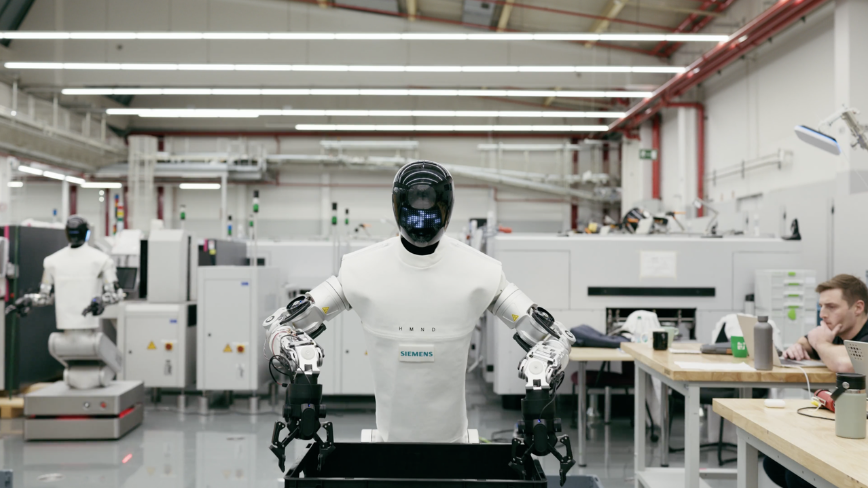

Siemens, Nvidia, and UK robotics startup Humanoid have successfully implemented an AI-powered wheeled humanoid robot in live logistics operations at a Siemens electronics factory in Germany.
The HMND 01 Alpha autonomously handled tote-processing tasks for over eight hours at a rate of 60 moves per hour, achieving a pick-and-place success rate above 90%, and was closely integrated into Siemens’ production systems.
Siemens, in collaboration with UK robotics firm Humanoid and Nvidia, has announced the successful deployment of an AI-powered humanoid robot in real-time logistics operations at Siemens’ electronics factory in Erlangen, Germany.
Humanoid’s HMND 01 Alpha wheeled robot, developed using Nvidia’s physical AI platform, autonomously executed tote-destacking duties for more than eight hours, achieving a throughput of 60 container movements per hour with a pick-and-place success rate of over 90%.
The announcement was made at the Hannover Messe 2026, reinforcing the Siemens-Nvidia strategic partnership initially revealed at CES.
The task focused on picking totes from storage stacks, moving them to conveyor belts, and placing them at pickup points for human staff.
This repetitive, physically demanding work, typically difficult for industrial automation, often encounters challenges if the environment is unpredictable or if tasks require collaboration with humans in real-time.
The Erlangen trial is significant because it was conducted in a live production environment, alongside human operators and automated systems, where real production outcomes were at risk.
The HMND 01 Alpha features a wheeled lower segment with a humanoid upper part, offering advanced manipulation capabilities.
Integration into Siemens’ factory was achieved through the Siemens Xcelerator platform, offering digital twin capabilities, AI-enabled perception, PLC-robot interfaces, fleet management, and industrial communication networks.
This enabled the robot to coordinate with production systems, other autonomous vehicles, and human workers in real-time, highlighting the deep integration that differentiates genuine factory deployment from showcase demonstrations.
Stephan Schlauss, Global Head of Manufacturing Motion Control at Siemens, described the Erlangen plant as “customer zero,” with Siemens using its own facility for testing before offering the capability to customers.
On Nvidia’s end, the HMND 01 Alpha incorporates Nvidia Jetson Thor for edge computing, Nvidia Isaac Sim for simulation, and Nvidia Isaac Lab for reinforcement learning and policy training.
The simulation-first development strategy, training and validating the robot’s behaviors in a virtual setting prior to physical deployment, allowed Humanoid to reduce prototype development time from the typical 18 to 24 months to about seven months, according to the companies.
Deepu Talla, Nvidia’s vice president of robotics and edge AI, termed the deployment as “paving the way for humanoid robots meeting real production targets on a live factory floor.”
Founded in 2024 by Artem Sokolov, Humanoid is based in London with offices in Boston and Vancouver and comprises over 200 engineers from tech firms. The company also produces a bipedal version of the HMND 01 Alpha, featuring 29 degrees of freedom and equipped with RGB cameras, depth sensors, and 6D force/torque sensors.
The wheeled model deployed in Erlangen was previously tested in a proof-of-concept with Schaeffler for handling metallic bearing rings. The Siemens trial, conducted for two weeks in January 2026 before the April announcement, was the most challenging deployment thus far.
The companies were cautious not to overstate their timelines, describing the Erlangen trial as “a milestone in the journey to bring physical AI from vision to industrial reality,” without outlining a commercial rollout schedule.
The broader importance, as Siemens presents it, is the creation of a “factory-grade model” for humanoid deployment that other companies can emulate, serving as a reference architecture rather than a singular occurrence.
The partnership fits within a larger industrial trend: humanoid robots functioning in human-oriented environments are being increasingly considered as a solution to labor shortages in manufacturing areas where fully automated lines are impractical due to product variability, safety constraints, or the necessity for human-robot collaboration.