
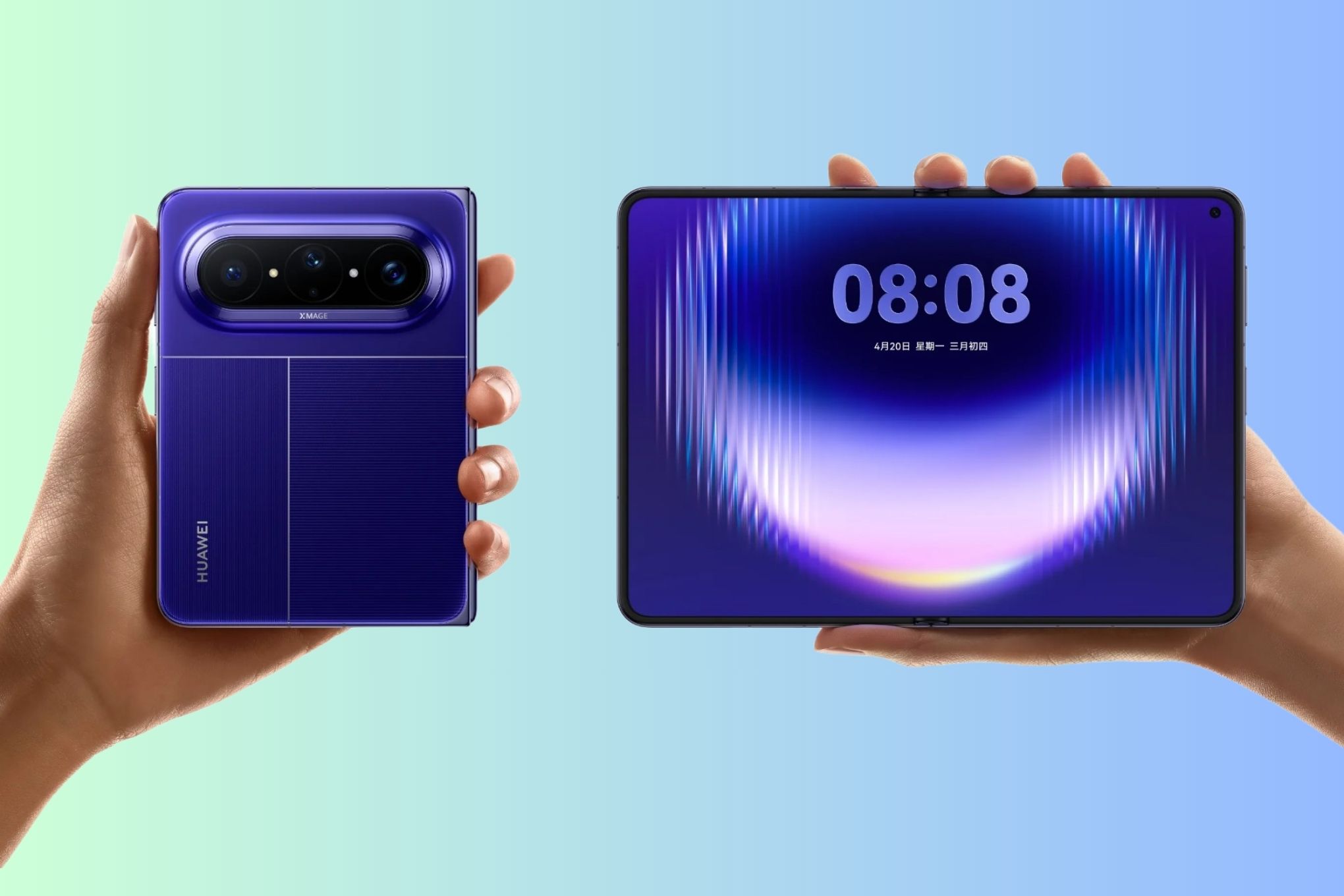

The Pura X Max was introduced in China today.
Huawei has unveiled its passport-style foldable device in China, preceding similar forthcoming products from Apple and Samsung. This makes the Pura X Max the first broad foldable phone available for purchase, with today’s release providing full specifications and pricing after its design was revealed by Huawei last week.
Two variants of the Pura X Max are available for preorder starting today. The standard version starts at 10,999 yuan (around $1,613) for 12GB RAM and 256GB storage or 11,999 yuan (about $1,800) for 512GB storage. The Pura X Max Collector’s Edition begins at 12,999 yuan (roughly $1,906) for a 16GB RAM / 512GB storage configuration or 13,999 yuan (about $2,053) for the 16GB/1TB model.
The foldable’s wide display orientation is a standout feature, adopting a book-like design compared to traditional foldables. It boasts a 5.4-inch cover display with 3500 nits peak brightness. Unfolding the Pura X Max reveals a 7.7-inch internal display with maximum brightness of 3000 nits, with both screens supporting a 1–120Hz LTPO adaptive refresh rate.
Apple and Samsung are reportedly developing their own wide-style foldable phones. Various leaks suggest a potential early glimpse at the rumored iPhone foldable and a wider version of Samsung’s Z Fold, although both are not expected until the latter half of 2026, giving Huawei a notable lead in this new design trend.
In terms of hardware, the Pura X Max comes with a homegrown Kirin 9030 Pro chipset and a 5,300mAh battery, supporting 66W wired charging and 50W wireless charging. Its triple camera setup includes a 50-megapixel main camera with variable aperture, a 50-megapixel telephoto lens, and a 12.5-megapixel ultra-wide shooter. The phone operates on Huawei’s latest HarmonyOS 6.1, is compatible with the Huawei M-Pen 3 Mini stylus, and offers an array of AI-powered features, such as pose recommendations for photography.
Huawei has not confirmed whether the Pura X Max will be launched outside China, but this possibility should cause concern for Samsung and Apple.