
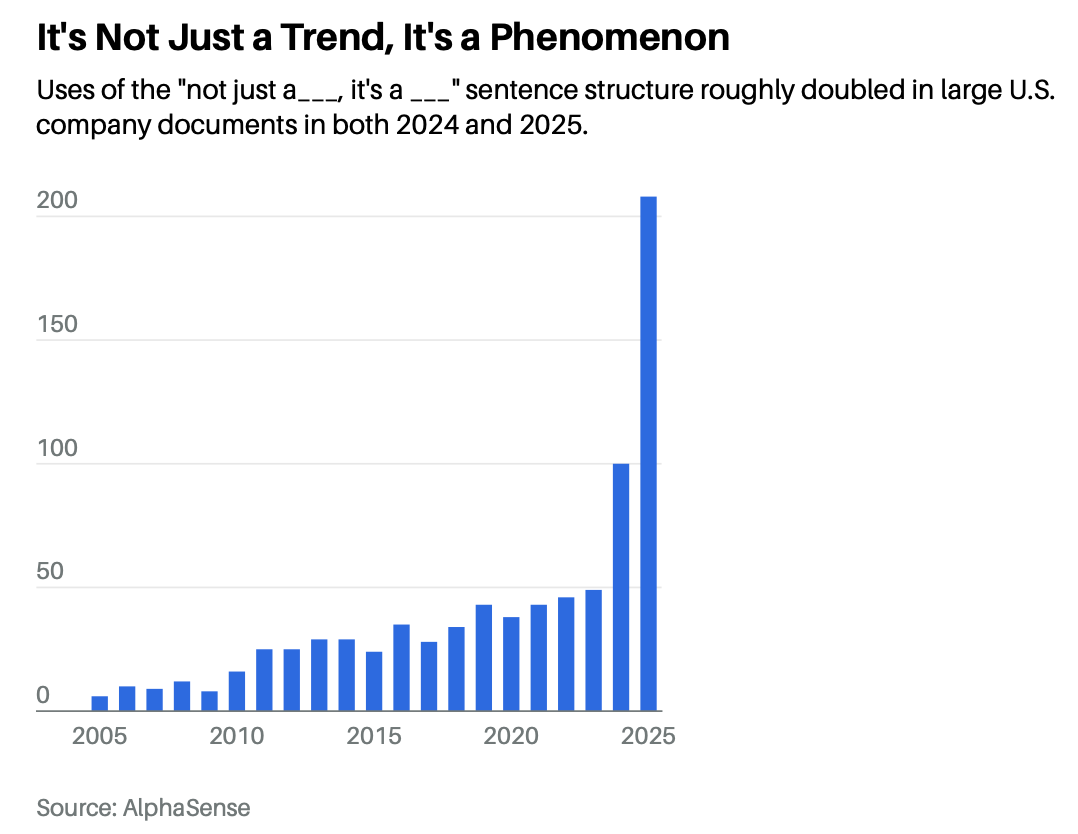

Things aren’t always just one thing—they can be something else as well. This sentence structure (“It’s not just this—it’s that”) is now so prevalent in AI-generated content that it almost guarantees a piece of writing is synthetic.
So, when I came across a Barron’s report about its increased usage in corporate communications, I wasn’t just intrigued—I was amused. The report noted the commonality of this phrasing in corporate communications and used market intelligence firm AlphaSense’s database to track its usage in corporate news releases, earnings reports, and government filings.
As reported by Barron’s, the use of this sentence construction is not just a quirky aspect of corporate communications—it’s an epidemic, escalating from about 50 mentions in 2023 to over 200 in 2025.
It’s not just the data showcasing this—I also found some examples from the past year:
– “In 2025, AI won’t just be a tool; it will be a collaborator.” (Cisco)
– “The future of autonomy isn’t just on the horizon; it’s already unfolding.” (Accenture)
– “DevOps teams are managing not just deployments, but also security compliance and cloud spending.” (Workday)
– “These systems aren’t just executing tasks; they’re starting to learn, adapt, and collaborate.” (McKinsey)
– “When Bill founded Microsoft, he envisioned not just a software company, but a software factory, unconstrained by any single product or category.” (Microsoft blog post by Satya Nadella)
– “It’s not just about building tools for specific roles or tasks. It’s about building tools that empower everyone to create their own tools.” (The same Microsoft blog post.)
– “Just imagine if all 8 billion people could summon a researcher … not just to get information but use their expertise to get things done that benefit them.” (Still, that same Microsoft blog post.)
It’s not just accidental that AI tools frequently use this phrase—it mirrors the writing these tools were trained on, often without our consent, which not only feels insulting to writers but is a breach of trust. And this isn’t just about this sentence structure—it’s also about the em-dashes that are now a hallmark of AI-generated text.
This isn’t merely a humorous trend—it highlights how dependent these companies have become on AI (though it’s uncertain if the above messages involved AI assistance). So, when you encounter such a sentence, remember it’s not just a catchy phrase—it could indicate something deeper.