
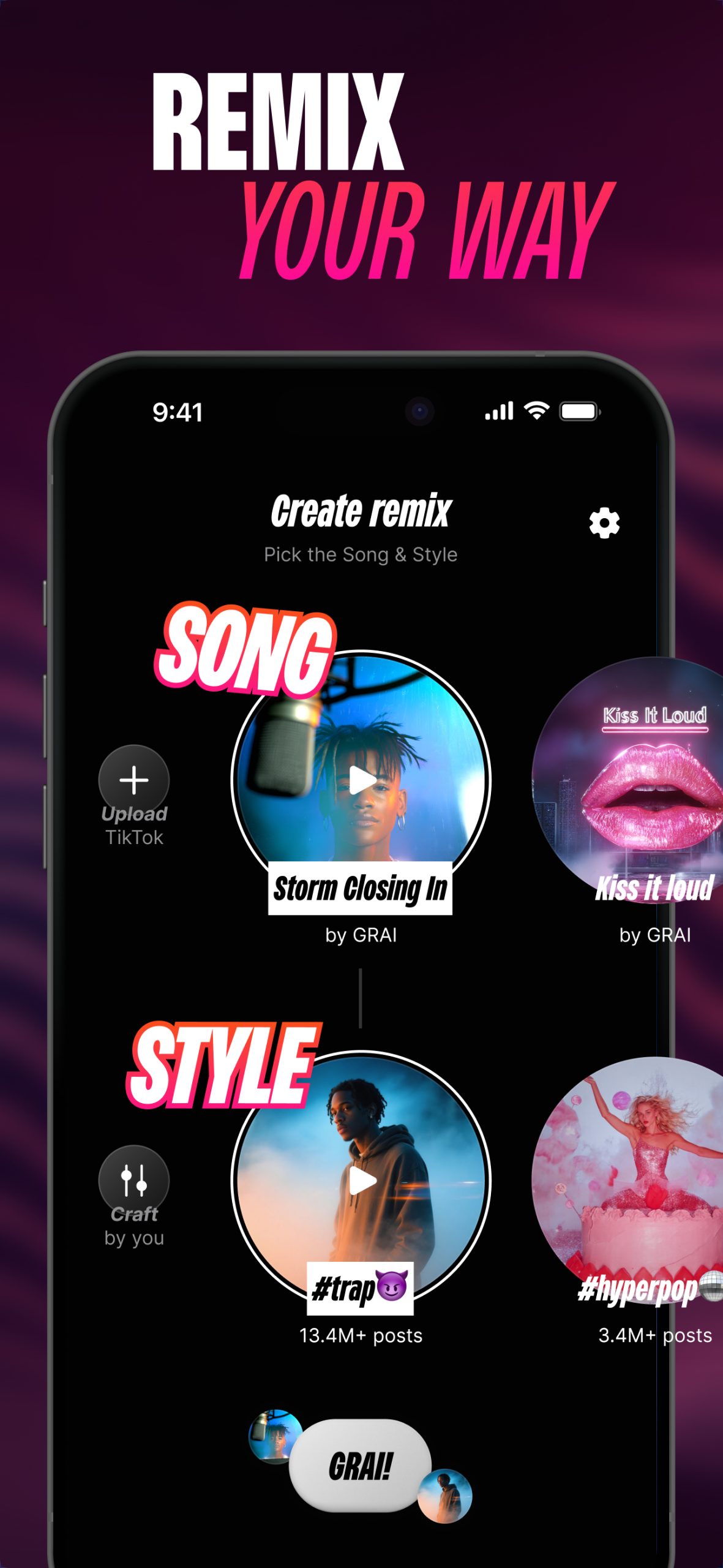

Today’s AI music startups, such as Suno and Udio, provide technology that uses artificial intelligence for music creation. However, a new company, GRAI, believes people mostly prefer engaging with music in other ways like remixing, sharing with friends, or altering a track’s style for fun rather than generating it from scratch with AI.
Whether artists allow others to interact with their tracks and to what extent should be their decision.
GRAI, supported by a $9 million seed round, aims to give artists control while leveraging AI to change how consumers interact with music.
Founded by Belarusians who previously sold their video app VOCHI to Pinterest, GRAI is exploring AI music products like the remixing app Music with Friends for iOS and another AI music playground for Android. These apps will provide insights into consumer preferences beyond AI-driven creation or mere listening.
“The idea driving our company is to explore future possibilities in music AI interaction and consumption,” says GRAI co-founder and CEO Ilya Liasun, based in Poland with much of the team. He states that music remains one of the last consumer areas not yet creator-focused.
“We face issues: discovery is flawed, listening is passive, and there is little social context,” observes Liasun.
He doesn’t believe AI will harm artists and labels. Instead, GRAI’s team sees AI as a means to enhance music engagement, beyond just AI-created tunes.
GRAI targets Gen Z and Gen Alpha, who find new music through cultural contexts like friends, fandoms, and short-form content like TikTok. They want to engage, not necessarily create or produce music.
GRAI has developed its own taste and participation graph and infrastructure, building a “derivatives pipeline” and real-time audio systems to preserve original tracks while enabling transformations.
Liasun mentions the goal is to legally work with artists and labels, ensuring activities don’t result in more unwanted AI music.
“Our focus is interaction, not adding more generative AI music to streaming services,” Liasun emphasizes.
Users could modify tracks in GRAI’s apps, perhaps remixing or altering a song’s style. These modified tracks might then generate new royalties for artists and labels.
GRAI approached labels before developing its social apps, prioritizing authorization.
“The core concept is creating a framework where artists can opt in or out,” Liasun explains. “We reach out to owners first, then integrate.” (Liasun didn’t disclose any existing agreements or with which companies.)
If remixing gains traction, GRAI believes it could help people discover new artists and music beyond platforms like TikTok or YouTube.
With its initial apps, GRAI hopes for consumer feedback, including criticism, to refine their offerings.
Co-founded by CTO Dima Kamarouski and Andrei Avsievich (President), GRAI is now backed by $9 million from a seed round led by Khosla Ventures and Inovo vc, with participation from Tensor Ventures, Tiny.VC, Flyer One Ventures, a16z Scout Fund, and angel investors.