
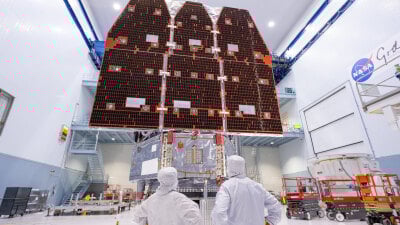

Get an exclusive look at the finished astronomical observatory by Elisha Sauers on April 21, 2026.
NASA has completed its new space observatory, designed to generate detailed, panoramic maps of the universe, shedding light on mysterious cosmic elements and distant worlds’ influence on the universe. Decades after the Hubble’s revolution in astronomy, alongside the ongoing James Webb era, NASA’s Nancy Grace Roman Space Telescope emerges not as a replacement but as a wide-angle collaborator. While Hubble and Webb provide close-ups, Roman will offer Hubble-like clarity over areas 100 times larger, transforming snapshots into extensive surveys that depict the universe’s framework.
Prelaunch tests are winding up at NASA’s Goddard Space Flight Center in Maryland, before it embarks on a 900-mile journey to the Kennedy Space Center in Florida for launch preparations. The telescope is on track to launch eight months ahead of schedule, in September, heading to an orbit about 1 million miles from Earth, in proximity to where Webb orbits the sun, initiating a prolonged deep space imaging campaign.
Nicky Fox, NASA’s science associate administrator, emphasized the collective urgency driving the mission. Named after Nancy Grace Roman, a pioneer in astronomy and one of NASA’s first female executives, the telescope honors her legacy in advancing space telescope technology.
Roman’s eight-foot-wide mirror and infrared imaging capabilities will achieve unprecedented wide-sky surveys, essential for studying the enigmatic “dark universe.” Focusing on the vast majority (95%) of the universe’s dark matter and energy, Roman will map galaxy positions and distortions, revealing the universe’s evolutionary journey and testing theories on cosmic structure and expansion.
The observatory will also excel in exoplanet discovery, concentrating on cooler, outer zones of planetary systems, unearthing planets even in distant and crowded regions using its microlensing method.
With an advanced coronagraph, Roman will test seeing planets that are up to 100 million times fainter than their stars, setting the groundwork for future missions aimed at detecting Earth-like planets around sun-like stars.
Additionally, Roman’s capacity for capturing vast areas with great detail will also facilitate the study of dynamic cosmic events. By conducting surveys away from the Milky Way’s plane, it will monitor star explosions, black hole activities, and other transient phenomena, creating a comprehensive astronomical archive.
NASA administrator Jared Isaacman praised Roman’s capacity to offer a new cosmic atlas, underscoring its monumental contribution to understanding the universe.
Topics: NASA