
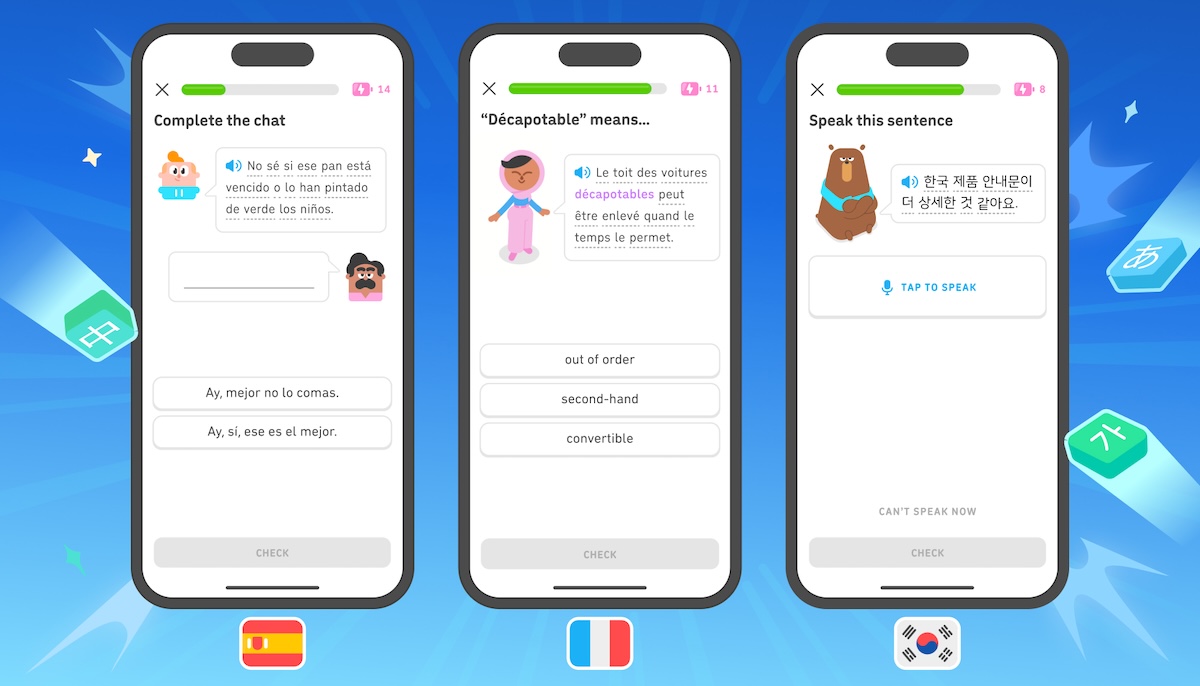

Duolingo revealed on Wednesday that its advanced language courses are now freely accessible in nine languages: English, Spanish, French, German, Italian, Portuguese, Japanese, Korean, and Chinese. This content can be accessed on the web, iOS, and Android.
The advanced materials align with the B2 level of the Common European Framework of Reference for Languages (CEFR), an internationally recognized standard for language skills beneficial for educational and workplace settings. B2-level materials often include no translations, complex contexts, and specialized vocabulary.
The new offering includes “Advanced Stories” for reading comprehension and DuoRadio, an audio feature for listening practice.
With Duolingo’s advanced learning resources now free, users can enhance their skills for job interviews, study abroad, or understand complex media without translations.
Duolingo is setting itself apart as the only app offering these advanced-level courses for free, unlike competitors like Babbel and Busuu, which generally charge for similar services. Busuu, for instance, offers some B2-level courses, but its free version is notably limited and lacks comprehensive features like grammar explanations, requiring users to pay for complete access.
Previously, Duolingo’s free courses were limited to A2 or B1 levels, concentrating on basic communication abilities.
The company touts the free advanced content as a valuable opportunity for job seekers, positioning language learning as a means to boost employment prospects in a global workforce.
This development comes amid a competitive job market with slowed growth, with research from the American Council on the Teaching of Foreign Languages suggesting that second language knowledge can enhance employability by up to 50%.
“Achieving job-ready proficiency in a new language was previously inaccessible for many,” stated Bozena Pajak, head of learning science at Duolingo, highlighting the barrier of costly classes or immersive experiences.
This free offering also aims to expand Duolingo’s user base. According to its Q4 earnings report, Duolingo recorded 52.7 million daily active users, showing a 30% year-on-year increase, a figure surpassing its paid subscriber count of 12.2 million. Despite this, the company’s shares declined following a forecasted slight decrease in Q2 2026 bookings growth rate.