
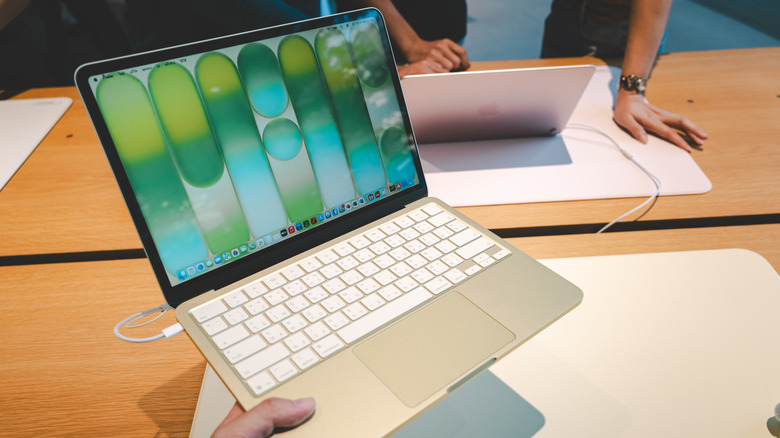

The MacBook Neo May Soon Face Limited Competition – Here’s the Reason
The latest Apple MacBook Neo has rapidly captured attention in the tech market. A budget-friendly gadget designed for casual users yet still offering solid performance is a rarity in 2026. So why haven’t other brands jumped on this new phenomenon? Many have begun to ponder this question following Microsoft’s increase in prices for its Surface laptops and tablet hybrids. For example, the Surface 7 in 2025 saw its price soar from $999 to $1,499. Even Microsoft’s entry-level devices, which could rival the Neo, have seen their costs rise from $799 to $1,049.
Examining similarly positioned devices, they’ve either faced price hikes or are already overpriced from the outset. So what’s truly happening? Apple possesses a significant advantage over its competitors due to its thorough pre-planning of manufacturing, and has so far successfully insulated itself from the current “RAMpocalypse.” The technology sector heavily invested in AI last year despite worries about its societal and environmental repercussions, which has led to hardware shortages as AI data centers consume a large share of common components.
RAM is the Key Element
As has been the topic of conversation recently, AI has drastically impacted RAM production. OpenAI has secured a deal to acquire 40% of the global supply, a situation expected to persist until after 2027. Every device containing any computing capabilities requires RAM. This includes not just laptops, but also televisions, smart gadgets, and more. It remains unclear how much RAM Apple initially possessed, but the company has not publicly indicated concern about it thus far.
Three companies supply 92% of the world’s RAM. One of them, Micron, has exited the consumer market to focus on AI and business clients. SK Hynix and Samsung are sharing responsibilities between consumer and business sectors, with reports indicating that Apple and Samsung have developed much closer ties during this shortage. In 2025, Korea Economic Daily reported that Apple was increasing its procurement from Samsung to 70%, up from 60%.
Other computer makers, such as Asus, MSI, or Acer, lack the financial clout that Apple enjoys. Valued at nearly $4 trillion and generating $416 billion in revenue in 2025, Apple has the resources to create virtually anything it desires. Consequently, the MacBook Neo requires just 8 GB of RAM and an iPhone A18 processor. In contrast, Windows 11 necessitates a minimum of 4 GB of RAM to function but only performs reliably on 8 GB or more, due to its substantial overhead.
Inexpensive Components, Inexpensive Laptop
The MacBook Neo, despite its accolades, is quite pieced together. It operates as a macOS device on an iPhone chip and comes equipped with only 8 GB of unified RAM. For years, Apple (via Tom’s Hardware) has asserted that its 8 GB is equivalent to 16 GB, which may not fully hold true, but it illustrates why the company can economize in this area. The laptop is also targeted towards the educational sector, providing a $100 discount for students, as most assigned tasks do not require a high-end device. This is merely one reason the MacBook Neo might not suit everyone.
Moreover, Apple maintains total control over its chips. In 2020, the company transitioned to Apple Silicon with its M-Series laptops. It now depends mainly on fabs like TSMC in Taiwan, having secured production of other components in China throughout the 2000s and 2010s. Other manufacturers do not possess this level of control over entire production lines, a streamlined pipeline established by Tim Cook’s efforts prior to his CEO tenure.
Considering this, companies that manufacture Windows or even Linux-based laptops must navigate the broader manufacturing crisis. While everyone has a stake in the game, companies like Apple or Nvidia, significant profit generators, have a preferred status. Even Apple, however, faces challenges from the surging demand for AI, with the company now contributing to the movement for American-made chips.