
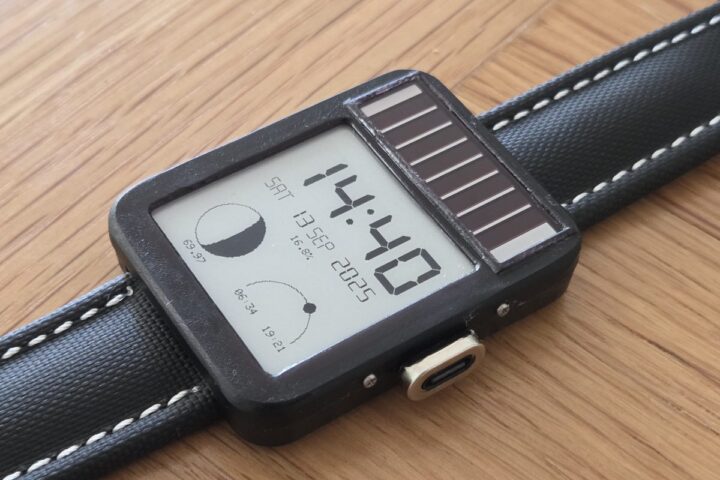

Daniel Ansorregui has created LightInk, an open-source solar-powered E-ink watch inspired by 90s solar digital watches. It includes a 1.54-inch e-paper display and offers Wi-Fi, Bluetooth, LoRa, and GPS, all powered by a 100mAh battery.
The project implements a custom low-power design with a TPS63900 buck-boost converter, capacitive-touch input, and deep-sleep-driven firmware, featuring ultra-fast e-ink updates (1 ms active time) and precise RTC timekeeping with drift calibration. It operates primarily on solar power (no dedicated charging IC) and utilizes dynamic power gating of peripherals, achieving roughly 9–10 months of operation on a small battery supported by solar power.
LightInk specifications:
– System-in-package: ESP32-PICO-D4 SiP
– CPU: Dual-core @ 240MHz
– Memory: 520KB SRAM
– Storage: 4MB flash
– Wireless: 2.4 GHz Wi-Fi 4 (up to 150 Mbps) and Bluetooth 4.2 BR/LE
– Display: 1.54-inch 200×200 B/W e-Paper panel
– Audio: 10-15mm piezo electric disc speaker
– Connectivity:
– Wi-Fi and Bluetooth via ESP32 SiP
– LoRa via Wio-SX1262 transceiver
– GPS
– Miscellaneous:
– Capacitive touch buttons using ESP32’s touch pins
– 3V 2.0 mm circular mini vibration motor
– LED light pins
– RTC with manual drift calibration
– Power:
– TPS63900 buck-boost converter operating at 2.6V/2.9V
– Solar cell input
– 100mAh battery
– Dimensions: TBD
– Enclosure: 3D printed
Daniel began the project in 2019 using a Heltec Wireless Stick Lite. He aimed to enhance power efficiency and add features like LoRa and solar support without increasing size, building on platforms like the SQFMI Watchy.
The boot process of the ESP32 posed a significant challenge, typically taking about 28 ms and consuming several milliamps of power. Daniel used the ESP32’s wake stub, allowing for immediate code execution upon waking, bypassing the flash entirely. This reengineering of SPI communication within the wake stub allows the device to boot, send data, and update the display in under 1ms before returning to deep sleep, extending battery life to an estimated 6 to 10 months on a 100mAh battery.
The hardware design features a single-sided PCB, enabling the e-paper display to sit flat, and a compact, 3D-printed case. To conserve power, high-consumption components like accelerometers and battery-charging ICs were omitted, using a solar cell instead.
LightInk is an open-source project with ESP-IDF firmware, KiCad hardware design files, and 3D case models available on GitHub. Further instructions and project logs can be found on Hackaday, where it was submitted for the Green Powered Challenge.
Support CNX Software through cryptocurrencies, becoming a Patron, or purchasing through affiliate links on Amazon or Aliexpress.