How to watch Europa League for free. Live stream Nottingham Forest vs. Aston Villa in the Europa League for free.

Selecting the Ideal Color for Your Motorola Razr Ultra 2026
There are merely two choices, and each is remarkably distinct.
In contrast to the four color options of the Razr Ultra 2025, the Motorola Razr Ultra 2026 is offered in just two color variants this time. The Razr Ultra 2026 does not include a red choice. Instead, you can select between the traditional wooden finish or a rich blue Alcantara finish. Since both colors are provided with identical 16GB/512GB memory configurations, your only consideration should be your personal preference. Thus, if you intend to buy the Razr Ultra 2026 despite the increase in price, here are your available color choices.
The Motorola Razr Ultra 2026 balances between two elements: wood and water
The Motorola Razr Ultra 2026 serves as an incremental update compared to the Razr Ultra 2025. That might be why Motorola opted to reduce the number of color variants by half relative to the colors of the Motorola Razr Ultra 2025. The Razr Ultra 2026 is available in just two hues: Orient Blue and Cocoa.
Orient Blue exhibits an almost indigo or sapphire tone with an Alcantara finish. For those unaware, Alcantara is a synthetic polyester blend resembling suede. It appears stunning in this deep blue color. Blue certainly presents a more conventional option compared to the bold Cocoa choice of the Motorola Razr Ultra 2026.
If you prefer a more adventurous appearance, opt for the wood-backed Cocoa variant instead. This wooden finish is truly unique as it’s rare to find phones that integrate such natural materials, especially foldables. The wooden variant of the Motorola Razr Ultra 2026 closely resembles the wooden choice from the Motorola Razr Ultra 2025, but the tone is slightly darker, akin to a walnut shade.
With no storage restrictions on either color option, you can freely follow your passion when selecting which Motorola Razr Ultra 2026 to acquire.

Preorder Instructions and Frequently Asked Questions for the Coming Motorola Razr 2026 Line
The wait is almost finished.
<button id="click-to-next-forward" type="button" class="hidden
fixed -right-[7px] top-1/2 -translate-y-1/2 z-[10001]
w-12 h-12 flex items-center justify-center
bg-white/60 backdrop-blur-[2px] border-0
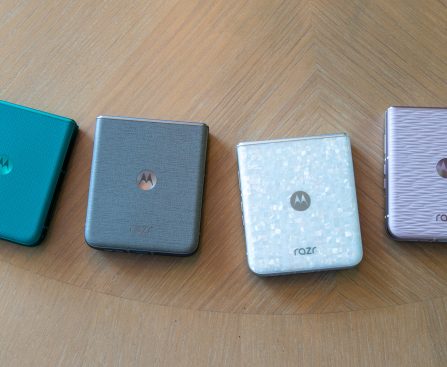
Guide to Selecting the Ideal Color for Your Motorola Razr 2026 Acquisition
The Motorola Razr 2026 presents a blend of classic and contemporary colors.

Boeing Creates Chinook-Inspired Drone Swarm Management System for Aerial Combat
The Boeing CH-47 Chinook has been an essential component of the U.S. armed forces since 1961, utilized for various roles including cargo transport, troop movement, and emergency response. Recently, Boeing introduced a vision for the future of the CH-47F Chinook, highlighting a potential drone deployment mechanism. This mechanism would enable drones to be housed within the helicopter’s fuselage and deployed from the rear, serving as reconnaissance units to survey and relay threats, thereby improving the Chinook’s operational safety and effectiveness.
Additionally, Boeing’s concept video alludes to a future where the Chinook may function autonomously, featuring an “uncrewed” mode that permits the helicopter to navigate to pre-determined waypoints without pilots. This functionality could be vital for extraction operations when pilots are not present. Although the video acts more as a proposal than a commitment, it indicates a future where autonomous Chinooks release reconnaissance drones, potentially outfitted with countermeasures against anti-aircraft systems and thermal cloaking capabilities. Boeing has not disclosed a timeline for these innovations, but the concept signifies a noteworthy advancement in military aviation technology.

iOS 26.4 Brings New iCloud Functionality: How to Activate It
**iOS 26.4: Improvements to iCloud and Fresh Features for Apple Services**
iOS 26.4 was released last month, bringing an array of new functionalities for Apple Music, Podcasts, and beyond. A major highlight of this update is the upgrade of iCloud on the web, especially with the inclusion of a search option that enhances accessibility for users visiting iCloud.com.
### Apple’s Online Services: A Change in Emphasis
Traditionally, Apple has favored native applications over web services, leading to online interfaces that frequently trail behind their app versions. This strategy supports Apple’s ecosystem, where users mainly interact with services on Apple devices, gaining an improved experience from native applications.
Nevertheless, with the arrival of iOS 26.4, Apple has taken significant steps to advance its web services, specifically iCloud.com. The newly added search capability enables users to locate files and images directly through the web interface, a feature that was previously confined to the native Files and Photos apps on iOS.
### The Updated Search Feature
The iOS 26.4 update features a toggle for ‘Allow Search,’ which is off by default. When activated, this feature permits users to search for files in iCloud Drive and photos in iCloud Photos via the web. Per Apple’s support guidelines, users may receive suggestions depending on their search terms, such as:
– **For iCloud Drive:** File names, folder titles, and document categories.
– **For iCloud Photos:** Dates, individuals, and geographical locations.
Crucially, searches performed via iCloud.com are encrypted and use on-device processing, guaranteeing that no search history is retained on Apple servers.
### Activating Search on iCloud.com
To turn on the search function on iCloud.com, users must adhere to these instructions:
1. Open Settings on your iPhone.
2. Tap your name at the top.
3. Tap ‘iCloud.’
4. Scroll down and select ‘iCloud.com.’
5. Toggle ‘Allow Search’ to on.
6. Confirm ‘Allow’ on the prompt.
This setting needs to be activated on every device that the user wants to yield search results to iCloud.com. However, if all devices are synced with the same files and images, enabling it once on an iPhone will be adequate.
### Consequences for Users
While users with a fully Apple ecosystem may not regularly use iCloud.com, the new search capability is especially advantageous for those who operate across various platforms, like Windows or Android devices. This upgrade streamlines access and management of files and photos on iCloud.com, making it more efficient and user-friendly.
To summarize, iOS 26.4 has brought notable advancements to iCloud’s web services, closing the gap between Apple’s native applications and online capabilities. As users begin to adjust to these updates, the lingering question is: how frequently will you utilize iCloud on the web, and has the new search feature affected your usage?

YouTube Introduces Free Picture-in-Picture (PiP) Function Globally for Android and iOS Users
YouTube has recently revealed that it will be offering its Picture-in-Picture (PiP) mode for free to all users worldwide, following a successful rollout in the United States. This functionality enables users to view longform, non-music content while engaging in multitasking on their mobile devices, thereby enhancing the overall viewing experience.
### What is Picture-in-Picture Mode?
Picture-in-Picture mode allows users to keep watching videos in a compact, resizable window while they explore other applications on their smartphones. To enable this feature, users merely need to start a video in the YouTube app and then exit the app. The video will continue to play in a small window that can be repositioned on the screen. Users can tap the window for play/pause controls or to return to the full app.
### Availability
The complimentary PiP feature will be available to all non-YouTube Premium subscribers on both Android and iOS devices. The rollout is currently underway and is anticipated to reach all users globally in the upcoming months.
### Impact on YouTube Premium Subscribers
For YouTube Premium subscribers, there will be no alterations to their existing perks. Premium members will continue to have access to PiP for both music and non-music content, ensuring a completely uninterrupted viewing experience. Additionally, Premium Lite members will maintain access to PiP for longform, non-music content.
### Conclusion
The launch of free Picture-in-Picture mode represents a significant upgrade for YouTube users, enabling greater flexibility and convenience while consuming content. As this feature becomes available globally, it is likely to enhance user engagement and satisfaction on the platform.
Unique Mother’s Day Gift Idea: Bouqs Flower Bouquets with Matching LEGO Sets
The limited-edition Bouqs Co. x Lego Botanicals collection bundles real flowers with matching Lego builds. They make a great unique Mother’s Day gift.

Motorola’s Newest Razrs Increase Battery Life but Also Increase Costs
Motorola Razr 2026 lineup adds battery improvements but comes with higher prices across models.

Gemini Unveils Features for Generating PDF, Word, and Excel Files
**Gemini’s New Feature: Generate and Download Files Directly from Chat**
Google’s AI, Gemini, has unveiled an innovative feature that empowers users to create and download a variety of file types straight from chat. This enhancement removes the necessity for manual copy-pasting and reformatting, optimizing the procedure of generating documents in formats like PDFs, Word, Excel, Google Docs, Sheets, Slides, and more.
**Key Highlights:**
– **Instant File Creation:** Users can now request Gemini to produce files in their preferred format immediately, without the need to export to another application.
– **Supported Formats:** The feature accommodates an extensive array of formats including Docs, Sheets, Slides, PDF, DOCX, XLSX, CSV, TXT, RTF, and Markdown.
– **Ease of Use:** This update streamlines actions such as transforming a budget into an Excel sheet or changing notes into a PDF or Word document directly within the chat interface.
**Missing PowerPoint Export:**
Although the feature supports numerous formats, direct export to Microsoft PowerPoint is currently unavailable. Nevertheless, users can export to Google Slides and download it as a PPT file.
**Availability:**
The feature is being rolled out to all Gemini users commencing today. If it is not yet visible, it may be part of a phased rollout.
**Conclusion:**
This update signifies a notable improvement in Gemini’s capabilities, offering users a more effective method to manage document creation directly from chat interactions.