
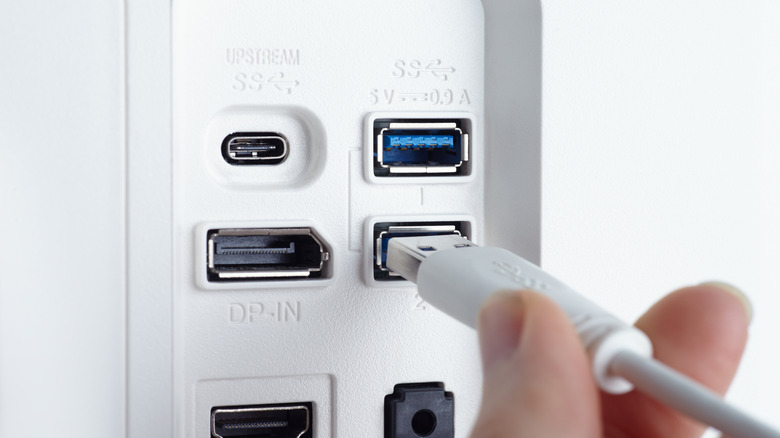

Upstream vs. Downstream USB Ports on Your Monitor: What Distinguishes Them?
Upstream and downstream USB ports on your monitor are designed to enhance your PC’s capability. Whether you have a laptop or a desktop, these ports enable the addition of more peripherals when your device’s port availability is somewhat limited. They make for a significantly more user-friendly USB hub for those looking for a simple method to connect devices such as keyboards, mice, or USB headphones.
Although monitor hubs have existed for a considerable time, identifying the monitor that made them widely popular is somewhat challenging. In 2004, Apple updated its now-defunct Apple Cinema Display, which included two FireWire 400 ports in addition to USB 2.0 ports. Nowadays, you will generally find these ports rated at USB 3.0 or higher to ensure a reliable mix of connectivity speeds and power delivery.
What is a USB upstream port on a monitor?
The USB upstream port located on the rear of your monitor serves to establish the connection between the PC and the USB hub. This connection is typically made via USB-B to USB-A cables (often called printer cables) or USB-C, enhancing the device’s capabilities. To determine which port is the upstream USB port, look for its size if it is USB-B, as this port is generally larger than USB-C. If your monitor’s upstream port is USB-C, it is usually marked with a small PC symbol nearby.
Technology companies like Apple and Dell have also incorporated Thunderbolt, an alternative to USB, which offers a consistent 40Gbps transfer speed for file management, a fourfold increase over USB 3.1 Gen 2. Some monitor ports may support cross-compatibility with USB-C or USB4 cables, which may not fully utilize some of Thunderbolt’s advantages but will still provide power to the hub via what is known as the upstream.
What is a downstream USB port on a monitor?
Downstream ports on your monitor’s USB hub are the remaining ports that activate when the upstream is connected. These are typically USB-A or USB-C, designed to provide maximum compatibility with various devices. Downstream ports can accommodate a wide range of devices, with keyboards and mice often suggested to relieve port congestion on desktops or laptops.
Downstream ports equipped with Thunderbolt can also facilitate daisy-chaining monitors from a single source. By connecting a Thunderbolt cable to the downstream port, you can link it to the upstream of the next monitor, allowing both monitors to be utilized. USB-C does support DisplayPort output, which is how it manages monitors, but USB 3.0 and its successors (along with USB4) do not support this feature. Monitors equipped with hubs that have a downstream configuration utilizing USB 3.0 or later will experience significantly enhanced transfer speeds, even when linked through the hub.