
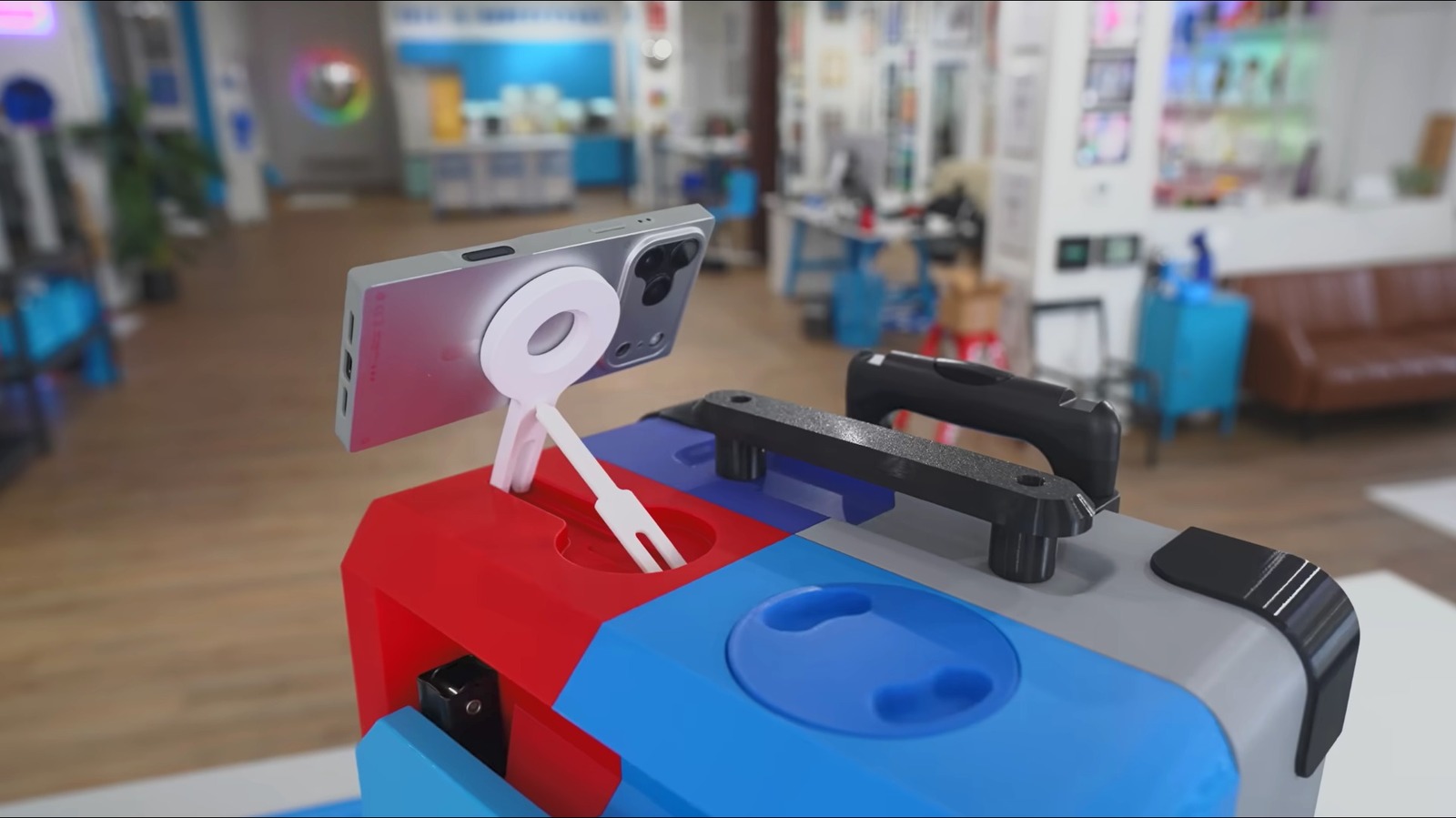

**The Creative 3D-Printed Luggage: A Fusion of Imagination and Functionality**
Flying is frequently an indispensable yet burdensome aspect of many individuals’ routines. Although large power banks are not allowed in carry-ons, intelligent luggage with tracking capabilities is permitted. Generally, travelers are confined to the options available in stores, but what if you could customize your own luggage with distinct attributes?
Recently, Matty Benedetto from the YouTube channel “Unnecessary Inventions” presented a 3D-printed suitcase. Motivated by his encounters with pricey Rimowa luggage that easily gets damaged, Benedetto chose to develop his own. His suitcase features a MagSafe phone holder, snack compartment, gimbal cup holder, foldable laptop table, and detachable feet for concealing Apple AirTags. It also includes a smart dial that shows airport weather. While Benedetto refers to these attributes as “unnecessary,” numerous travelers would value a suitcase that serves as a table and provides easy access to snacks.
**The Creation Process of the Suitcase**
Benedetto employed a Bambu Lab H2C printer, capable of producing multi-colored prints, which costs $2,399. Although pricier than the original suitcase, the H2C is a beneficial investment for diverse 3D-printing endeavors. Benedetto used TPU filament for shock-resistant corners and PLA filaments for wheel interiors. While the majority of components were 3D-printed, certain ones, like metal latches and hinges, were standard stock. He halted the printing of wheels to incorporate ball bearings for seamless rolling. The assembly process involved printing segments with metal dowels for robustness, applying Gloop glue to the shell, and securing metal components with screws.
**The Outcome of This Suitcase Experiment**
To evaluate his invention, Benedetto traveled with the suitcase on two flights. An unexpected problem occurred when the overhead compartment proved smaller than anticipated, resulting in a wheel detaching. Luckily, it was simple to reattach. However, during checked baggage storage, the suitcase lost the lid of the snack compartment and cup holder, developed a minor crack, and incurred scuffs. Despite these concerns, the suitcase remained in one piece, and the AirTag remained securely fastened.
Benedetto concluded that the 3D-printed suitcase “wasn’t a total loss,” but it was not the most practical option. While replacing lost components is doable, the usefulness of the suitcase as a laptop table may not warrant frequent repairs.