
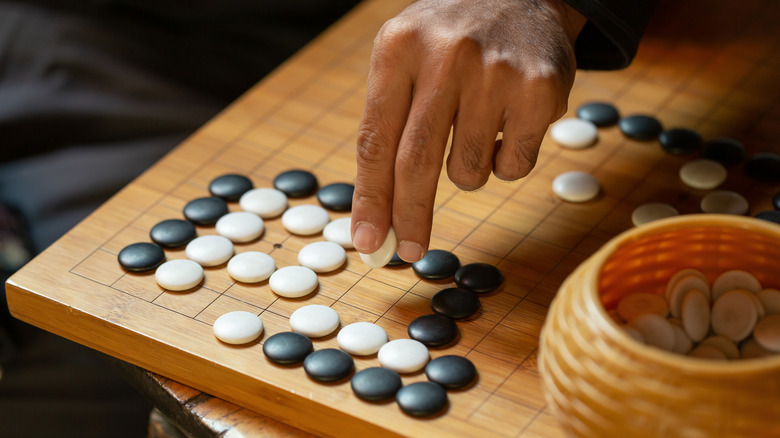

QR codes, also known as Quick Response Codes, may have surged in fame in recent years, but they have existed for quite a while. First launched in Japan in 1994, QR codes are now omnipresent, appearing in venues ranging from dining establishments to industrial environments. Despite their prevalence, many individuals are unaware that QR codes are inspired by the classic board game “Go.”
The grid-oriented game served as the creative influence for QR codes, which can store considerably more information than traditional barcodes and present notable advantages over previous scanning technologies. Nowadays, with all modern smartphones equipped with scanning capabilities, QR codes have evolved beyond their initial design. They were initially developed by the Japanese automotive parts manufacturer Denso Wave to serve as a replacement for UPC barcodes, which lacked sufficient data for efficient inventory tracking on manufacturing lines.
Masahiro Hara, a Denso Wave employee, took inspiration from the game “Go” to design the QR code, eventually replacing barcodes in production facilities. Denso Wave recognized the potential of QR codes and made them available for free worldwide, although they continued to sell the scanning devices. The company has since shifted focus, as smartphones can now perform the scanning functions.
What is Go? The board game that inspired QR codes
“Go” is a timeless game, comparable in complexity to chess or checkers. The oldest known reference dates back to China around 548 B.C., and it gradually made its way to Japan and Korea, where it has consistently remained popular. After being played for millennia outside of Asia, it was only introduced to the West in the 19th century, where it has not gained much traction, largely due to the dominance of games like chess.
So, how do you play? Two opponents compete on a 19-by-19 grid, aiming to control as much territory as possible. The game is traditionally played with black and white stones placed at the intersections of the grid. The opposing player must then surround these stones, and once encircled, those stones are captured and removed from the board.
The deeper you explore the game, the more intricate “Go’s” endless complexity reveals itself. For example, it wasn’t until 2016 that Google’s AlphaGo succeeded in defeating a human player, whereas DeepBlue triumphed over chess master Garry Kasparov in 1997.
Why are QR codes superior to UPC barcodes?
In addition to being physically simpler to scan on products within an industrial context, QR codes also contain substantially more information than UPC barcodes. This advantage stems from their modular construction—those black and white squares are referred to as modules. Each version incrementally adds four additional modules on both sides, with QR codes having reached version 40, which accommodates 177 modules. Version 1, a 21-by-21 QR code, can hold up to 152 bits, while version 40 can accommodate 23,648 bits. In terms of alphanumeric storage, a UPC barcode can retain 12 digits through its vertical bars, whereas a QR code extends horizontally, with version 40 supporting as many as 4,296 alphanumeric characters simultaneously.
This vast capacity for information enables QR codes to be significantly more versatile than UPC barcodes. Links, images, and a variety of other content can be embedded within a QR code to direct users to, for instance, a restaurant menu or a webpage displayed on a poster. It has become an essential part of public transportation in China, seen on train tickets nationwide, and has emerged as a useful tool for businesses to eliminate the need for customers to manually enter URLs in their web browsers prior to accessing promotional sites.