
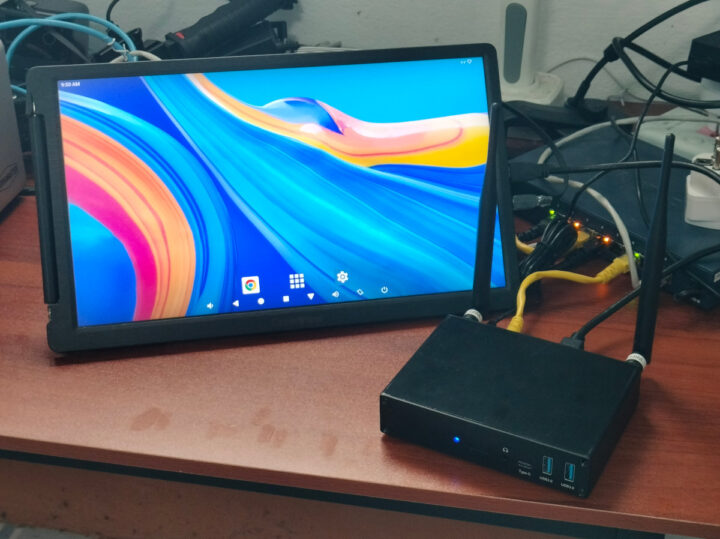

Rikomagic sent me a DS08 digital signage player for review. It’s powered by the Rockchip RK3588 SoC with 8GB RAM and a 128GB eMMC flash, featuring dual HDMI 2.1 ports, gigabit Ethernet, WiFi 6, Bluetooth 5.2, multiple USB ports, optical S/PDIF audio output, and more. Initially unsure about receiving the sample due to Thai hardware regulations, Rikomagic assured us it wouldn’t be an issue using DDP. The parcel arrived smoothly. This review will not include benchmarks since the Rockchip RK3588 platform is well-established. Instead, we’ll focus on unboxing, teardown, and digital signage features like video playback, RTC support, and display orientation.
**Rikomagic DS08 Unboxing**
The DS08 arrived in a plain white box, including the player, two WiFi antennas, a 12V/2A power adapter, an “8K” HDMI cable, and a basic IR remote control. The front panel features an IR receiver, power LED, microSD card slot, 3.5mm audio jack, USB 2.0 OTG Type-C port, and two USB 3.0 ports. The rear panel has two SMA antenna connectors, optical S/PDIF audio output, USB 2.0 port, an 8K HDMI port, a 4K HDMI port, gigabit Ethernet port, and a 12V DC jack. My sample had two screws on the front instead of four.
**Rikomagic DS08 Teardown**
To disassemble, loosen the screws on the front and rear panels, remove SMA antenna connectors, then slide the mainboard out of the metal case. The mainboard houses a Rockchip PMIC, a GL805G USB 2.0 hub controller, and a RealTek RTL8211F Gigabit Ethernet transceiver. The Rockchip RK3588, RAM chips, and 128GB flash reside under a large heatsink. Additional features include four UART console pads, a reset button behind the audio jack, RTC battery, a WiFi 6/BT 5.2 module, and footprints for an optional 4G LTE module with SIM card slot.
**First Boot and System Info**
After reassembly, connect Ethternet and an HDMI monitor for testing. The device boots to a typical Android launcher without a pre-installed digital signage app. The UI resolution is 3840×2160. The DS08 runs Android 13 on Linux 5.10.157 kernel.
**Preinstalled Apps**
Google Chrome, Explorer (file manager), Gallery (image viewer), Music, Google Play Store (nonfunctional for me), Power Manager (power scheduling), Settings, and Video (local video playback). Custom settings allow hiding the navigation bar and adjusting button visibility.
Google Play Store was nonfunctional, despite firmware checks and cache clearance. Instead, I used APKPure to install necessary tools like CPU-Z. System confirms an octa-core Rockchip RK3588 CPU with 7916 MB RAM but displays only 53 GB storage, due to my sample’s 64GB flash. Retail units have 128GB flash. The system supports root access.
**DRM Support**
I couldn’t check DRM licenses due to Google Play restrictions. Terminal checks show Widewine L3 enabled though.
**Video Playback**
Video playback is crucial for digital signage. I tested video playback using USB 3.0 hard drive and speakers. 4K videos played well, except for unsupported AC3 audio in the Video app. The DS08 supports 8K but with limitations due to Rockchip RK3588 VPU. H.265 videos played fine, but VP9 videos were choppy.
**Signage Features: Display Orientation, RTC, and Watchdog Timer**
The DS08 supports display orientation changes via a Screenrotate button, remembered through reboots. Power Manager app supports scheduled on/off/reboots, and the watchdog timer ensures recovery from system crashes.
**Dual-Display Support**
The DS08 provides dual-display support with HDMI interfaces, capable of mirroring output. Independent displays might be possible but likely require firmware adjustments.
**Connectivity and Power**
WiFi 6 and gigabit Ethernet tested via iperf3. WiFi speeds reached 311 Mbps (downloads) and 318 Mbps (uploads) but lack the performance seen in dedicated WiFi devices. For higher speeds, use Ethernet.
**Power Consumption**
Measured at 0.4W (off), 2.5W (standby), 3W (idle), and 4.9-5W (8K playback), emphasizing the power consumption of connected displays.
**Conclusion**
Rikomagic DS08 is suited for 4K digital signage with features for enhanced uptime. It’s powered by the Rockchip RK3588 SoC, performs well but may face limitations with 8