
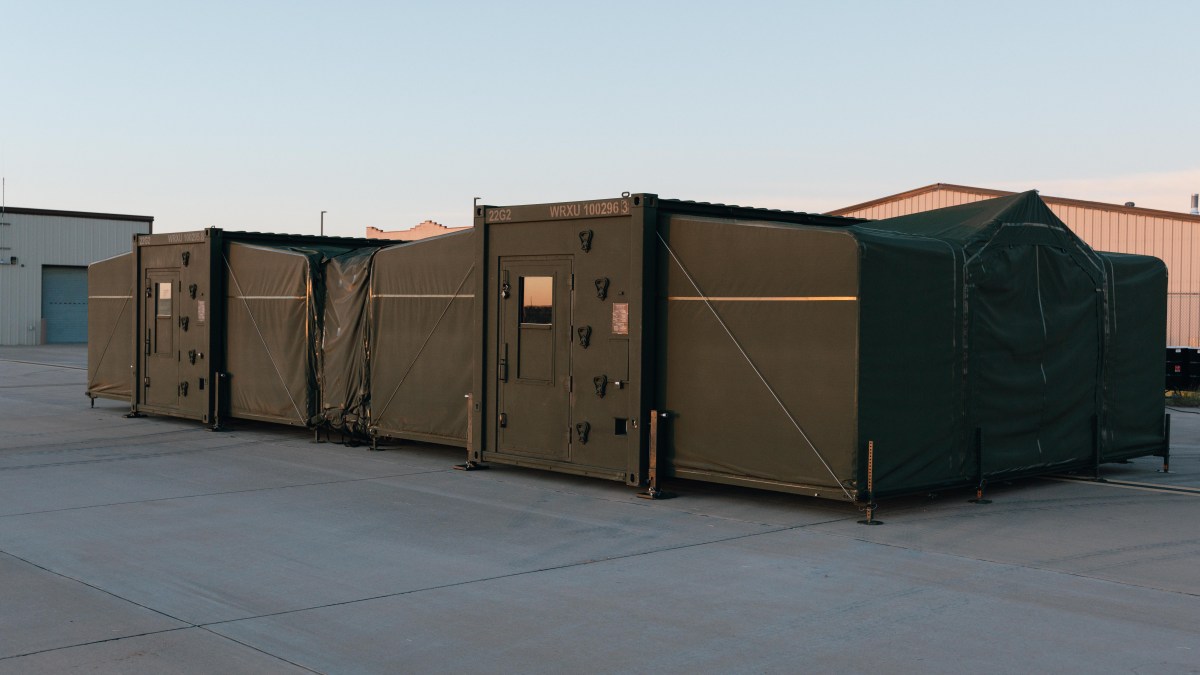

In a Pacific conflict, the nearest U.S. drone factory is thousands of miles away, leaving ships and planes carrying parts to the front lines vulnerable to attack. Defense startup Firestorm Labs believes the solution is a drone factory that fits inside a shipping container.
The company announced it raised $82 million in Series B funding led by Washington Harbour Partners with participation from NEA, Ondas, In-Q-Tel, Lockheed Martin, Booz Allen Ventures, Geodesic, Motley Fool Ventures, and others, bringing its total funding to $153 million.
Firestorm didn’t initially start as a factory company. It began as a drone maker but pivoted when customers wanted production closer to the front lines.
Firestorm Labs CEO Dan Magy is a serial defense tech entrepreneur. His co-founders, Chad McCoy, a career special operations veteran, and CTO Ian Muceus, who holds over a dozen patents in 3D printing, bring varied backgrounds.
The San Diego-based startup produces xCell, a containerized manufacturing platform that can print drone systems in under 24 hours. These drones aren’t locked into a single purpose and can be configured for surveillance or electronic warfare, said Magy. When asked about lethal operations, Magy confirmed they are capable. All platforms are delivered to Department of Defense operational commands, who deploy them following military doctrine.
The Pentagon has acknowledged the importance of contested logistics—keeping weapons and supplies moving under fire—designating it a critical technology area. Firestorm generates revenue through hardware sales and government contracts with all U.S. military branches, including a $100 million ceiling Air Force contract, with $27 million obligated so far.
The technology is already in real-world use. Two xCell units are deployed domestically with the Air Force Research Laboratory in Rome, New York, and Air Force Special Operations Command in Florida. Firestorm hasn’t disclosed which units in the Indo-Pacific region are using xCell, though it is said to be operational there.
Each xCell container houses an industrial-grade HP 3D printer that prints the body and shell of each drone. Firestorm has a five-year global exclusive agreement with HP to use its 3D printing technology in mobile deployment units. The weapons are added separately, not 3D-printed. The Army has used xCell to print replacement parts for a Bradley Fighting Vehicle on-site, which would otherwise take months to procure.
The problem isn’t just the distance. Fixed manufacturing sites are potential targets, a lesson Ukraine learned. Modern conflict moves quickly, requiring rapid adjustments to drone design.
For Firestorm, the Indo-Pacific is a focal point, where logistics challenges of modern conflict are most difficult. The startup aims for xCell to achieve full operational deployment there, “ideally within the next two years,” according to Magy.