

The ’80s were an incredible era for films, particularly within the sci-fi category. These movies featured numerous futuristic gadgets that offered audiences a glimpse into what the future could hold — you probably recall how these technologies seemed enchanting and made the 2000s feel so distant. Films like “Back to the Future,” “Runaway,” and various others showcased devices that many believed were impossible to develop at that time, yet some materialized and gained popularity in the years following.
If you grew up seeing these movies on an ’80s television, you understand that numerous predictions about what life would be like in the future never materialized. For those gadgets that did become reality, some arrived precisely as envisioned or in forms even more impressive than how they appeared in films. Others, however, came with certain constraints that the writers didn’t foresee, such as hoverboards requiring specialized tracks. Thus, while some technologies still have shortcomings, they transitioned from ’80s films into our everyday reality in various ways.
Self-tightening shoes
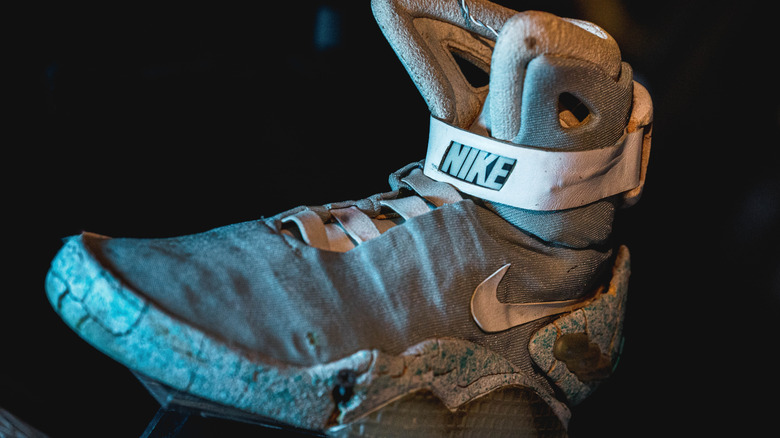
“Back to the Future Part II” debuted in 1989 and, in addition to continuing Marty McFly’s adventures, it attempted to forecast life in the then-far-off future of 2015. Some of those forecasts have aged better than others — and the self-tightening shoes are among the few to actually become a reality. What began as a brief visual effect on set transformed into an engineering feat that Nike ultimately accomplished.
During the making of “Back to the Future Part II,” Nike received an invitation to envision what footwear would resemble in 2015. In 2016, Nike unveiled a self-tightening rendition of the MAG model that McFly sported in the film, featuring sensors that recognized the presence of a foot and activated motors to adjust the laces. The inaugural functional model of that line was gifted to Michael J. Fox himself and his charitable organization.
Subsequently, this initiative led to the creation of the HyperAdapt 1.0, a product designed specifically for athletes that utilized the same self-tightening technology found in the MAG. The most affordable sneaker resulting from this initiative was the Nike Adapt BB from 2019, although due to its price and past software issues, the models failed to gain traction among the general population. Ultimately, the technology became real, but its popularity did not follow suit.
Floating skateboard
“Back to the Future Part II” stands out as a principal reference point when discussing ’80s technology that people wish were tangible. Another device featured in this film was the floating skateboard, which became a coveted item for many kids of that time — the concept of a flying skateboard was astonishing. In reality, a version of that device was indeed created, though not in the manner many anticipated.
In 2014, Greg Henderson came close to making this concept a reality by launching the Hendo Hoverboard on Kickstarter. Utilizing magnetic levitation technology, the board could hover above the ground and support a weight of up to 250 pounds. Tony Hawk gained attention by utilizing one of those boards during that period. Following that, Lexus attempted to penetrate the market in 2015 with its Slide, which was cooled with liquid nitrogen and could also float over magnetic surfaces.
The downside was that neither product reached commercial launch. Both were reliant on specially designed surfaces, which was a far cry from the freedom Marty McFly enjoyed on the streets of Hill Valley. Eventually, Hendo pivoted its maglev technology toward industrial uses. So, hoverboards do exist, but not in the form many envisioned back in the ’80s.
Wrist watches
Numerous films during the 20th century delved into the idea of possessing a powerful device on your wrist, with James Bond being one of the key figures to showcase it. In “Octopussy,” he was equipped with the Seiko TV watch, which was, in fact, a genuine product that the Japanese company had already introduced at that time. Thus, businesses had been contemplating something akin to a smartwatch for quite a while. However, contrary to its on-screen portrayal, the watch was not particularly practical.
For the small liquid crystal display to receive television channels, the user had to carry a bulky and weighty signal receiver in a pocket. Additionally, a cable connected it and ran inside the user’s clothing. Unsurprisingly, it didn’t prove very useful in daily life. Fast-forward to today, and even the most budget-friendly smartwatch brands can perform more intricate tasks and do so more efficiently than a Seiko TV from the ’80s. Companies like Apple and Samsung have capitalized on the miniaturization of electronic components to develop sophisticated devices, enabling users to make calls, track their health, and conduct transactions from their wrists.
Automated vacuum cleaners
If you own a robot vacuum cleaner, know that, in part, you are experiencing a future that Hollywood envisioned in the ’80s. Nowadays, multiple