
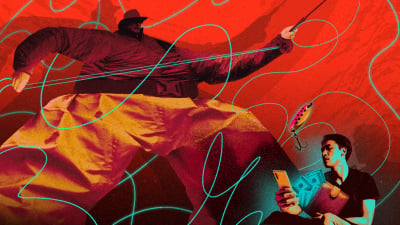

“Can I give you some money? You don’t have to do anything.”
In 2018, at 22, fresh out of college with an unused art degree, I hoped to become the next Ryan McGinley, capturing photos of handsome twinks in New York City. But I was naïve, living with my parents, and working with my dad over the summer to earn quick cash as I applied for unpaid photography internships around Manhattan.
Broke, I got my first credit card to buy a much-needed mattress and a ticket to Firefly Music Festival with my friends. I needed more money, so I signed up on Seeking Arrangements, but with no results. Turning to Omegle with the tag “sugar daddy,” I hoped to find someone to pay me incrementally for playful ridicule, but that didn’t work either, and I abandoned my sugar baby fantasy.
Then came Firefly. It was a hot weekend, I saw SZA, Kendrick, Eminem, and Arctic Monkeys. My money drained fast, spent mostly on festival food, and I was a typical 22-year-old, a little horny. Back at the tent, charging my phone while my friends slept, I scrolled through Grindr, finding plenty of profiles from near and far. One message from a blank profile caught my eye: “Can I give you some money? You don’t have to do anything.” My eyes widened.
Today, almost 10 years later, I’d ignore such a message easily, aware of bots on Grindr offering money or fake sugar daddy arrangements. But in 2018, it was less common. Curious, I asked, “I don’t have to do anything?” The reply assured me, “Nothing. Just send me your email for PayPal and I’ll give you money.”
Skeptical, I Googled if sharing my email could lead to a PayPal hack—no, it couldn’t without my password. “Why do you want to give me money? What do you get out of this?” I asked, and he confessed, “Being used financially turns me on.”
Feeling a bit guilty, I requested $30. Minutes later, a PayPal notification came through. Using his first and last name, let’s call him S.J. I verified his identity on Facebook—he was real, residing in Maryland, with a family and a bank job. “Can I pay you throughout the weekend?” he proposed.
“Sure,” I replied, and fell asleep. The next morning, I kept the secret from my friends; the $30 was mine. I enjoyed festival delicacies, avoiding the weak cell service inside, until another PayPal notification announced $70 from S.J., totaling $100. Yet his Grindr profile vanished, leaving me richer but puzzled.
Back in New Jersey, resuming my courthouse job, the memory of S.J. and easy money lingered. I decided to message him on Instagram—“Good, missing Firefly. I spent so much money that weekend,” I hinted.
We agreed on a payment plan: $250 weekly starting next week. But when the time came, nothing arrived. Every attempt to contact him failed. Then, one late night, a “Hey” appeared—too little, too late.
Soon, a PayPal email informed me of a $50 dispute by S.J. for “services not rendered,” referencing financial domination, against PayPal’s terms. Their policy forbids transactions for sexually oriented services, yet I explained there was no sexual exchange. Despite the warning, they withheld $70—$50 refunded and $20 dispute fee.
Frustrated, I emailed S.J., unleashing my anger, only for his amused reply, “That was so hot.” I demanded more money in vain as his online presence vanished entirely.
To S.J.: Should you see this, my contact remains unchanged—I could still use that $50.