
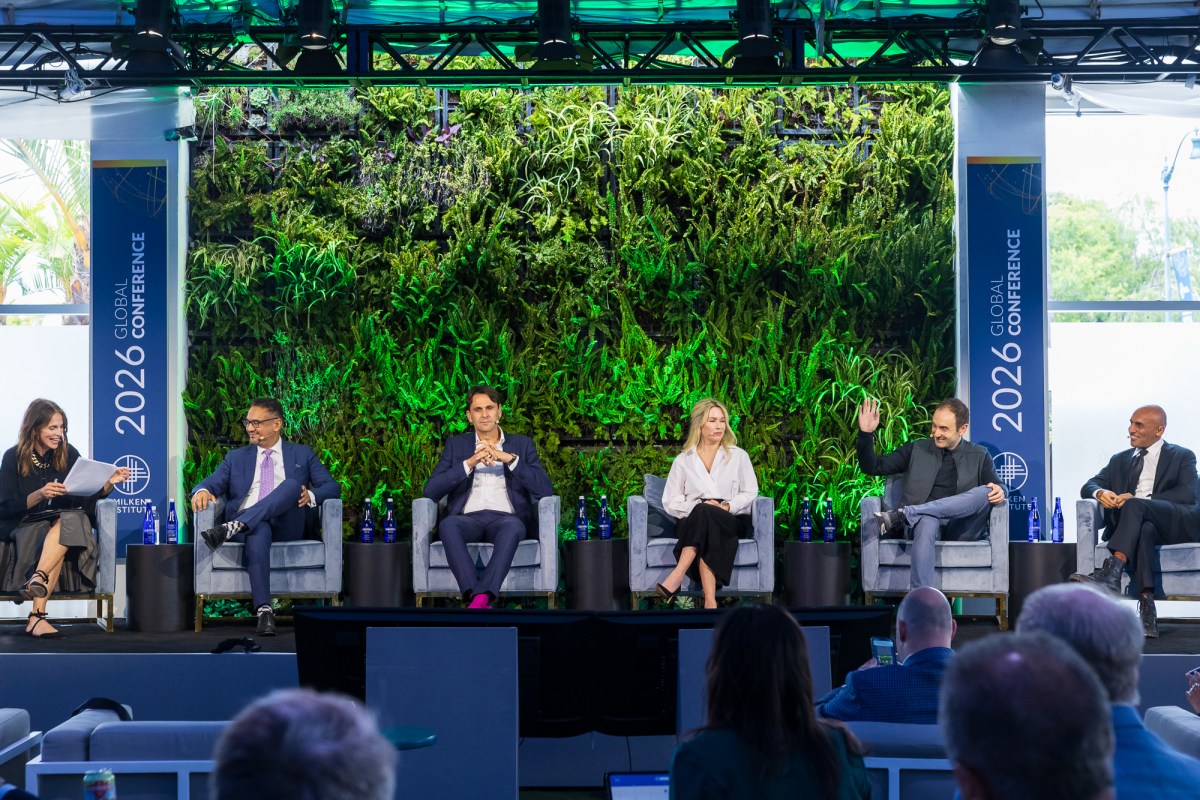

Earlier this week, five individuals involved in different aspects of the AI supply chain gathered at the Milken Global Conference in Beverly Hills. They discussed topics such as chip shortages, orbital data centers, and potential flaws in the foundational technology architecture.
On stage were Christophe Fouquet, CEO of ASML, which monopolizes the extreme ultraviolet lithography machines essential for modern chip production; Francis deSouza, COO of Google Cloud, which is making significant infrastructure investments; Qasar Younis, CEO of Applied Intuition, known for its $15 billion physical AI company that has expanded into defense; Dimitry Shevelenko, chief business officer of Perplexity, an AI-native search-to-agents firm; and Eve Bodnia, a quantum physicist challenging conventional AI architecture at Logical Intelligence, alongside Meta’s former chief AI scientist, Yan LeCun.
Here’s their discussion:
**The bottlenecks are real**
The AI industry is facing physical constraints, particularly in chip manufacturing. Fouquet noted that despite efforts to accelerate chip production, the market will be supply-limited for the next few years. DeSouza highlighted Google Cloud’s rapid growth and backlog expansion, evidencing strong demand. Younis emphasized a data constraint, as Applied Intuition relies on real-world data, which synthetic simulations cannot fully replicate.
**The energy problem is also real**
Energy constraints are another issue. DeSouza mentioned Google’s exploration of space-based data centers to access more abundant energy, though challenges remain. Google’s co-engineered AI stack optimizes energy efficiency. Fouquet pointed out that more computing power requires more energy, emphasizing its cost.
**A different kind of intelligence**
Bodnia’s company, Logical Intelligence, uses energy-based models (EBMs) to grasp underlying data rules rather than predicting sequences. Her approach, involving fewer parameters, allows rapid updates and better suitability for domains requiring understanding of physical rules, contrasting with large language models.
**Agents, guardrails, and trust**
Shevelenko discussed Perplexity’s transition from search to “digital worker” models. The Perplexity Computer operates as a staff managed by knowledge workers, with control through granularity. Security is ensured through permission settings and action approvals by users.
**Sovereignty, not just safety**
Younis noted that physical AI impacts national sovereignty due to real-world manifestations, unlike digital AI. Autonomous systems provoke concerns about control, safety, and data governance. Fouquet acknowledged China’s advancements in AI but mentioned their limitations in semiconductor manufacturing.
**The generation question**
In response to concerns about the impact on future critical thinking skills, deSouza highlighted AI’s potential to address major global challenges. Shevelenko noted the ease of starting independent ventures today, while Younis emphasized AI’s role in addressing labor shortages in physically demanding industries.