
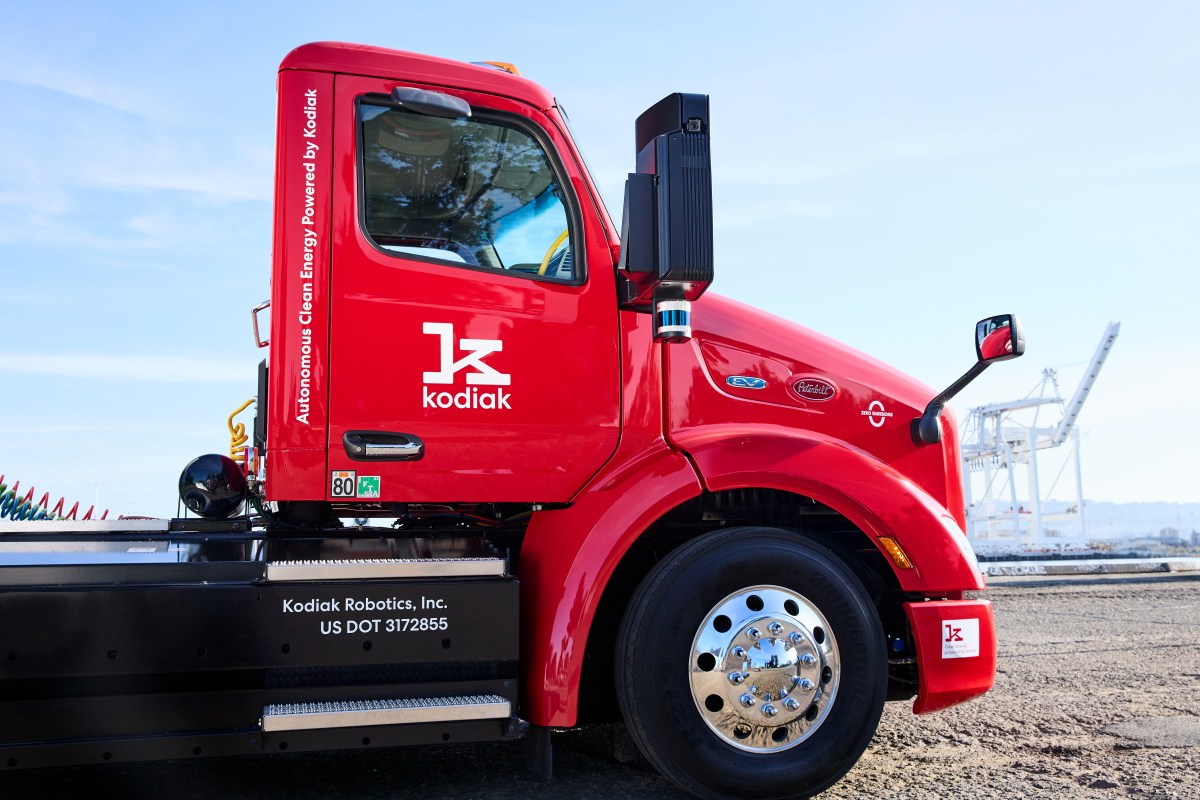

Kodiak AI’s stock dropped 37% in after-hours trading Thursday after the self-driving truck startup announced it had raised $100 million by selling shares at a significant discount, indicating that investors were willing to support the company but not at its current market rate.
The company sold shares at $6.50 each, considerably lower than its closing price of $9.10, as per a filing with the Securities and Exchange Commission (SEC). The raise also included warrants—tools that give investors the option to purchase additional shares later at a set price, in this case as low as $6.
The funding came from existing backer Ares Management and several unnamed institutional investors.
This capital injection arrives as Kodiak advances on the costly endeavor of scaling its self-driving truck business, which spans off-road industrial settings and public highways, aiming to eventually spend less than it earns. Kodiak reported revenue of $1.8 million in the first quarter, up from $1.4 million in the same period a year ago. The company’s operational loss was $37.8 million, double what it reported in the same period last year.
These figures partly explain why the discount terms unsettled investors. The company is rapidly burning cash, and the raise—though substantial—does little to alter that situation in the short term.
Kodiak has recently made progress on the business front, including a new commercial contract with Roehl Transport, a pilot program to test Kodiak-equipped autonomous trucks at West Fraser Timber Co.’s log-hauling operations in Alberta, Canada, and a collaboration with military vehicle maker General Dynamics Land Systems to develop autonomous ground vehicles for defense applications.
As part of the deal with Roehl announced Thursday, Kodiak-equipped trucks will autonomously haul freight between Dallas and Houston on four round trips per week. The trucks operate autonomously throughout the journey, but Kodiak keeps a human safety operator behind the wheel as a precaution.
Kodiak founder and CEO Don Burnette stated the company is on track to transition to driverless trucking on public highways later this year as it expands operations.
“We have many over-the-road long haul initiatives, and bringing on new partners shows our ongoing momentum,” he said in an interview. “We’re excited about the progress we’re making as we move toward our driverless launch later this year.”
Currently, Kodiak owns the trucks, provides the safety driver, and handles the freight delivery for Roehl alongside its other current on-highway customers, which include Werner, J.B. Hunt, Bridgestone, Martin Brower, and C.R. England. However, this setup will change once driverless trucking operations commence.
“Our plan is not to own the trucks at that time but to operate our driver-as-a-service model, where [customers] own and operate the vehicles,” Burnette said. He added that this model is used with its off-highway customer Atlas for its driverless deployment in the Permian Basin of Texas.
While Kodiak plans to remove the safety driver by the end of 2026, Burnette noted it won’t begin driverless operations on public highways until the technology has been fully validated.
“It’s already functioning under all the conditions we expect to launch driverless, but there’s extensive validation work to do, which is where we introduce our autonomy readiness measure,” Burnette explained. The initiative—launched Thursday—is a zero-to-100 score monitoring how much of Kodiak’s internal safety validation is complete. As of April, Kodiak was at 86%, Burnette said.
The company, formerly known as Kodiak Robotics, went public in September through a merger with special-purpose acquisition company Ares Acquisition Corporation II, affiliated with Ares Management. The deal valued the startup at approximately $2.5 billion.
At that time, Kodiak raised $275 million in funding. More than $212.5 million came from certain institutional investors, including $145 million in PIPE funding (Private Investment in Public Equity, through which investors buy shares directly from a public company) and around $62.9 million in trust cash from Ares. This trust cash decreased from its original $562 million as some SPAC investors redeemed their shares—a standard provision allowing SPAC investors to reclaim their money before a merger is finalized.