

Scientists have identified a microwave laser beam approximately 8 billion light-years away, recognized as the most potent and distant of its type. The author of the study informed New Scientist that the signal is about 100,000 times brighter than a typical star. It’s so intensely luminous that researchers have established a new classification for it: the “gigamaser.”
A maser operates as the radio-wavelength equivalent of a laser. Both represent focused, coherent streams of electromagnetic radiation; however, a laser emits wavelengths visible to the eye, while a maser produces radio waves that remain unseen. Hydroxyl masers, like the recently discovered one, arise when two galaxies collide. This collision compresses gas and excites hydroxyl molecules, which subsequently amplify the incoming radio waves into a concentrated beam. Such amplification results in a maser with a 7-inch wavelength, significantly longer than that of visible light.
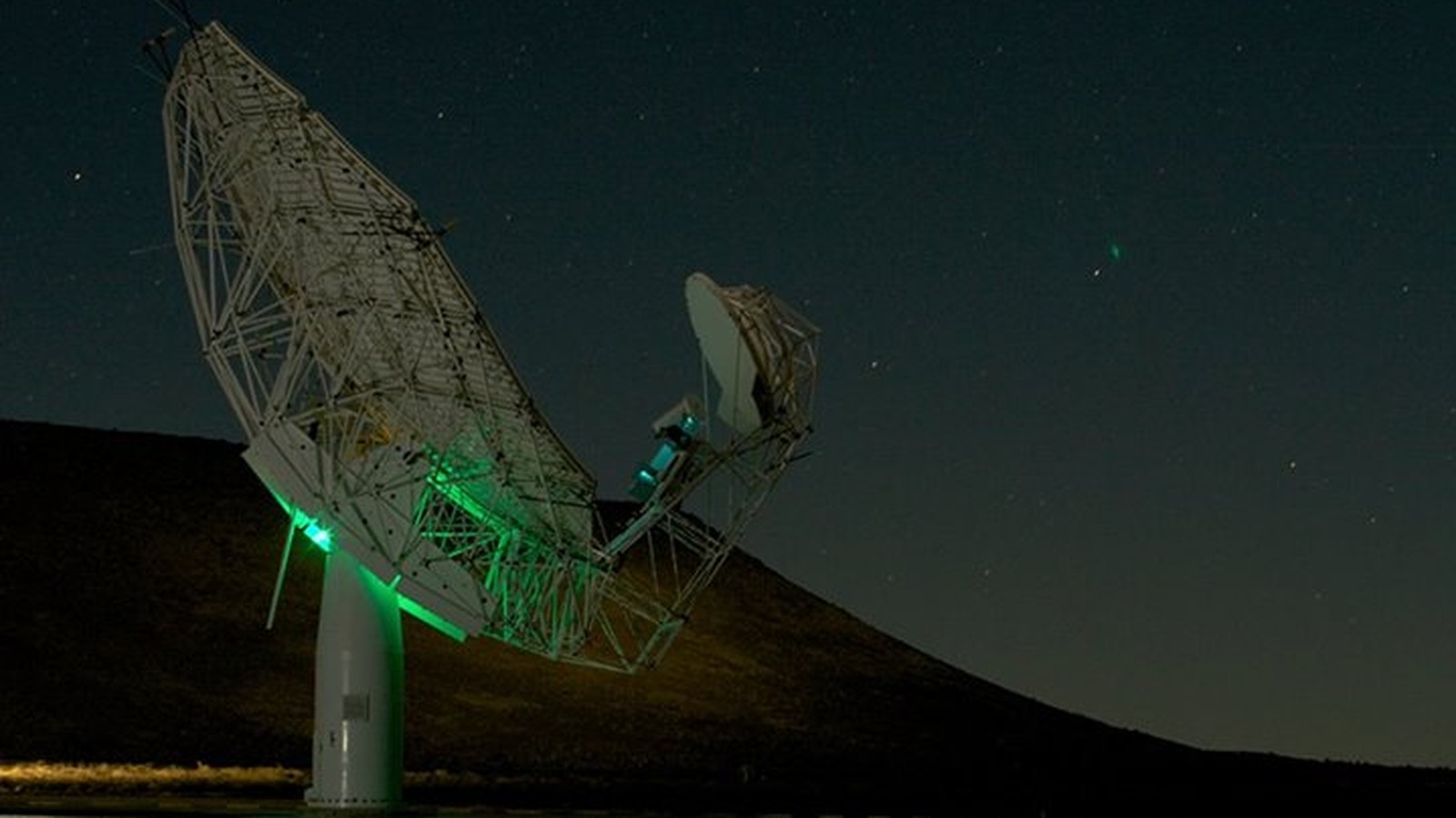
A group of astronomers made use of the MeerKAT radio telescope located in South Africa to uncover the maser within the galaxy HATLAS J142935.3–002836. This galaxy is undergoing a tumultuous merger over 8 billion light-years away, marking it as the most distant signal of its kind recorded to date. The Milky Way will eventually encounter a similar merger, albeit on a much smaller scale. The HATLAS maser discovery was aided by a fortunate occurrence and the utilization of advanced technology.
How a fortunate alignment of galaxies unveiled the record-breaking laser
We are observing the maser and its galaxy as they were over 3 billion years prior to the existence of Earth. Typically, a signal from such a distance would be too weak for the MeerKAT to capture. However, researchers experienced a stroke of luck. In this instance, while stars were not aligned, a galaxy was perfectly positioned. It was located in almost perfect alignment between Earth and HATLAS J142935.3–002836. The galaxy’s substantial mass of stars, gases, planets, black holes, and dark matter warped the local space-time, enhancing the signal as it traveled through. The maser’s signal took advantage of that curvature to reach the MeerKAT’s receivers. Without such alignment and amplification, this groundbreaking space laser would have remained concealed.
However, the discovery required more than mere luck. The MeerKAT ranks among the most sensitive radio telescopes globally, specifically designed to capture faint signals from throughout the universe. It collects around 2.5 terabytes of data each hour. Astronomers rely on advanced computing and custom-designed processing pipelines to analyze the data efficiently. This is how the team detected the gigamaser’s signal. They aspire to uncover hundreds or even thousands more. Masers typically emerge in the most tumultuous galaxy mergers, which instigate starbursts and nourish supermassive black holes, a phenomenon more prevalent than previously believed. Investigating them could significantly alter astronomers’ understanding of galaxy formation and evolution.