

Productivity software maker Notion is entering the agentic era. During a live-streamed product announcement on Wednesday, the company introduced a new developer platform that enhances its custom AI agents, links with external agents, and enables teams to build automated multi-step workflows that draw data from any database.
By creating an orchestration layer—coordinating AI work across various tools and data sources—Notion positions itself beyond a note-taking app with AI features, evolving into a hub for collaboration across tools and databases. In February, Notion launched Custom Agents for handling repetitive tasks like answering FAQs, compiling status updates, and automating workflows, with over one million agents built since, according to the company.
Limitations existed, as these agents couldn’t connect with external data or use custom logic, requiring teams to rely on third-party automation platforms or write bespoke scripts. “It’s true that, historically, Notion hasn’t been the most developer-focused platform,” said Ivan Zhao, Notion co-founder and CEO, during the presentation. “But things are changing.”
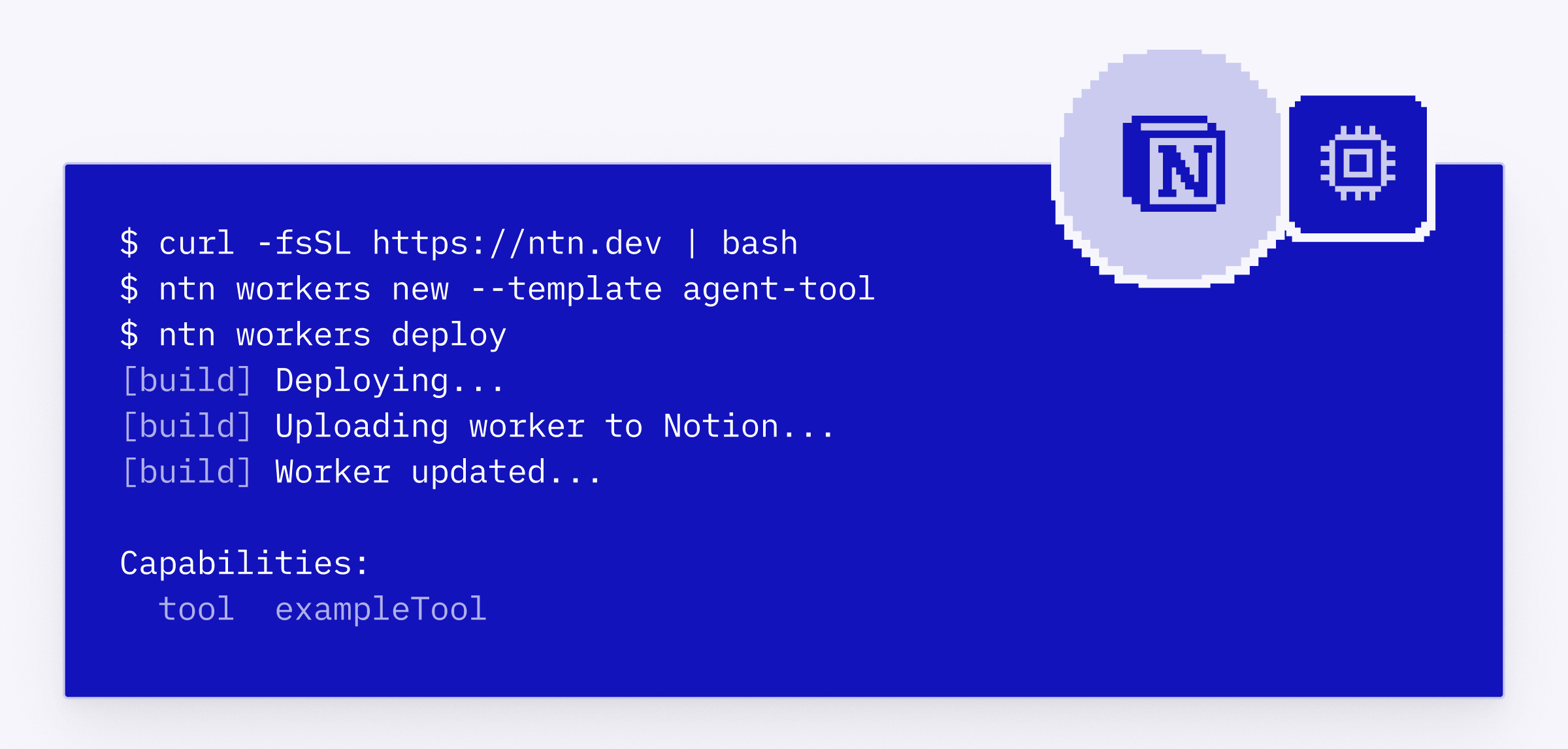
Notion now allows teams to deploy custom code using Workers, a cloud-based environment for running custom code in a secure sandbox. This enables teams to sync data with Notion, build custom tools, and trigger tasks with webhooks—automated signals that initiate actions when events occur in another app—without external infrastructure. You don’t even need to write the code yourself; an AI coding agent can handle it for you.
Workers operate on the same credit system as Custom Agents, which is free until August for developer experimentation. Syncing external data sources with the Notion Developer Platform, powered by Workers, allows pulling data from any API database into Notion databases, such as Salesforce, Zendesk, and Postgres, keeping it updated.
Zhao remarked this development means users can “use your Notion database as a sheer canvas to power both your workflows and your agents.”
Workers can also create agent tools with custom logic when connecting a third party via the Model Context Protocol (MCP)—a standard for AI tools accessing external data and services—is inadequate.
The update includes the ability for Notion users to chat with and manage external AI agents like Claude Code, Cursor, Codex, and Decagon, similar to native custom agents, with more partners planned. There’s also an External Agent API for teams to connect internal agents developed for specific company needs.
Developers and agents interact with Notion’s new platform using the Notion CLI, a command-line tool for the company’s Business and Enterprise Plans.
Notion’s Developer Platform signifies a shift towards a programmable platform, setting it in competition with workflow automation systems. As businesses aim to automate knowledge work and develop AI systems, a cohesive platform integrating agents, custom code, and live data becomes critical infrastructure.
This aligns with a trend among AI firms expanding beyond chatbots to agentic tools capable of acting across diverse software platforms. “Any data, any tool, any agent—that’s the big picture for the Notion Developer Platform,” Zhao said.