
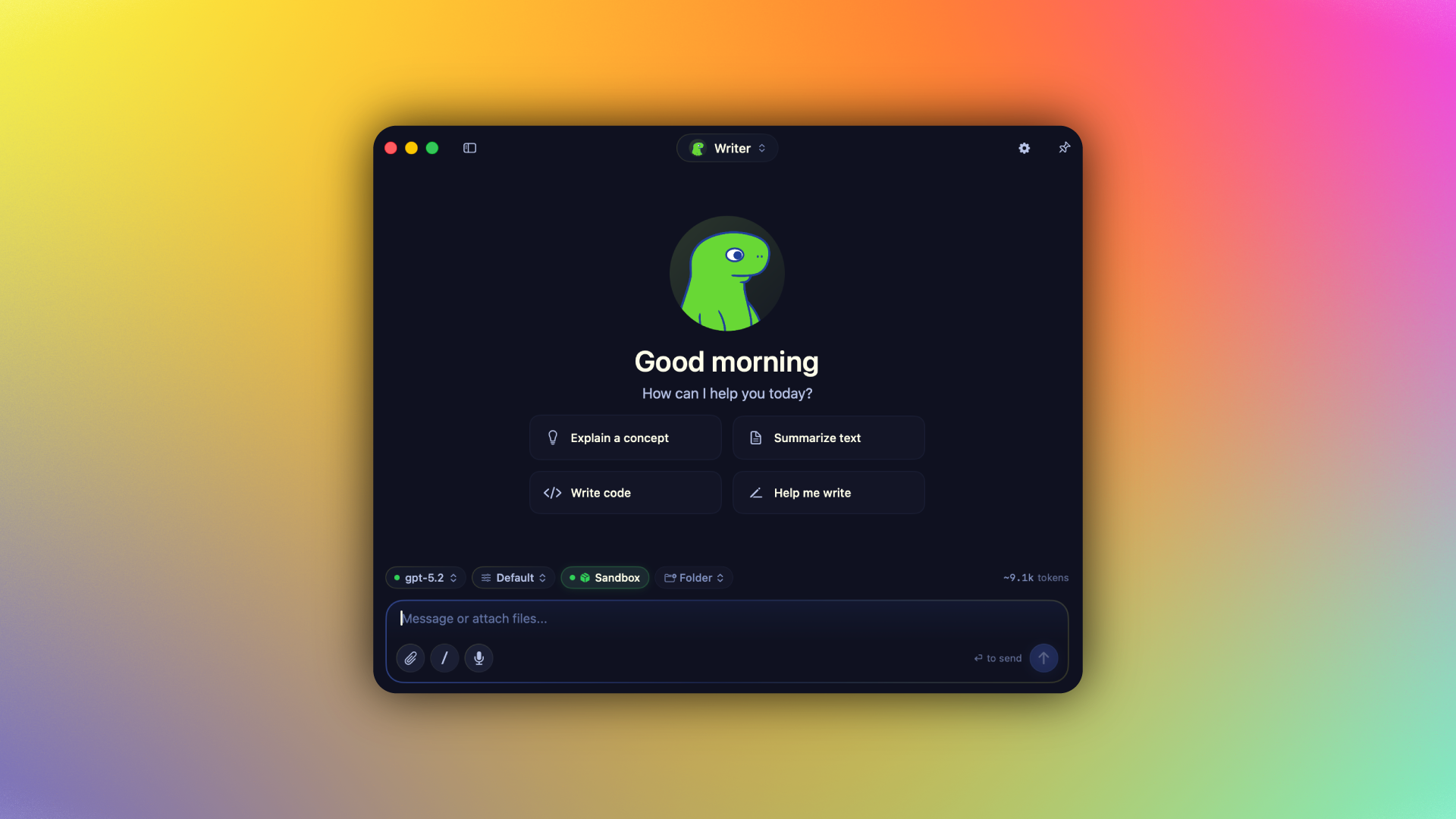

As AI models become more commoditized, startups are focusing on building a software layer above them. An intriguing player in this area is Osaurus, an open source, Apple-only LLM server allowing users to toggle between local AI models on their devices or in the cloud while keeping files and tools on their hardware. Osaurus originated from a desktop AI companion, Dinoki, whose customers questioned paying for the app if they still needed to purchase tokens for AI service usage.
This led co-founder Terence Pae to explore the potential of running AI locally. Pae, previously a software engineer at Tesla and Netflix, explained his aim to run an AI assistant on users’ Macs, taking advantage of their local capabilities. He began developing Osaurus as an open-source project, enhancing it over time.
Now, Osaurus connects with local AI models or cloud providers like OpenAI and Anthropic, letting users choose AI models while maintaining control over aspects like model memory and files. This design positions Osaurus as a “harness” that integrates AI models, tools, and workflows through a single interface, similar to OpenClaw or Hermes. However, Osaurus targets consumers with an easy-to-use interface and runs in a hardware-isolated sandbox to ensure security.
Running AI models locally is still new due to resource and hardware demands. Systems need at least 64 GB of RAM for local models, and about 128 GB for larger models like DeepSeek v4. Pae anticipates that local AI’s demands will decrease as it becomes more efficient, noting the significant improvement in intelligence per wattage over the last year.
Osaurus supports a variety of models like MiniMax M2.5, Gemma 4, Qwen3.6, GPT-OSS, Llama, DeepSeek V4, Apple’s foundation models, Liquid AI’s LFM models, and can connect to several cloud services. It functions as a full MCP server, allowing MCP-compatible clients access to its tools and includes over 20 native plugins. Recently, Osaurus gained voice capabilities.
Since its launch about a year ago, Osaurus has been downloaded over 112,000 times. Currently, its founders are part of the New York-based accelerator Alliance, contemplating steps forward like offering Osaurus to businesses in sectors like legal and healthcare to address privacy concerns.
As local AI model capabilities grow, Osaurus’ team believes they could reduce the need for AI data centers. Pae emphasized the potential for substantial power savings and cloud-like capabilities without reliance on data centers.