
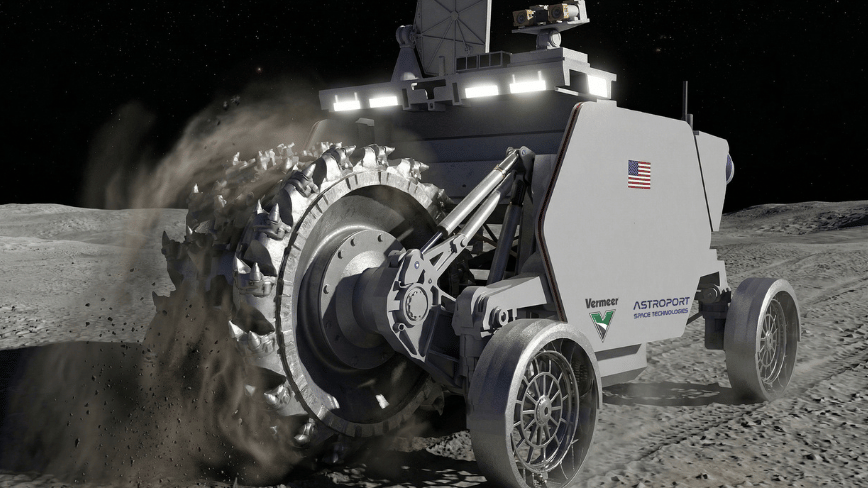

Astroport Space Technologies and Vermeer Corporation have announced they will collaborate to adapt industrial surface mining equipment for autonomous construction on the Moon. This partnership is seen as providing the necessary “Lunar Iron” machinery to support a permanent human presence on the Moon.
The announcement was made at the 20th International Conference on Engineering, Science, Construction, and Operations in Challenging Environments (ASCE Earth & Space 2026) in College Station, Texas. The focus is on the “lunarisation” of Vermeer’s mining machinery using Astroport’s Universal Tool Implement Payload Adapter (UTIPA), a modular system for robotic construction in the Moon’s environment. The project will re-engineer traditional heavy equipment to function in low gravity, extreme temperatures, and abrasive lunar regolith, starting with a surface miner application.
The term “Lunar Iron” refers to heavy construction machinery like excavators, trenchers, and surface miners required for lunar base development, including digging foundations, grading roads, and building landing pads. This machinery must operate autonomously in a vacuum, withstand extreme temperature variations, and function without gravity. Jason Andringa, President and CEO of Vermeer, emphasized the company’s commitment to innovation, highlighted by its history in farm, natural resource, and underground construction equipment.
Sam Ximenes, Astroport’s founder and CEO, described the partnership in national policy terms, focusing on the U.S.’s commitment to a permanent lunar presence. This collaboration with Vermeer aims to provide the “Lunar Iron” necessary for key infrastructure on the Moon.
The collaboration’s technical centrepiece is the UTIPA system, which adapts proven industrial machinery for lunar construction through modular interfaces, allowing versatility with a single autonomous base unit for various construction tasks. This modular approach reduces the need for multiple machines launched from Earth, as each can perform multiple roles in base construction.
Prototype testing will take place at Vermeer’s headquarters in Pella, Iowa, utilizing existing testing infrastructure for high-torque cutting and trenching technologies. The partnership supports NASA’s Moon Base program, seeking lunar infrastructure by 2030, and fits with Astroport’s and Vermeer’s ongoing developments for lunar construction, including NASA contracts and collaborations with companies like Venturi Astrolab and ispace.
The Astroport-Vermeer collaboration contributes to the evolving lunar construction ecosystem. While other companies like Blue Origin and SpaceX develop lunar landers and habitation modules, the challenge remains to achieve heavy civil engineering on the Moon at a scale needed for permanent habitation.
Astroport operates in San Antonio, Texas, with branches in Luxembourg and Adelaide, Australia, while Vermeer operates in over 60 countries. The goal is to leverage terrestrial prototypes for lunar applications, addressing unique challenges like the Moon’s abrasive regolith and low gravity. With the US government’s commitment to a lunar presence by this decade’s end, companies like Astroport and Vermeer aim to be at the forefront of delivering construction-ready hardware essential for upcoming contracts.