
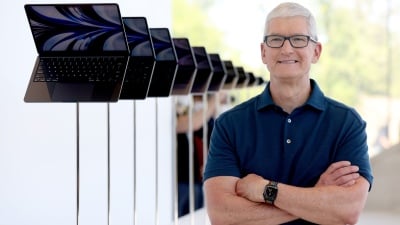

Steve Jobs set the stage, but Tim Cook’s legacy might surpass it.
Few CEOs have faced the challenge Tim Cook did in 2011, stepping into big shoes left by Steve Jobs at his waning. Not many rise to the challenge and manage to leave such a remarkable legacy.
Apple’s head, aged 65, announced he’ll be stepping back this September, transitioning to an emeritus role as Executive Chairman while John Ternus assumes the CEO position. Of all the tech, financial, and logistical feats over 14 years—and we’ve detailed them below—some business experts argue this succession itself may be the most significant.
Apple’s flawless leadership handoff signifies Cook’s legacy, as per Laurie Barkman, adjunct professor of entrepreneurship at Carnegie Mellon University. This doesn’t occur by chance; it reflects the company’s strategic operations.
Many CEOs driven by ego botch successions, even crippling their teams—consider the chaos depicted in the series “Succession.” Such turmoil is why the typical S&P 500 company survives just 18 years. But as Jobs’ COO, Cook focused intensely on logistics, which is how Apple celebrated 50 years with thriving resilience.
In Apple’s lean years pre-iPhone, Cook saved the firm by managing inventory and controversially sustained growth amid high tariffs and political tensions, even working with an administration counter to his values. This calm, decisive transition underlines Apple’s evolution into a smooth operation.
Barkman asserts that moving Apple from a founder-led to institutional succession is Cook’s crowning achievement.
The unpredictable Jobs co-founded and drove Apple’s renaissance and the iPhone’s launch during his 1997-2011 return. However, his absence since 1985 wasted years before clawing back relevance. When he left, Apple was worth $350 billion—from $1 billion at IPO. Cook transformed it into over $3.9 trillion.
Under Cook, Apple hit market value milestones of $1 trillion and then $2 trillion. Only NVIDIA created more value, benefiting from the AI boom.
The iPhone narrowly escaped becoming like the original Macintosh, which was elegant but overtaken by Windows PCs. Cook’s diligence helped Apple overtake Samsung as the top smartphone maker.
Cook’s reputation is conservative, modifying more than innovating. The iPhone 17, though far removed from the iPhone 5, shows iterative progress. Still, Apple unveiled new products like the Apple Watch, born after Jobs’s death, which dominates wearables with over 100 million users.
And then there’s AirPods, enhanced by acquiring Beats for $3 billion, a risky yet rewarding move.
Apple’s leap into streaming was groundbreaking, not just device iterations. Launched in 2019, its secret was Apple Studios, producing original hits. “CODA” claimed Apple’s first Best Picture Oscar—something Netflix pursued for years. Scorsese’s “Killers of the Flower Moon” and sporting events also marked Apple’s streaming triumphs.
Apple shows, like “Ted Lasso” and “Severance,” dominate today’s cultural scene, paralleling what “Game of Thrones” did. Additionally, Apple’s diverse content and strategic promotions cultivate a loyal audience without intrusive ads.
Some claim Cook lagged on AI, overlooking ChatGPT-induced buzz, downplaying AI’s mention, and instead spotlighting Apple’s ongoing “machine learning” use. Cook’s compromise was on-device AI, lacking a major Siri overhaul until 2026. But Cook feels disenchanted consumers prefer privacy-centric tech.
If Apple’s cautious AI approach proves popular—balancing utility over hype—Cook’s planning would be vindicated, especially if Apple Silicon, like the AI-friendly M5 chip, outperforms competitors.
Cook, soon CEO emeritus, may indeed be proven insightful.