
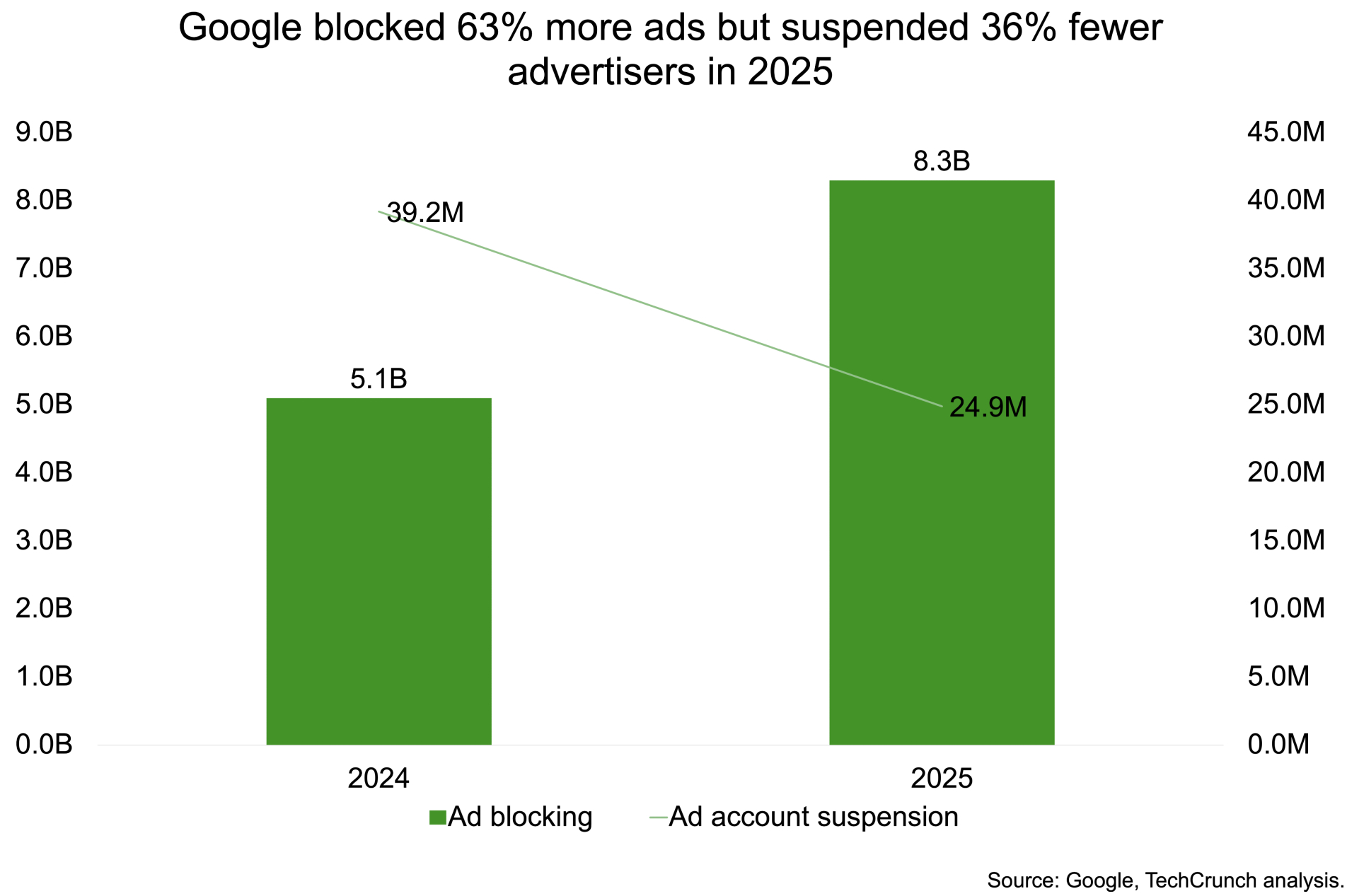

On Thursday, Google announced that it blocked a record 8.3 billion ads worldwide in 2025, an increase from 5.1 billion the previous year. However, the number of advertiser accounts suspended was notably less than the surge of blocked ads, prompting concerns about the platform’s enforcement measures.
The discrepancy was attributed to the expanded use of AI, specifically Google’s Gemini models, enabling more accurate and earlier detection of policy-breaching ads. Google’s AI systems reportedly caught over 99% of these ads before they reached users.
These observations, found in Google’s 2025 Ads Safety Report, highlight a strategic shift in enforcement. While more problematic ads are being intercepted, fewer accounts are being suspended, suggesting a new approach of targeting individual ads rather than entire accounts.
Google mentioned the sharp increase in blocked ads is also due to scammers increasingly using generative AI to create deceptive content, with Gemini models helping identify patterns in large-scale campaigns and intercept them sooner.
This adjustment reflects Google’s broader integration of Gemini models into key products and infrastructure, including ads, to automate campaign creation, detect policy breaches, and swiftly address new threats.
Within the blocked ads and suspended accounts, 602 million ads and 4 million advertiser accounts were connected to scams. In the U.S., Google blocked over 1.7 billion ads and suspended 3.3 million accounts in 2025, mainly due to network abuse, misrepresentation, and sexual content. Meanwhile, in India, which hosts Google’s largest user base, 483.7 million ads were blocked, nearly two times the previous year, while account suspensions reduced to 1.7 million from 2.9 million, with trademark, financial service, and copyright violations among the top issues.
At a virtual briefing, Keerat Sharma, VP and general manager of ads privacy and safety at Google, stated that the company has shifted towards more granular, AI-led enforcement at the creative level, avoiding broader measures like account suspensions. This approach has reportedly decreased incorrect suspensions by 80% annually.
Sharma also emphasized that Google employs layered defenses including advertiser verification, which asks businesses to verify their identity before running ads, to stop bad actors from creating accounts, contributing to the reduction in suspensions.
According to Sharma, the figures are expected to vary as Google introduces new defenses and bad actors adjust, with the goal being to halt harmful ads as early as possible.