
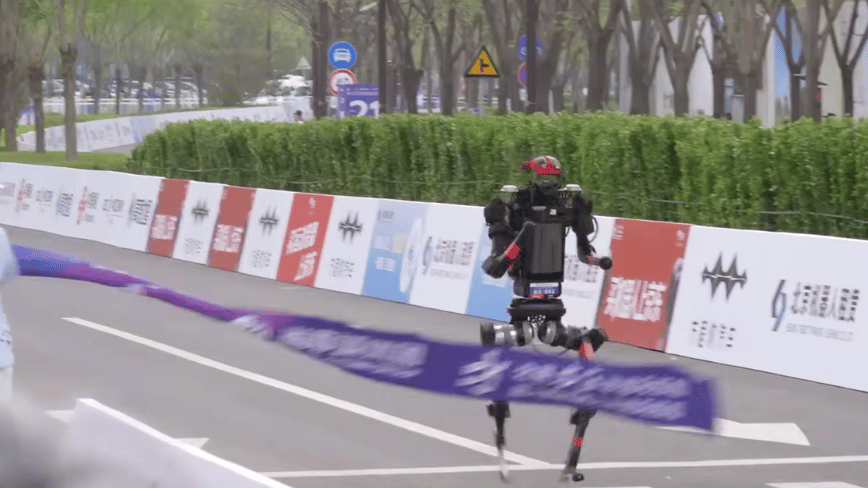

A humanoid robot named Lightning completed the Beijing E-Town Half-Marathon in 50 minutes and 26 seconds, surpassing the human world record by almost seven minutes. Created by Shenzhen Honor Smart Technology Development Co., it autonomously navigated the 21-kilometer course using multi-sensor fusion and real-time decision-making algorithms. A second unit, remotely controlled, finished faster at 48 minutes and 19 seconds. The human half-marathon record is 57 minutes and 20 seconds, set by Uganda’s Jacob Kiplimo in Lisbon on March 8.
The robots and about 12,000 human runners used the same route but competed in separate lanes. The human race was won by Zhao Haijie of China in 1 hour, 7 minutes, and 47 seconds. The robot race winner was a machine 169 centimeters tall, with a leg length of 95 centimeters, 400 newton-meters of peak torque, and a proprietary liquid cooling system with a heat exchange flow rate of over four liters per minute, technology adapted from Honor’s smartphone division.
The event was the second Robot World Humanoid Robot Games Half-Marathon, co-hosted by the Beijing Municipal People’s Government and China Media Group. The first, last year, had only six of 21 robotic runners finishing, with several mishaps. A Tiangong Ultra robot won in 2 hours, 40 minutes, and 42 seconds.
The 2026 edition saw significant improvements, with 112 teams from 26 brands and over 300 robots participating, including international teams from Germany, France, and Brazil. Around 40% competed in the autonomous category, with remote-controlled teams facing a 1.2 time penalty to encourage autonomy. Honor robots dominated the autonomous podium, all besting the human world record.
Improvements from 2025 to 2026, from six to over 100 teams with autonomous capabilities, highlighted significant progress. Lightning collided near the finish line and required assistance, while another robot fell at the start, but such failures were exceptions.
Honor, a smartphone company spun off from Huawei in 2020, entered the humanoid robotics market, unveiling its robot program on March 1 and pledging $10 billion over five years to AI development. Lightning’s 4 meters per second speed is 14% faster than Boston Dynamics’ Atlas, with the development process taking a year.
Du Xiaodi from Honor emphasized the competition’s technological transfer value. Structural reliability and liquid-cooling could apply to industrial scenarios. The race aids locomotion, balance, navigation, and endurance development vital for various environments.
China invests extensively in humanoid robotics, similar to past investments in EVs and solar panels. The 15th Five-Year Plan prioritizes robotics, dedicating a 1-trillion-yuan fund. In February, the Ministry of Industry and Information Technology introduced the “Humanoid Robot and Embodied Intelligence Standard System,” with an international standards roadmap by 2028.
Humanoid robots are regarded as the next major innovation, projected to reach 20 billion yuan this year. Chinese companies dominate production, with AGIBOT, Unitree Robotics, and UBTech leading shipments, while Boston Dynamics, Figure AI, and Agility Robotics lag.
The marathon raises whether speed translates to factory or home utility. Western companies, like Tesla and BMW suppliers, focus on dexterity and manipulation. Chinese companies prioritize speed, offering dramatic demonstrations but limited practical scope.
The global humanoid robot market may reach $6.5 to $15 billion by 2030, with Goldman Sachs estimating $38 billion by 2035. Lightning’s half-marathon is a significant engineering feat, showcasing balance at 25 km/h, liquid cooling, and collision recovery. The challenge is whether China’s $138 billion investment leads to justified applications before global competitors adopt different strategies.