
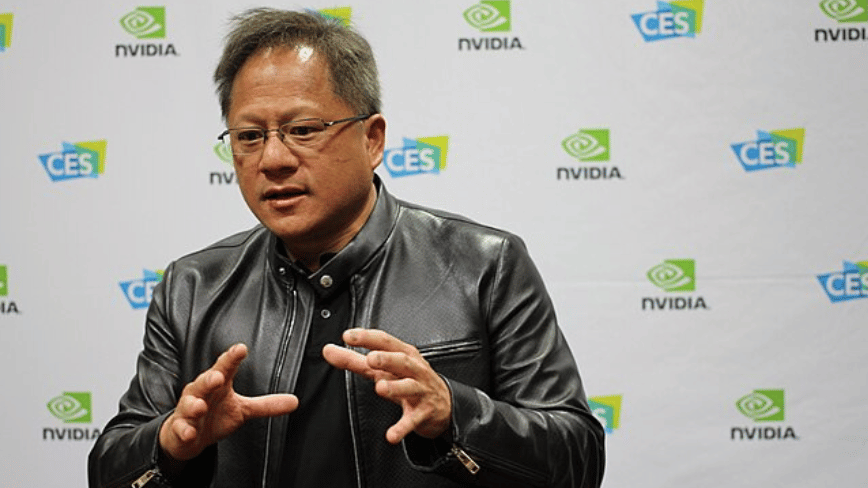

Nvidia CEO Jensen Huang recently expressed concerns on the Dwarkesh Podcast regarding DeepSeek’s decision to optimize its AI models for Huawei’s Ascend chips instead of using American hardware, calling it a potential “horrible outcome” for the United States. This shift signifies a threat to the technological leverage that has bolstered American dominance in AI, as DeepSeek plans to launch its V4 model on Huawei’s Ascend 950PR processor. The transition from Nvidia’s CUDA framework to Huawei’s CANN framework could dismantle the software-hardware dependence that underpins American AI superiority, even as US legislators contemplate including DeepSeek on the entity list for export control.
Huang warned that if AI models are optimized for non-American tech stacks, and if China’s technology becomes standard globally, the US could be surpassed in AI capabilities. This is significant given that Nvidia has largely benefited from its GPUs and CUDA framework being the basis for cutting-edge AI models worldwide.
DeepSeek is set to launch V4, a foundation model developed to run on Huawei’s new Ascend processor. Reports suggest V4 was trained on Nvidia’s Blackwell chips, potentially violating US export controls, though these claims may not conflict since models can be trained on one set and deployed on another. The migration to Huawei’s CANN breaks Nvidia’s ecosystem reliance, where CUDA software has been a controlling factor beyond chip hardware, often influencing export limits.
During its V3 model launch, DeepSeek utilized 2,048 Nvidia H800 GPUs, banned from China in 2023. Known for competitive models with fewer resources, DeepSeek aims to demonstrate V4’s success without American hardware, proving an alternate AI development route.
Despite American chips being significantly more powerful than their Chinese counterparts, Huang’s concerns lie beyond performance gaps, hinting at China’s potential to catch up due to available energy resources and a sizable pool of AI researchers. If V4 performs effectively on Ascend chips, it could validate an alternative AI progression independent of Nvidia’s supply chain.
Highlighting export control contradictions, Nvidia started China-facing production of the H200 chip, yet faced blockades by Chinese protections for Huawei. This approach may be accelerating Chinese alternative development instead of limiting capabilities. DeepSeek previously faced issues with its R2 model on Huawei hardware, a critical inference for training’s intense compute-need but viable for commercial inference use.
US lawmakers push for tougher restrictions, accusing China of exploiting and stealing AI advances, suggesting export control entity evaluation for firms like DeepSeek. Huang’s forecast emphasizes software-hardware co-design, underlining Nvidia’s reliance not solely on chip quality but also on CUDA’s development ubiquity. Shifts suggest the CUDA/Nvidia dominance may erode if competitive models emerge through non-Nvidia paths.
Although Huawei is not immediately overtaking Nvidia, and performance gaps remain visible, Huang’s warnings focus on future trends. DeepSeek’s progress could inspire others, potentially weakening Nvidia’s market position, long protected by CUDA’s moat. If V4 performs successfully on Huawei hardware, Huang’s remarks transform from mere corporate cautioning to pivotal AI chip war predictions.