
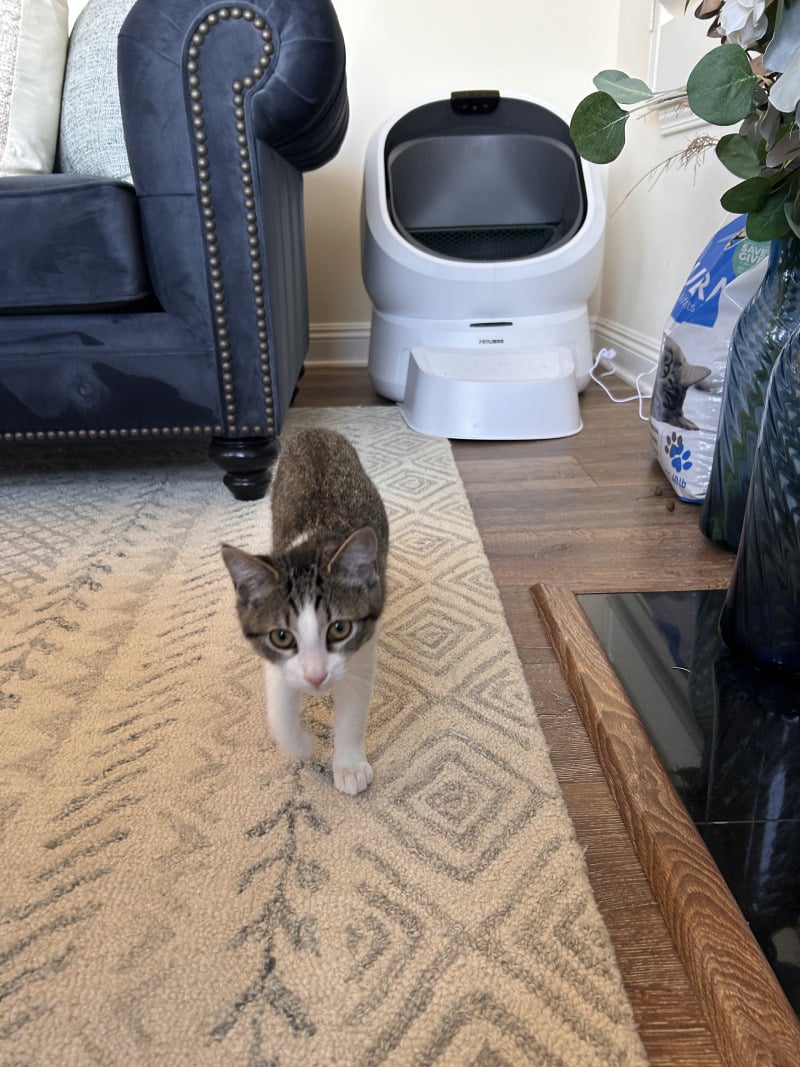

As a lifelong cat owner, the one chore I dislike the most is cleaning the litter box. Despite my efforts to understand why, I’ve not had much success. It’s not particularly gross or tedious if done daily. However, when Petlibro released its first automatic litter box shortly after I adopted a kitten, it seemed like an answer from the universe.
My kitten, Mouse, helped me test the Petlibro Luma Smart Litter Box, with and without its AI features. After three and a half months, and significant growth for Mouse, here are my thoughts on this Litter-Robot alternative.
The Petlibro Luma Smart Litter Box is priced at $599.99. This includes a litter mat and filter (pre-installed), an additional filter for different types of litter, 15 waste bags, a removable step, and a carbon filter. While pricey, it’s cheaper than the $749 Litter-Robot 4 and the more expensive $799 Litter-Robot 5 and $899 Litter-Robot 5 Pro. It’s the same cost as the Litter-Robot Evo, but more expensive than the $119.99 PetSafe ScoopFree.
This pricing suggests Petlibro aims to offer an elevated automatic litter box experience to rival the Litter-Robot, but at a slightly lower cost.
Besides the upfront cost, the Luma requires replacement of the carbon air filter ($19.99) every one to three months and the interior litter mat ($29.99) every 90 days. Additional AI features can be accessed with a subscription:
1. Video Cloud AI Standard: $95.99/year for one Luma device, with a seven-day video history and smart summaries.
2. Video Cloud AI Premium: $135.99/year for one device, with a 30-day video history.
3. Video Cloud AI Premium Family: $159.99/year for up to three devices.
These AI features aren’t required but offer valuable health monitoring for your pet. During testing, I used the AI premium subscription, provided by Petlibro.
The Petlibro Luma Smart Litter Box performs automatic cleaning with odor control, multi-cat detection, and safety features such as weight and motion sensors. With AI, it offers waste analysis, video cloud storage, and long-term health analytics. For basic cleaning, the central part rotates back to deposit waste, with air purification running simultaneously. This cleaning process takes one to two minutes and pauses if your cat is nearby.
Maintenance is simple, with notifications for cleaning the waste drawer every two weeks. The central drum can be cleaned easily, which proved less cumbersome than complaints about the Litter-Robot’s mechanism found online.
Performance is seamless, with the waste drawer effectively containing odors until emptied. The app provides real-time notifications about your cat’s activity and a live video feed with AI features. Without AI, it tracks usage, weight, and provides notifications about daily habits and needed maintenance.
AI features include waste identification and video analysis, with improved accuracy through corrections. Monthly, the app provides a summary video of your cat’s activity. Health trends, such as changes in weight or litter usage, are easily tracked.
Concerns about safety from the box’s rollback design are addressed by sensors ensuring the cleaning only happens when the box is vacant. Safety features, including a child lock, ensure peace of mind during operation.
In comparison to the Litter-Robot, the Petlibro Luma offers competitive features. The Luma’s enclosed design appeals to cats preferring privacy. Petlibro also accommodates up to 10 cats, while the Litter-Robot Evo isn’t recommended for more than two.
In conclusion, for those seeking a high-end litter box without the Litter-Robot’s cost, the Petlibro Luma is a worthy option, particularly for multi-cat households and those desiring AI features. The value is better, especially if bought on sale.