
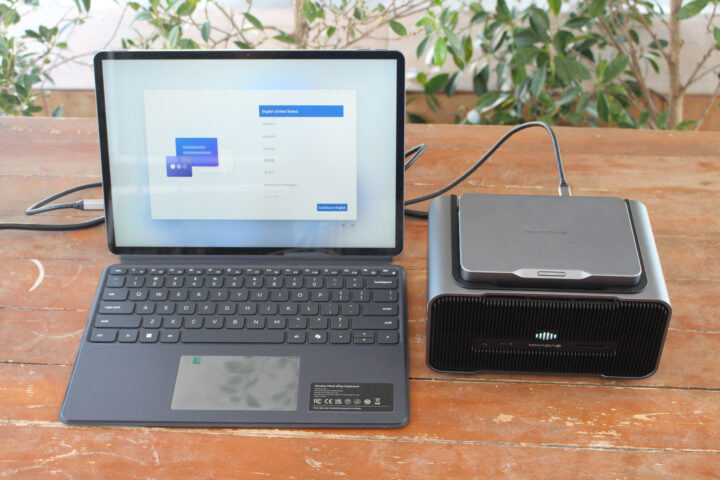

Khadas has provided the Mind Graphics 2 dock, Mind xPlay portable display and keyboard, and the Mind 2 mini PC for evaluation. In the initial section of the review, I will outline the specifications, unbox the three packages, dismantle the graphics dock, and initially test the xPlay and Mind Graphics 2 with the mini PC.
While the Mind 2 is utilized for testing, detailed coverage isn’t included here since it’s almost identical to the Mind 2 AI Maker Kit evaluated last year. Instead, forthcoming sections will feature reviews of the xPlay with it, the first-generation Mind, and possibly another platform capable of USB-C video output. Afterward, there’ll be comprehensive testing of the Khadas Mind 2, exploring its graphics and AI performance with the integrated NVIDIA GeForce RTX 5060 Ti 16GB card, and assessing all functionalities. Plans include finishing the Creality Sermon S1 3D scanner review since the Mind 2 and Graphics 2 dock combination meets or surpasses the scanner’s substantial hardware needs for optimal performance (frame rate).
Khadas Mind xPlay specifications
I previously mentioned the xPlay when the Mind mini PC debuted but never delved into specifics. Let’s do that now.
xPlay specifications:
Mind xPlay Portable Display
Display
13-inch LCD with 2880 × 1920 resolution
Refresh Rate – 60Hz
Color Gamut – 100% sRGB
Brightness – 500 nit
Audio
Dual microphone with a pickup range of about 2 meters
Stereo speakers (2x 2W)
Camera – 2 MP webcam
USB
1x USB-C input port
1x USB-C output port
Expansion – Custom Mind Link interface for Khadas mini PCs
Misc
Power, Volume Up/Down buttons
Magnetic keyboard port
Adjustable Stand – 0°–120°
Battery & Power
Power Input: 20V/5A (max) via USB-C or Mind Link
Battery – Capacity: 4,150 mAh; energy: 47.94 Wh
Dimensions – 290.5 × 199.95 × 9.5 mm
Weight – 820 grams
Mind xPlay Keyboard
Designed for the Mind xPlay Portable Display
Connection to xPlay – Magnetic attachment
Keyboard Layout – 79 keys; note: I can only see “Global” and “Korean” options
Touchpad – High-precision touchpad (polling rate > 120 Hz)
Key Functions – Copilot key and Custom key to switch work modes, set key combinations, or launch files and apps
Dimensions – 293 × 215 × 6 mm
Weight – 340 grams
Khadas Mind Graphics 2 specifications
Just launched earlier this year, the Mind Graphics 2 dock is newer.
Mind Graphics 2 specifications:
Graphics Card – NVIDIA GeForce RTX 5060 Ti Blackwell GPU with 16GB GDDR7 VRAM, up to 180W power
Storage – Full-size SD 4.0 card reader up to 200 MB/s
Video Output
2x HDMI 2.1b ports up to 4K @ 480Hz or 8K @ 165Hz
1x DisplayPort 2.1b port up to 4K @ 480Hz or 8K @ 165Hz
Multiple display support
Up to 3x independent displays at 4K 165Hz
Up to 2x independent displays at 4K 360Hz or 8K 100Hz
Up to 4x independent displays when including the Mind 2/2s mini PC’s HDMI port
Audio
3.5mm headphone jack
Dual microphone
Stereo speakers
Networking – 2.5GbE RJ45 port
USB
USB4 Type-C (40 Gbps) port; note: usable as Thunderbolt 3/4/USB4 eGPU port when the Mind 2 is not connected through the Link connector.
USB 3.2 Gen2 Type-C (10 Gbps) port with PD output up to 5V/3A
2x USB 3.2 Gen2 (10 Gbps) USB ports
Expansion – Custom Mind Link (PCIe Gen4 x8) interface for Khadas mini PCs
Misc
Fingerprint reader (press to mute)
Volume buttons
Power Supply – Integrated 350W GaN PSU
Dimensions – 199 x 133 x 100 mm
Weight – 3 kg
Khadas Mind xPlay, Mind Graphics 2, and Mind 2 unboxing
I received three packages for the Mind Graphics, Mind xPlay, and the Mind 2 mini PC.
The Mind 2 package reveals the Mind 2 mini PC with two USB-C ports, HDMI video output, two USB ports, a 65W USB PD power adapter, and a USB