
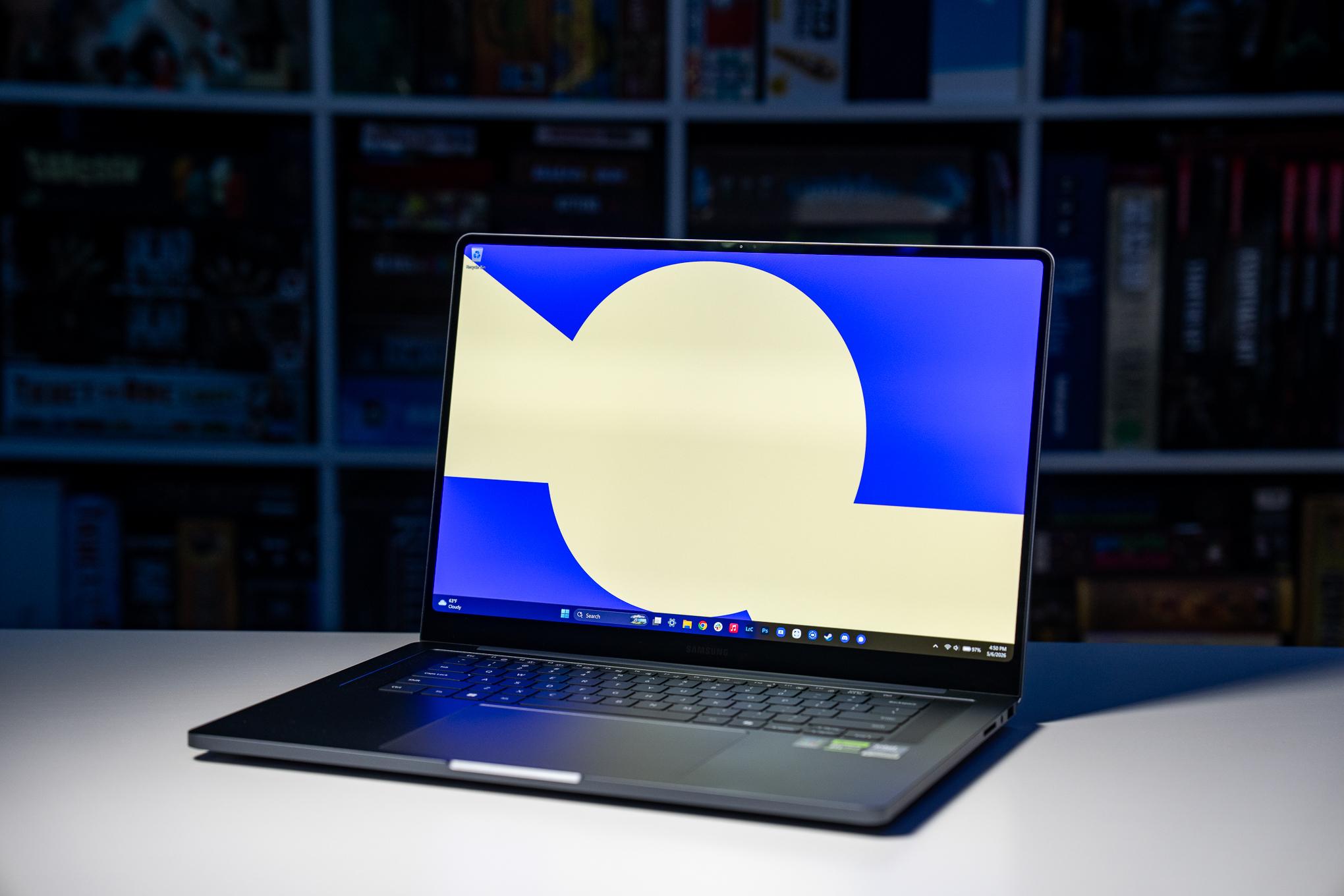

The Samsung Galaxy Book6 Ultra is a high-priced Windows laptop with some significant drawbacks that are difficult to ignore.
I know I’m not the only one looking for a Windows equivalent of the MacBook Pro: a sleek, ultra-powerful, super-portable machine with a great screen and high-quality construction. Samsung’s Galaxy Book6 Ultra certainly aims for this. It features a stunning screen and attractive design, and it’s as solidly built as laptops get.
It also closely resembles a MacBook Pro, to the point where I sometimes use the wrong keyboard shortcuts out of habit. While other Windows laptops have adopted certain MacBook design elements, the Galaxy integrates so many that Samsung’s intent is clear.
Imitating desirable features makes sense, but Samsung also repeats some of Apple’s past mistakes, such as a poor keyboard and webcam. Moreover, it’s priced like a premium MacBook Pro but doesn’t deliver comparable performance.
“Good artists copy, great artists steal.” But what if they fail in their attempt?
The Galaxy Book6 Ultra starts at $2,900 with a 16-core Core Ultra X7 358H chip and integrated Intel Arc B390 graphics. Our review model has an Intel Core Ultra 7 356H processor paired with an Nvidia RTX 5070 Laptop GPU, along with 32GB of soldered RAM and a 2TB SSD, priced at $3,200 before a RAM price surge drove costs up. Now, it’s priced at a hefty $3,800 with a 1TB SSD, just $100 less than a 16-inch MacBook Pro with M5 Max, 36GB of memory, and a 2TB SSD.
As expected from Samsung, the display is outstanding. The 16-inch, 2880 x 1800 OLED touchscreen is bright and clear, with vibrant colors and perfect contrast. The 120Hz adaptive refresh rate ensures smooth motion.
Like a MacBook Pro, the Galaxy Book6 Ultra includes Thunderbolt and HDMI 2.1 ports and an SD card slot. While Macs feature three Thunderbolt 5 ports, the Samsung offers two Thunderbolt 4 ports and a USB-A slot. Regardless, it offers a useful port selection for demanding users and creators, although Thunderbolt 5 would have been preferable at this price, but Panther Lake lacks native support for it.
The Book6 excels in performance, handling multitasking and heavy edits in Lightroom Classic with ease. It slows slightly with complex edits, but this is expected on most laptops besides high-end Macs.
The discrete graphics allow for gaming titles like Battlefield 6 and Marathon to run reasonably well, although the underside of the chassis can get very hot.
The Intel Panther Lake CPU and Nvidia RTX 5070 make the Book6 a sleeper in gaming performance, exceeding MacBooks in this area. However, its $3,800 price tag could get better performance from gaming-specific laptops or similar performance from less costly options like the Razer Blade or Asus ROG Zephyrus. Unfortunately, this isn’t enough for a laptop approaching $4,000. It benchmarks closer to a $1,700 MacBook Pro with the base M5 chip, though it excels in graphic-heavy tests. Apple leads in single-core performance, which impacts multicore capabilities as well.
Battery life is inconsistent, spanning over 10 hours on light days but dropping to seven hours under similar conditions. Though other Panther Lake laptops offer better endurance, Nvidia uses more power. Macs, by contrast, are inherently more consistent due to their optimized integrated graphics.
The speakers are good, but lack depth and bass compared to Apple’s high-end laptops. The biggest misstep is the keyboard, with insufficient key travel and comfort, similar to Apple’s past butterfly keyboards. I often type with an external keyboard over it.
The haptic trackpad has a large active area but suffers from occasional delayed clicks and repeated inputs. The webcam is also a drawback, presenting a grainy and smoothed appearance.
Samsung wants its flagship to be a MacBook Pro for Windows. It has a nice design and good performance, but fails on numerous basic aspects. It’s priced like an M5 Max MacBook Pro but performs like a lower-cost model, lacking the stellar battery life. You might as well get the real thing.
Samsung Galaxy Book6 Ultra specs (as reviewed):
– Display: 16-inch (2880 x 1800) 120Hz OLED touchscreen
– CPU: Intel Core Ultra 7 356H
– GPU: Nvidia GeForce RTX 5070 Laptop GPU
– RAM: 32GB LPDDR5X (soldered)
– Storage: 2TB NVMe SSD with second storage slot
– Webcam: 1080p
– Connectivity: Wi-Fi 7, Bluetooth 5.4
– Ports: 2x Thunderbolt 4 USB-C (DisplayPort / Power Delivery), 1x USB-A 3.