
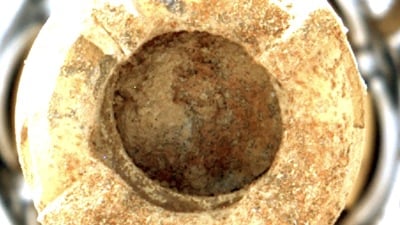

It’s surprisingly simple. By Elisha Sauers on May 13, 2026. NASA’s Perseverance rover closely examines the Cheyava Falls rock sample, potentially hinting at ancient microbial life, within its drill bit on July 21, 2024. Credit: NASA / JPL-Caltech / ASU / MSSS
Two rovers have made significant advancements in determining whether Mars hosted life. Curiosity, exploring Gale Crater, conducted an experiment on a rock sample revealing complex carbon compounds. Meanwhile, Perseverance, situated 2,300 miles away at Jezero Crater, discovered fossilized material that could have been excreted by an ancient microorganism. Despite these promising leads, NASA remains uncertain if these organic molecules were produced by ancient life forms or resulted from other processes, such as chemical reactions between rock and water. Due to instrument limitations, it is unlikely that this possibility will be ruled out unless the samples are brought back to Earth.
“This finding by our incredible Perseverance rover is the closest we’ve actually come to discovering ancient life on Mars,” said Nicky Fox, NASA’s associate administrator for science, last year. Yet a new approach by scientists might help close the gap of ambiguity. Instead of searching for specific molecules, the idea focuses on studying the overall pattern of chemicals within a sample. Researchers compared samples from living organisms, fossils, ocean sediments, meteorites, and laboratory experiments simulating early Earth or space chemistry. They concentrated on amino acids, which form proteins, and fatty acids, which contribute to cell membranes, finding that life organizes chemicals differently.
A recent study found a strong statistical divide between biological and nonbiological samples. Published in Nature Astronomy, it suggests molecular diversity in a sample might not definitively detect aliens but could provide substantial evidence. “Astrobiology is fundamentally a forensic science,” said Gideon Yoffe, lead author of the paper and a researcher at the Weizmann Institute of Science in Israel. “We’re trying to infer processes from incomplete clues, often with very limited data collected by missions that are extraordinarily expensive and infrequent.”
The study noted that biological samples typically had a wider variety and more organized mix of compounds as cells create many compounds for specific functions. In contrast, abiotic samples appeared sparse, dominated by a few simple amino acids. Some contaminated meteorites leaned closer to the biological group, suggesting that life alters chemical patterns recognizably.
However, biological samples that experienced damage from heat, radiation, or age resembled nonliving chemistry due to loss of molecular diversity over time. In particular, ancient rocks, fluids from hydrothermal vents, and some fossils exhibited signs of this deterioration. Researchers found that while radiation might erase the biological signal, diversity patterns often survived significant chemical damage, such as on Europa, Jupiter’s moon.
Fatty acids showed the opposite trend but still effectively distinguished life from non-life. Biological samples had fewer fatty acids due to consistency in the set of fatty acids used for membranes, whereas nonliving chemistry resulted in broader, more uniform mixtures.
This statistical strategy could enhance current space missions focused on chemical analysis and life-detection tests. Scientists often look for unusual isotope ratios or molecular “handedness,” but such signals may fade over time and require sensitive instruments. Curiosity and Perseverance might conduct this statistical test if the rovers detect a wide range of related organic compounds and accurately measure their relative abundances, says Fabian Klenner, a UC Riverside assistant professor of planetary sciences and coauthor of the paper.
The technique could be particularly helpful for NASA’s Dragonfly aircraft, expected to explore Saturn’s icy moon Titan in the mid-2030s. The aircraft will have a mass spectrometer to analyze and characterize organic molecules. “Dragonfly is another interesting case,” Klenner mentioned to Mashable. “If it can resolve organic molecules and their relative abundances, then I would love to see our diversity approach applied to the data.”
Elisha Sauers writes about space for Mashable, taking deep dives into NASA’s moon and Mars missions, chatting with astronauts and discoverers, and flying above the clouds. Over 17 years, she’s covered various topics including health, business, and government, with a penchant for public records requests. She worked for The Virginian-Pilot in Norfolk, Virginia, and The Capital in Annapolis, Maryland. Her work has earned state awards, including the Virginia Press Association’s top honor, Best in Show, and national recognition for narrative storytelling. For each year covering space, Sauers has won National Headliner Awards, including first place for her Sex in Space series. Send tips and story ideas to [email protected] or text 443-684-2489. Follow her on X at @elishasauers.