
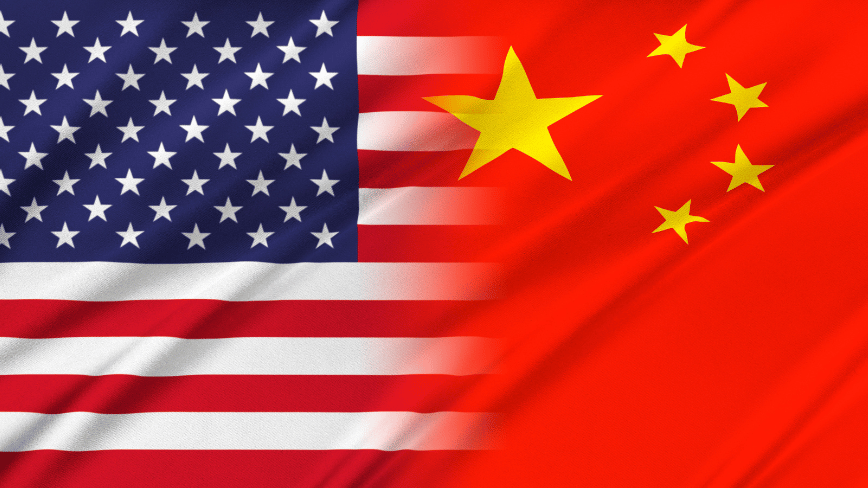

Summary: Stanford’s 2026 AI Index Report reveals a narrowing performance gap between leading American and Chinese AI models, now just 2.7%, down from 17.5-31.6 percentage points in May 2023, despite the US spending more on private AI investment ($285.9 billion vs $12.4 billion). China excels in AI patents (69.7% of global filings), publications (23.2% of global output), industrial robot installations (9 times the US rate), and energy infrastructure. Meanwhile, AI talent migration to the US has decreased by 89% since 2017.
According to the 2026 AI Index Report by Stanford University’s Institute for Human-Centered Artificial Intelligence, the performance gap between top American and Chinese AI models has reduced to 2.7%. In May 2023, this gap was 17.5 to 31.6 percentage points. As of March 2026, Anthropic’s Claude Opus 4.6 leads with an Arena score of 1,503, while ByteDance’s Dola-Seed-2.0-Preview scores 1,464. DeepSeek’s R1 matched a top US model in February 2025, with leadership traded between American and Chinese models.
This 423-page report, the most extensive annual evaluation of the global AI landscape, informs us that the US’s private AI investment is 23 times greater than China’s, yet America leads in model performance by less than three percentage points. The report questions whether this spending helps maintain US leadership or if China has found alternative competitive methods.
Leading Roles
The United States dominates with $285.9 billion in private AI investment, compared to China’s $12.4 billion. California contributes $218 billion alone. American companies produced 50 AI models last year, while China’s number doubled to 30 from the previous year’s 15. The US has 5,427 data centers, over ten times more than any other country.
China leads in volume: it contributes 23.2% of all global AI publications, with 20.6% of citations, compared to the US’s 12.6%. Chinese entities filed 69.7% of all AI patents globally. China installed 295,000 industrial robots, nearly nine times the US’s 34,200. China maintains an 80% electricity reserve margin, twice the necessary capacity, while the US power grid suffers from underinvestment, identified in the report as a potential AI infrastructure growth bottleneck.
However, the investment figures may underestimate China’s actual AI spending, as resources are channeled through government-guided funds and state-initiated investments, not recorded in private databases. The 23-to-1 spending ratio may be less pronounced than it seems.
Talent Challenges
The report’s most notable finding involves people: AI scholars migrating to the US have dropped 89% since 2017, with 80% of that decline in the last year. This drop is described as “precipitous.” Switzerland now ranks first globally in AI researchers and developers per capita.
This talent migration challenges the notion of secure American AI leadership due to investment advantages. Without researchers choosing the US, investments purchase hardware and infrastructure but lack the intellectual capital to turn resources into capabilities. In January 2025, DeepSeek matched a top Silicon Valley model with fewer resources, indicating that such conditions are intensifying.
AI Limitations
The report notes performance improvements that seemed implausible two years ago. For SWE-bench, a coding benchmark, performance rose from 60% to nearly 100% in one year. Graduate-level science question accuracy hit 93%, above the expert human baseline of 81.2%. Google’s Gemini Deep Think earned a gold medal at the International Mathematical Olympiad. Frontier models improved by 30 percentage points on Humanity’s Last Exam.
Still, the report highlights a “jagged frontier.” The top model correctly reads analog clocks just 50.1% of the time, and robotic manipulation systems have 89.4% simulation success but only 12% in real household tasks. Nearly half of the clinical AI studies reviewed use exam-style questions rather than real patient data; only 5% used actual clinical records. There remains a significant gap between benchmark performance and real-world reliability, where errors matter.
Adoption and Regulation
Generative AI achieved 53% population adoption within three years, faster than the PC or internet. Eighty-eight per cent of organizations report AI use, and four in five university students use generative AI tools