
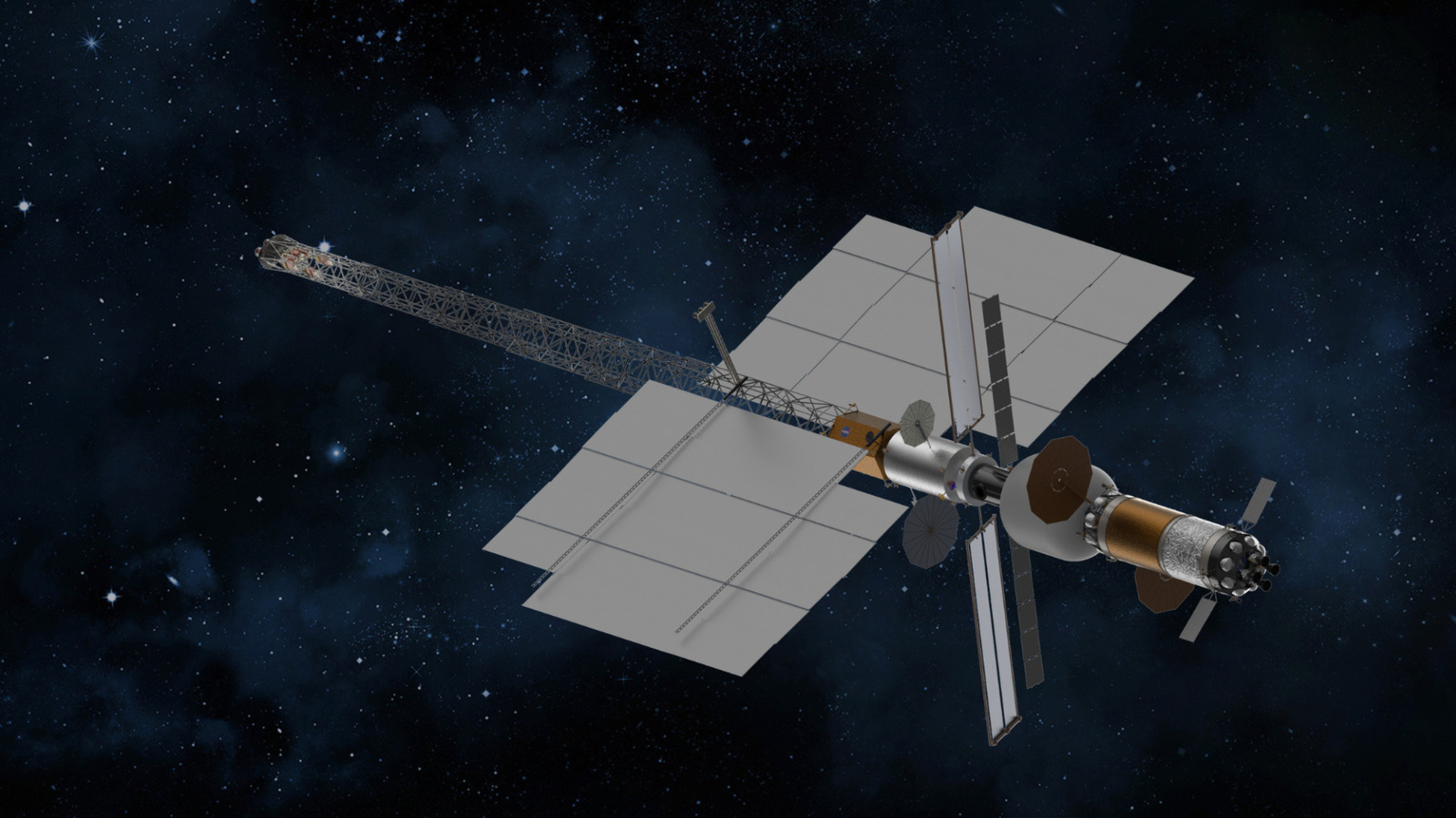

NASA’s upcoming mission resembles an Andy Weir space saga more than a government initiative. Unveiled at NASA’s March 2026 ‘Ignition’ occasion, NASA is pushing towards its inaugural nuclear-powered journey to Mars. The vehicle designated for the task, named Space Reactor-1 Freedom, aims to be the first spacecraft to implement nuclear electric propulsion in deep space, marking a potentially groundbreaking advancement in humanity’s exploration of the vast frontier.
Scheduled conveniently for the closing month of President Trump’s administration, NASA officials are touting the mission as a part of the president’s National Space Policy, which seeks to “broaden the horizon of human exploration, safeguard the nation’s crucial economic and security interests, spur commercial growth, and lay the groundwork for a new era in space.” These efforts are part of an expedited blueprint aimed at establishing “American preeminence in space.” They encompass intensifying the agency’s lunar landing initiatives, including a new phased plan to establish a consistent lunar base, transforming its low-earth orbit strategy in light of the forthcoming decommissioning of the International Space Station, and investing in nuclear electric propulsion. How the administration intends to realize these aspirations while cutting NASA’s scientific budget by fifty percent remains a significant concern.
Per NASA’s disclosure, SR1-Freedom will facilitate the agency’s Skyfall mission to the Red Planet. Skyfall, a joint venture between UAV manufacturer AeroVironment and NASA’s Jet Propulsion Laboratory, aims to examine Mars’ surface using a squadron of three remotely piloted helicopters. If successful, NASA’s delivery system could eclipse its Mars exploration initiative, representing a pivotal moment for the country’s endeavors in space exploration. Nevertheless, experts express skepticism regarding the agency’s declared timeline. Ultimately, NASA anticipates that this mission will provide insights for its Lunar Reactor-1 program, which aims to establish the agency’s inaugural permanent nuclear-powered lunar base.
How it operates
Nuclear propulsion could enhance the distance, duration, and pace of space travel. Present rockets operate on chemical propulsion, where a blend of liquid hydrogen and oxygen ignites to create an explosive reaction. While chemical propulsion generates enough thrust for journeys within Earth’s immediate vicinity, nuclear energy offers a more potent and efficient reaction, allowing spacecraft to travel faster and longer than traditional propulsion methods. Incorporating nuclear reactors might also address NASA’s solar issue. Currently, most spacecraft rely on solar energy for their electrical needs, meaning power supplies diminish as they move further from the Sun. NASA indicates that a spacecraft’s solar energy drops to 4% upon reaching Jupiter. By transitioning to nuclear space travel, NASA could surpass its present exploration boundaries.
Nuclear spacecraft replicate the processes employed in terrestrial reactors, wherein uranium is bombarded with neutrons to produce a significant fission reaction. Gas turbines transform the generated heat into electricity, which ionizes the spacecraft’s gas propellant into plasma, propelling its thrusters. This reaction is considerably more efficient than standard chemical fueling techniques. Utilizing a different type of uranium than their terrestrial equivalents, a nuclear thermal reaction achieves roughly ten times the power density of conventional reactors, reducing missions’ fuel demands to a mere fraction of the immense quantities required by chemically driven rockets.
Importantly, nuclear propellant lacks the initial thrust required to attain orbit, consequently relying on traditional boosters for launch. Nevertheless, nuclear fission facilitates spaceships to gradually accelerate to speeds unattainable by their chemically fueled predecessors. Future endeavors utilizing more potent nuclear thermal propulsion could reduce a journey to Mars by over two-thirds. Some speculate that astronauts could soon reach the outer solar system in just two years.
Moving forward
Nuclear space travel isn’t as implausible as it appears. During the ’50s and ’60s, for example, both the USSR and U.S. launched nuclear reactors into orbit. Additionally, radioisotope thermoelectric generators, or RTGs, have been employed in numerous NASA missions. SR-1 Freedom will shift the utilization of nuclear reactors from generating spacecraft’s electrical power to serving as its primary thrust mechanism. It is noteworthy that American efforts to exploit nuclear propulsion have faltered due to financial and safety concerns. The latest attempt, known as DRACO, fell victim to the administration’s significant 2025 budget cuts affecting the agency.
NASA plans to launch “an American industrial campaign” in collaboration with the Department of Energy to meet its 2028 deadline. Instead of opting for a more powerful and complex thermal propulsion system, SR-1 will implement a more straightforward electric power-and-propulsion system repurposed from NASA’s now-defunct Gateway lunar space station. Reports suggest that this electrical framework will be connected to a DOE-designed nuclear reactor, which NASA Administrator Jared Isaacman claimed is “largely completed.”
While the scientific community holds a hopeful outlook regarding its potential, many harbor doubts about the timeline. Individuals consulted by Science, for example, remarked that a mission akin to SR-1 would typically take three to five years to design and construct.