
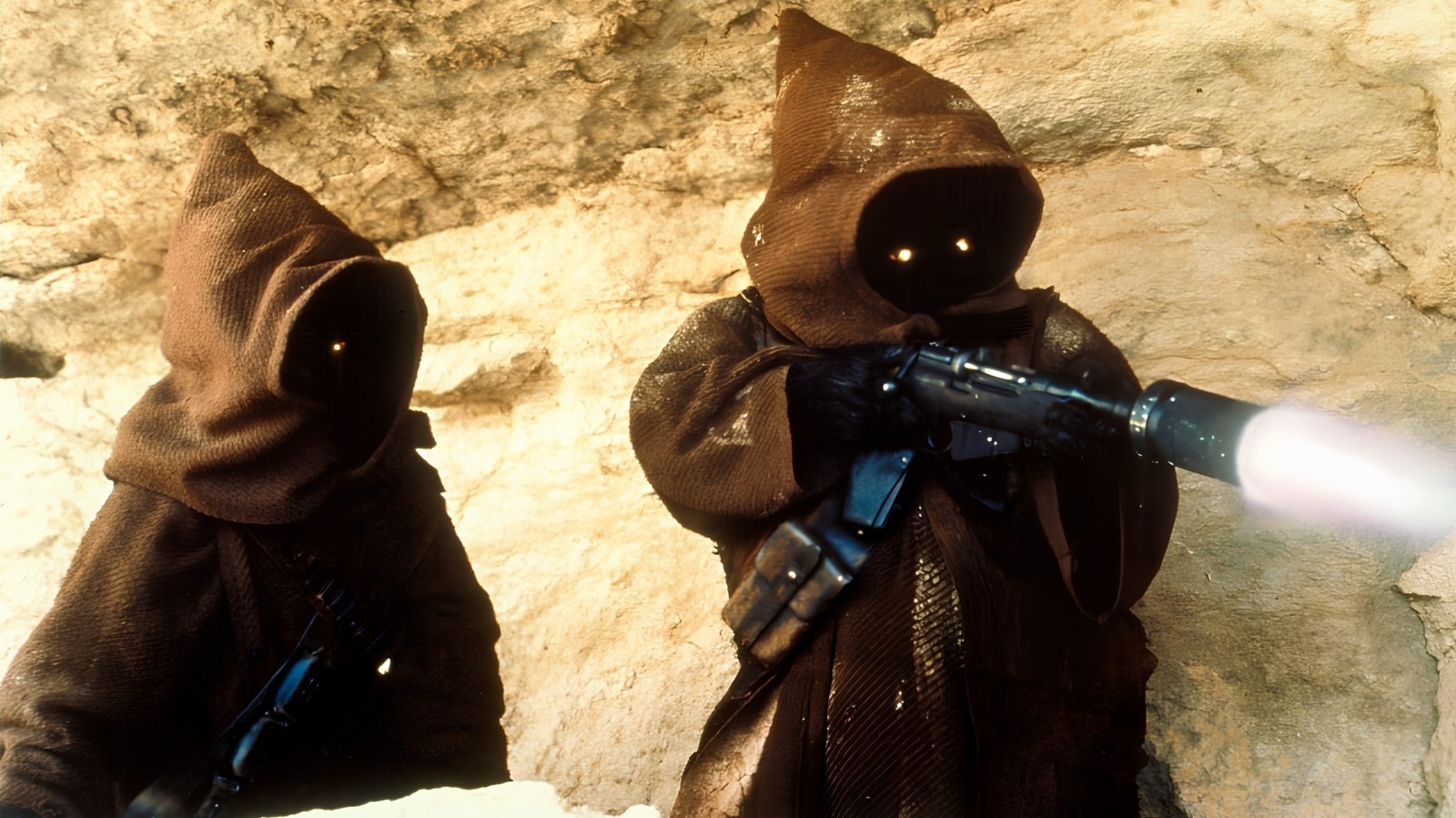

When reflecting on the twin sunset of Tatooine in “Star Wars: Episode IV – A New Hope,” one of the initial thoughts that may come to mind is Jawas. These cloak-wearing, luminous-eyed nomads and junk merchants seem perpetually in motion, existing as itinerant scavengers who roam the dunes of Tatooine, taking residence in massive Sandcrawler vehicles. This practice of gathering mechanical remnants, dismantling starships, and trading with moisture farmers will persist in some of the most thrilling “Star Wars” films and series that are currently being developed.
Yet, behind-the-scenes insights indicate that Jawas almost had a more settled way of life in a discarded production sequence that would have transformed their cultural persona by assigning them permanent residences. George Lucas ultimately rejected the notion during the initial stages of development, prior to his filming crew capturing a single frame on-location in Tunisia. This solitary choice nearly altered our perception of Anakin and Luke Skywalker’s home planet, significantly changing the portrayal of one of the franchise’s most legendary alien races on a desert world in a galaxy not so far away.
George Lucas imagined a permanent dwelling for Jawas
During preliminary location scouting in Tunisia, the “Star Wars” production team encountered unique indigenous architecture that dramatically shifted the director’s original vision. George Lucas elaborated on this finding in a discussion with Rolling Stone, revealing that his team discovered grain storage structures towering four stories high. These buildings had small doors and windows, with Lucas likening the setting to a hobbit village. This inspired him to conceive a scene showcasing a complete Jawa community, inhabited by “these little hobbit-world slum dwellers” living collectively.
Rather than existing as a wandering tribe, Jawas would have resembled settled townsfolk or indigenous people, according to Lucas. These grain houses would eventually serve as the backdrop for the quarters of Anakin and Shmi Skywalker in “Star Wars: Episode I – The Phantom Menace.” However, the constraints of a limited production budget prevented audiences from witnessing this distinctive scene on the silver screen. The selected Tunisian location was too distant from the principal filming site. Thus, Lucas — who anticipated that viewers would dislike “Star Wars” — eliminated the entire segment, a choice that resulted in the Jawas evolving into the roaming scavengers we recognize today.
A video game revived the notion
Although it did not reach theaters, the idea of a stationary Jawa society did not entirely vanish from the “Star Wars” realm. In the “Star Wars Galaxies” video game, the concept of a fixed home for the Jawas re-emerged as a trading outpost. While “Star Wars Galaxies” is considered Legends and isn’t part of the official “Star Wars” Canon, the Jawa Mountain Fortress, also referred to as the Jawa Trading Outpost, from the game provided fans with a glimpse of what Jawas could become beyond their nomadic existence.
It stands as an excellent illustration of how much “Star Wars” lore is woven into video games, comics, books, board games, and more. Although the Jawa Mountain Fortress isn’t Canon, it suggests that the species could flourish outside their mobile Sandcrawlers. Much like Jodie Foster almost being cast as Princess Leia, this Jawa community would have undoubtedly altered crucial narrative elements of the original “Star Wars” film.