

The phone projection system will now completely fill unconventionally shaped screens, in addition to a variety of other improvements. It’s the biggest update in its 10-year history, says VP for Android Automotive Patrick Brady.
This week at I/O, Google rolled out a series of major updates for Android Auto that include better sizing for unconventionally shaped screens, video streaming through YouTube, widget support, and of course, more AI-powered Gemini features. The company also announced some updates for cars that run on Google’s built-in native software, including the ability to ask Gemini questions that are specific to the car you’re driving.
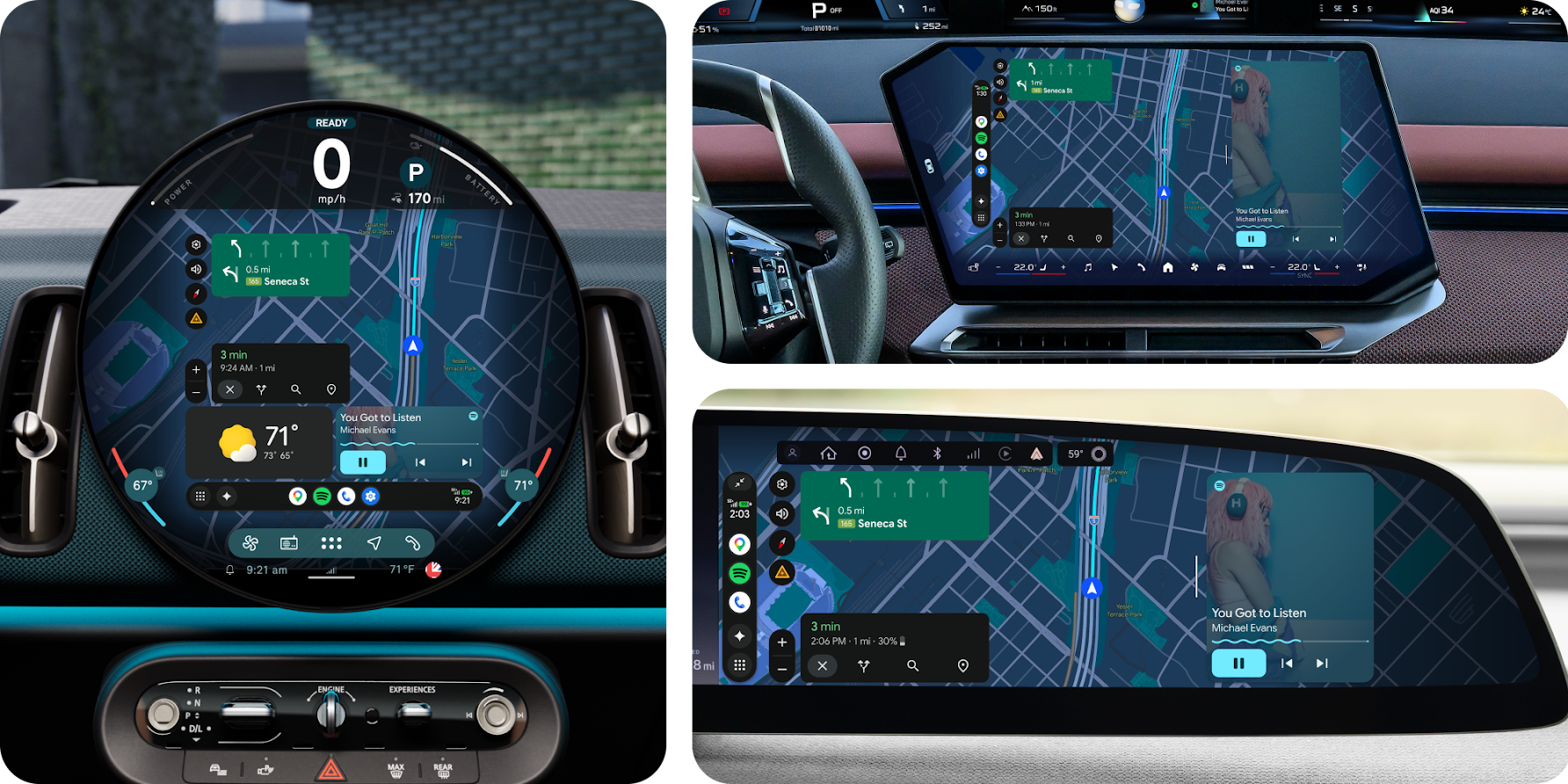
First off, it’s screen size. It used to be that in-car screens all came in the same basic shape. But now the standard rectangle has evolved into a variety of curved, panoramic, swooping, and even circular displays. Google is rising to the moment, announcing a new update that more accurately tailors Android Auto to any size screen.
Previously, phone projection systems behaved similarly to older videos on widescreen televisions, placing a standard rectangular interface inside a larger display area with unused margins around it. Google is now trying to embrace the full shape of each vehicle’s screen, said Patrick Brady, VP of Android Automotive at Google, citing unconventional screens like Lucid Air’s curved display or MINI Cooper’s circular one.
“You have the new BMW Neue Klasse that has an irregular trapezoid. I don’t even know the shape. It’s kind of parallelogram-ish,” Brady said in an interview. “I was like, man, I need to go back to geometry classes.” Brady said the new “full bleed” design would allow applications like Google Maps to fill the entire display regardless of geometry.
That will come in handy when streaming video on YouTube through Android Auto, which is another update that will arrive later this year. The feature, which only works while the vehicle is parked, supports 4K, 60-frames-per-second video playback, alongside spatial audio support using Dolby Atmos. All of this content will originate from the user’s phone rather than from a fully embedded system. The car informs the phone when it’s in park, which unlocks video functionality. According to Brady, users have been badgering the company for the ability to watch movies or videos while charging their EV, waiting in parking lots, or sitting outside schools.
Google is also bringing its new Material Three Expressive design language to Android Auto. When it was released last year, my colleague Allison Johnson described it as a more “youthful direction” for Android, “full of springy animations, bold fonts, and vibrant color absolutely everywhere.” Now, that design language is coming to Android Auto, which will inherit personalization cues from the user’s phone. That includes wallpaper-based color palettes and themes, giving Android Auto a more personalized and visually integrated appearance.
Another major update is widget support, in which Android users can project their personalized widgets for things like sports scores, smart home controls, one-tap contact shortcuts, garage door shortcuts, lighting controls, and more. And users will be able to use Google’s Gemini AI assistant to access their widgets using natural language. For example, a user could ask for sports scores, upcoming schedules, or calendar information, and Gemini would generate the appropriate response in Android Auto.
A new feature called “Magic Cue” can analyze incoming messages and proactively surface useful information. If someone texts you asking for an address or somebody’s phone number, Gemini can retrieve the relevant information from your phone and suggest a one-tap reply. Brady argues that this will hopefully reduce unsafe phone interaction while driving.
“We do driver distraction studies in a simulator,” Brady said. “We test the heck out of everything.”
Gemini is also improving as an agentic go-between with other apps on your phone. For example, drivers can now ask Gemini to place a pickup order through the Starbucks app. Brady explained that rather than rely on special API integrations, Gemini can operate apps like Starbucks and DoorDash in the background to place orders through Android Auto. Again, this will hopefully reduce drivers’ impulse to use their phone while speeding down the road.
The new “Immersive Navigation” view in Google Maps, which the company announced earlier this year, is now coming to Android Auto. When you start a navigation, the map will now feature refreshed colors, detailed 3D buildings, elevated roadways, realistic terrain, and even greenery.
A smarter, better fitting, more customizable Android Auto helps narrow the divide between phone projection and embedded software, Brady argues. Either way, Google usually wins. Even the vehicles that don’t allow phone projection, like EVs from Rivian, Chevy, and Cadillac, ultimately end up using the company’s native Android Automotive and Google built-in systems as its foundation. And many of Android Auto’s functions end up in embedded Android Automotive systems over time and vice versa.
That said, there are still limitations. Android Auto users, for