

After playing a key role in the lawsuit that led to the closure of media firm Gawker, Aron D’Souza perceived a flaw in the American media landscape: those feeling aggrieved by media coverage had limited means to contest it. His fix is a software solution. D’Souza’s latest venture, Objection, aims to leverage AI to assess the accuracy of journalism. For $2,000, individuals can initiate a challenge against a story, prompting a public scrutiny of its assertions. D’Souza is also behind the Enhanced Games, an Olympic-like event permitting performance-enhancing drugs, scheduled to launch in Las Vegas soon.
Objection made its debut on Wednesday with substantial seed funding from Peter Thiel and Balaji Srinivasan, along with venture capital firms Social Impact Capital and Off Piste Capital. Thiel, who partly financed the Gawker lawsuit in support of privacy rights, has consistently critiqued the media. D’Souza’s intention is to rebuild trust in journalism, claiming it has weakened over time. However, some critics, including media attorneys, caution that Objection might complicate the publication of investigative reporting that relies on anonymous sources to hold powerful entities accountable.
Anonymous informants have been crucial in uncovering significant cases of corruption and corporate malfeasance. These are typically individuals who risk reprisal for revealing crucial information. Journalists, along with their editors and legal teams, are responsible for ensuring these sources are credible and the information they offer is verified. However, D’Souza believes this isn’t sufficient, stating that the use of unverified anonymous sources would negatively impact an article’s credibility on Objection. The platform relies heavily on definitive evidence like official documents and emails, while anonymous claims are ranked lowest.
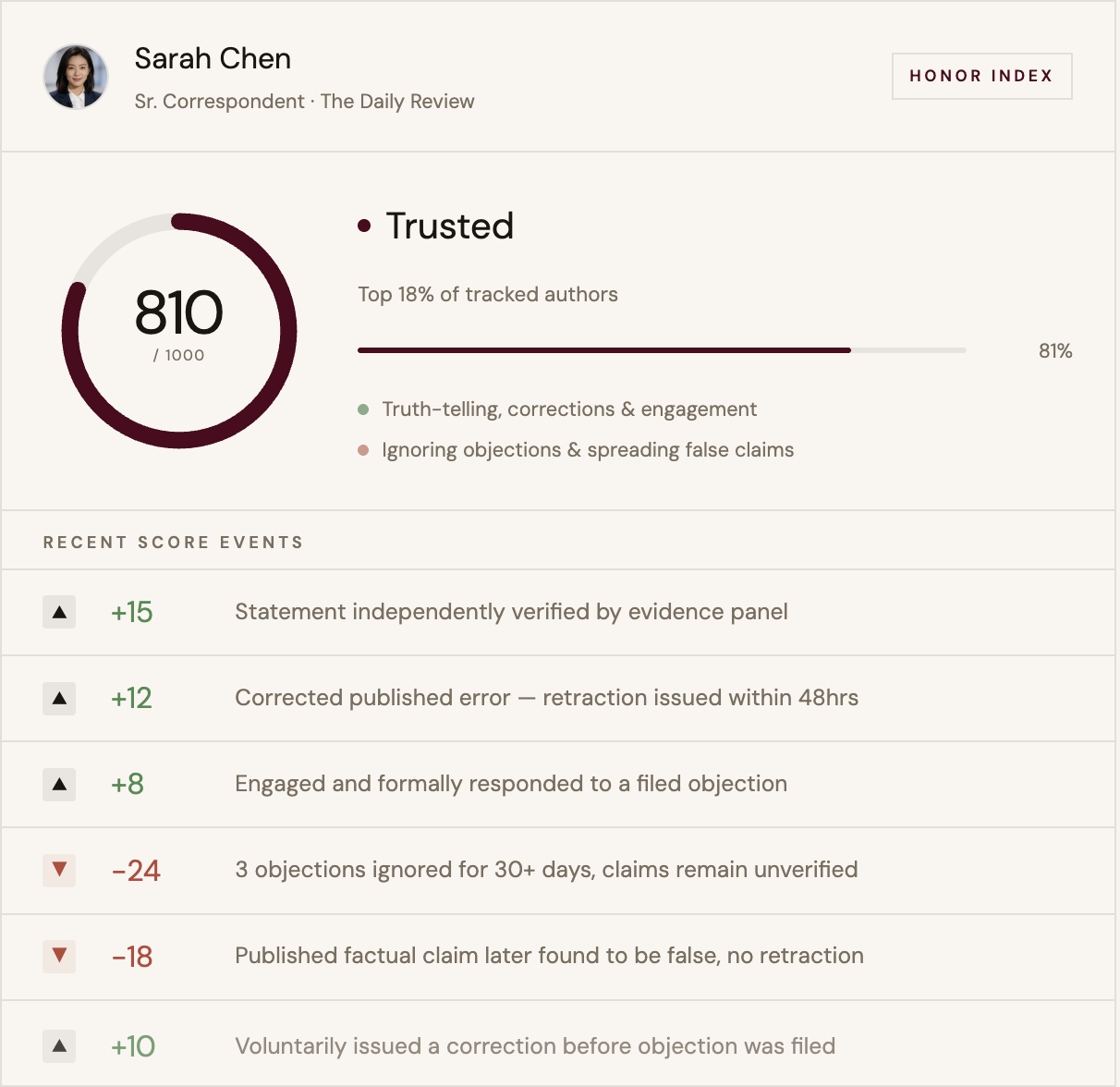
Objection’s evidence collection involves freelancers, including former law enforcement and investigative journalists, which feeds into its “Honor Index,” reflecting a reporter’s integrity and record. D’Souza argues that protecting source information is crucial, yet the lack of accountability for those sources is problematic. He presents a challenging choice for journalists: disclose sensitive information for Objection’s scrutiny or face penalties for shielding sources providing significant yet risky information. Critics argue that such technology could discourage whistleblowing.
Jane Kirtley, a media law and ethics expert, places Objection within an ongoing trend of undermining trust in journalism. Despite established journalistic ethics advising limited use of anonymous sources, Kirtley questions whether tech entrepreneurs unfamiliar with journalism can properly assess public interest. D’Souza maintains Objection isn’t about silencing whistleblowers but fact-checking, drawing parallels to community-driven truth-assessment tools like X’s Community Notes.
D’Souza sees potential benefits if Objection enhances transparency and trust, framing it as a “trustless system” guided by language models from companies like OpenAI, Anthropic, and others, promoting scientific scrutiny of factual disputes. Nonetheless, AI systems face challenges of bias and reliability, raising concerns about their role in truth verification. Objection targets tangible media outlets but applies broadly across content types, focusing challenges on individual factual points within articles.
Though each objection costs $2,000, the platform may appear to favor those with sufficient resources to engage it, raising concerns among critics. Kirtley and others suggest that it primarily serves powerful players able to exert pressure on journalism. Lawyer Chris Mattei characterizes it as disproportionately benefiting the rich, potentially hindering whistleblower activity. Objection evaluates disclosed evidence, potentially casting doubt on stories lacking comprehensive or available information.
D’Souza counters that journalists can protect their work by submitting evidence, but participation remains voluntary, leaving room for uncertainty if an “indeterminable” outcome arises. Even when confirming a story’s accuracy, Objection utilizes a feature named “Fire Blanket” to issue real-time warnings on disputed claims, potentially affecting public discourse.
First Amendment expert Eugene Volokh views the platform as fitting within the criticism landscape surrounding journalism, likening it more to opposition research than a direct threat to voice freedom. The platform’s impact depends on its adoption and influence on journalism’s evolving tech-integrated environment. As Kirtley questions placing AI over journalistic expertise for factual reliability, whether Objection reshapes the media landscape remains uncertain.