
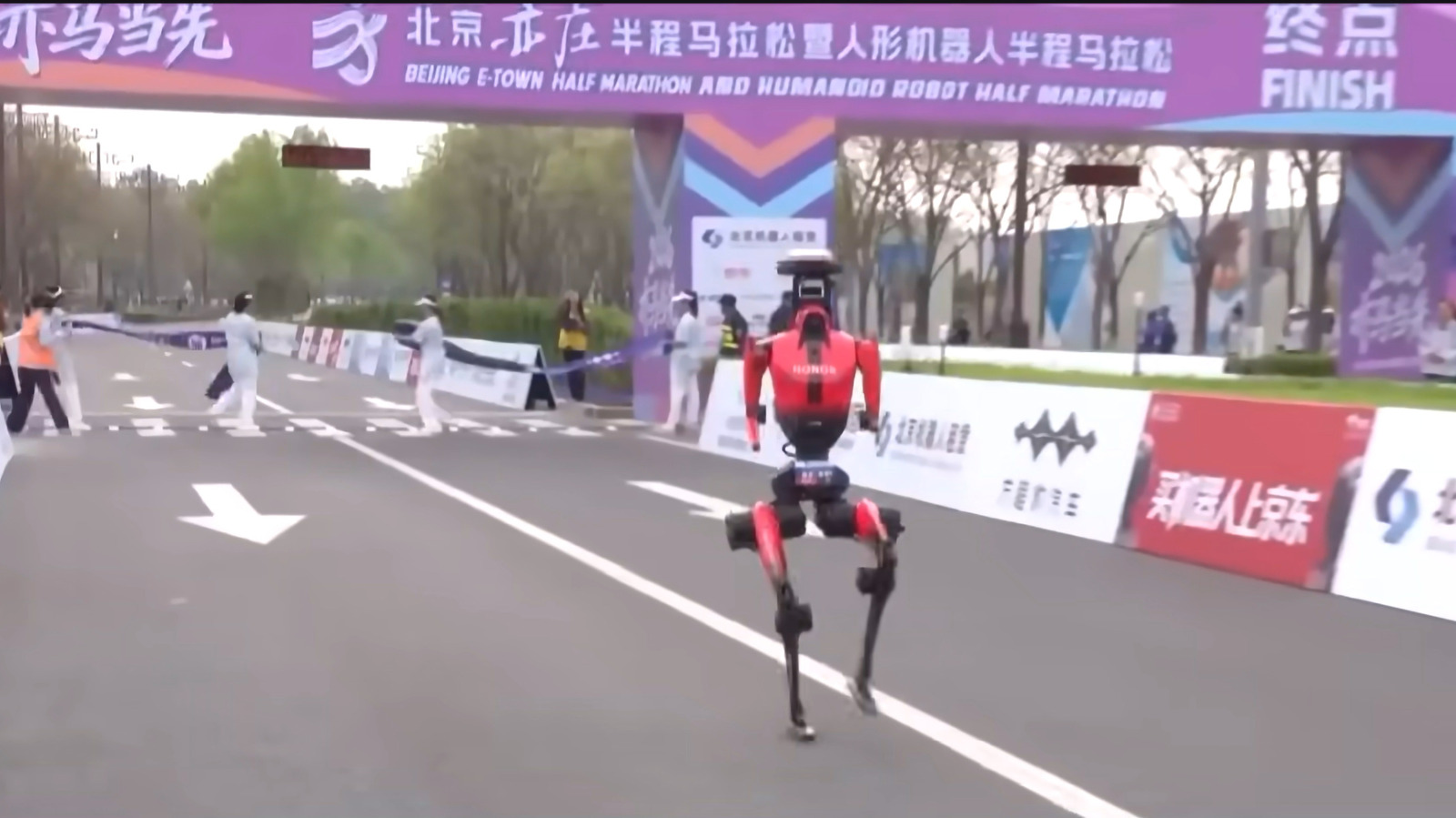

A robotics competition on the fringes of Beijing could ignite a new era of Asimovian fears, as humanoid robots outpaced human contenders en route to record-breaking achievements. The event, now in its second installment, highlighted a rapidly advancing Chinese robotics sector on the brink of commercial success.
Following an initial race filled with technological setbacks, the 2026 half marathon turned out to be a remarkable triumph. Featuring autonomous and remotely controlled robots from over 100 developers competing against 12,000 human racers, the event displayed significant advancements. The champion, developed by Chinese smartphone manufacturer Honor, crushed the half marathon world record previously established by Ugandan athlete Jacob Kiplimo this year. Completing the 13-mile course in an impressive 50 minutes and 26 seconds, the robot surpassed Kiplimo’s record by nearly seven minutes. Honor, a subsidiary of Chinese technology giant Huawei, produced the top three autonomous finishers.
Observers regard the competition as a demonstration of China’s booming robotics sector. It not only multiplied its competitors fivefold but also introduced substantial technological advancements. Apart from reducing the slapstick mishaps that characterized last year’s event, attendees remarked on the enhanced mechanics of the robots. Additionally, Honor’s victorious autonomous humanoid finished over three times faster than the gold medalist from the previous year.
Experts emphasize that the technology behind these robotic athletes has significant industrial uses. China, the global leader in robotics, has started integrating robots in various sectors, ranging from military applications to fully autonomous agricultural practices. However, some contend that China’s humanoid robots still need further development to dominate the economic and security landscape. Following this recent exhibition of robotic prowess, the pressing question remains: will the rest of the world keep pace?
Racing to the finish
Organized by the economic development group Beijing Economic-Technological Development Area, the second Humanoid Robot Half-Marathon saw its bipedal participants make impressive advancements from the inaugural race. The victor, a 5-foot-5-inch cherry red runner named Lightning, sped through the track, adeptly navigating turns, obstacles, and uneven surfaces to break the world record. Handling a more challenging course than in the previous year, robots significantly outperformed a 2025 group that faced a series of notable slapstick incidents leading to only 6 of 21 competitors finishing.
This year, hundreds of millions of online spectators witnessed robot sprinters achieving record-setting speeds. Generally, this year’s entries navigated the track without the disastrous malfunctions that marked last year’s race. For example, the 2025 champion from the Beijing-based lab X-Humanoid managed to more than halve its previous championship time. Overall, nearly 40% of the participants were fully autonomous.
However, the enthusiasm surrounding the event should be taken with a grain of caution. While teams dramatically enhanced the agility and efficiency of their robots, they were also permitted to assist their autonomous humanoids on the course, helping them off the ground in the event of a crash, which was common during the event. A notable entry from China’s largest humanoid robot manufacturer, Unitree, exited the half marathon in a manner reminiscent of my own: on a stretcher. Even Lightning, hailed as China’s speedy champion, required assistance from the pavement after a dramatic collision near the finish.
The grand robotics race
Beijing’s robotic competition served as more than just a spectacle for robotic athletes. As Du Xiaodi, an engineer on the victorious robotics team, articulated, “running faster may not seem significant at first, but it facilitates technology transfer, such as in structural reliability and cooling, leading to industrial applications” (via Reuters). In one regard, the race reflects rapid strides toward these functionalities. Nevertheless, some experts caution that the techniques employed in the race aren’t as economically transferable as suggested and do not tackle the vital challenges that separate the industrial robotics sector from widespread implementation, lacking the advanced dexterity and sensory perception necessary for complex, non-repetitive tasks. As Xue Qingheng, a participant in the race, put it, “robots today have the physique of Mike Tyson but still need a mind like Stephen Hawking. Once we solve the brain issue, the possibilities for creativity will be vast” (via NBC News).
The half-marathon underscores a Chinese robotics sector significantly ahead of its American counterparts. Beijing has heavily invested in advancing its robotics capabilities, establishing it as a cornerstone of its 2026 five-year development strategy and launching a $158 billion state-backed capital fund in 2025. Leveraging advantages in manufacturing and component supply chains, China has capitalized on its dual-purpose robotics investments, claiming an estimated two-thirds of global patents and deploying more industrial robots than all other nations combined. One motivation for this focus is its potential to mitigate the impact of China’s declining population on