

The starfighter confrontations in George Lucas’ space saga “Star Wars” draw inspiration from authentic air combat. Films like “The Dam Busters” and “633 Squadron” significantly influenced the 1977 film that ignited the “Star Wars” phenomenon in “Star Wars Episode IV: A New Hope.” The distinctive ships themselves are modeled after aircraft utilized in wartime, such as the Y-Wing starfighter bombers.
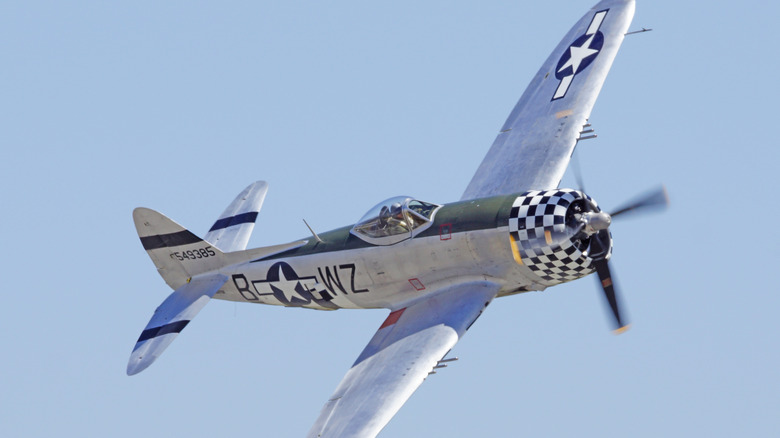
The Y-wing was crafted as a sturdier starfighter intended to endure impacts and inflict substantial damage. Employed by the Rebels, Y-Wings were frequently retrofitted from older ship components, enhancing their resilience akin to their real-world equivalent, the P-47 Thunderbolt. Though the rugged WWII aircraft may not resemble the Y-Wing, they shared attributes of dependability, durability, and strength.
While many might contend that the Millennium Falcon is one of the greatest sci-fi vessels of all time, the Y-Wing also played a crucial role in assisting the Rebels in saving the galaxy on multiple occasions. From its debut in “A New Hope” during the Death Star trench run to the Scarif battle in “Rogue One: A Star Wars Story,” Y-Wings delivered essential support in conflicts. They were utilized as bombers and delivered powerful strikes with proton torpedoes designed to annihilate the Death Star.
Origins of the Y-Wing concept
It’s evident that when comparing pictures of the P-47 and the futuristic Y-Wing, the two lack similarities in appearance. The aircraft served merely as a reference for crafting the Y-Wing. However, both shared a commonality in usage. Each excelled in strafing techniques, performing runs to assault ground targets before returning home with minimal damage.
For those interested in experiencing the P-47 firsthand, one can be viewed on display at the National Museum of the United States Air Force. Conversely, encountering a full-sized Y-Wing may prove more challenging, as the ones featured in the films were miniatures. The starfighters were designed by engineers at Industrial Light & Magic, the production company of George Lucas. Each was a scaled-down model of the ship, filmed against a blue screen. The process was spearheaded by modelmaker Colin Cantwell.
Cantwell was the principal model designer for nearly every ship seen in the original trilogy. He developed prototypes beginning in 1975, two years prior to the film’s debut, guided by descriptions from Lucas. Cantwell’s Y-Wing design served as the foundation for the artwork used by concept artist Ralph McQuarrie for “Star Wars.” Meanwhile, he conceived the X-Wing design while at a British pub.
The most renowned Y-Wing pilot
The films prominently feature the X-Wing fighter pilots, notably hero Luke Skywalker, who was part of Red Squadron and operated an X-Wing. However, it’s the Y-Wings and their commander that were intended to obliterate the Death Star before being brought down by Darth Vader. The pilots spearheading the assault were led by Jon “Dutch” Vander, portrayed by actor Angus McInnes.
McInnes played Gold Leader in “A New Hope” and reprised the role in “Rogue One: A Star Wars Story” many years later. The latter takes place prior to the events of the fourth film and includes McInnes as Gold Leader through previously unused cockpit footage from the 1977 film. New dialogue was recorded for the 2016 film, along with some lines from the original movie.
“Star Wars” may unfold in a galaxy far, far away, but it is a narrative influenced by historical events. Concerning the future of the franchise, it appears quite bright with additional Star Wars films and television series in the works. Iconic ships like the Y-Wing could reappear to aid the Rebel Alliance in achieving another triumph.