
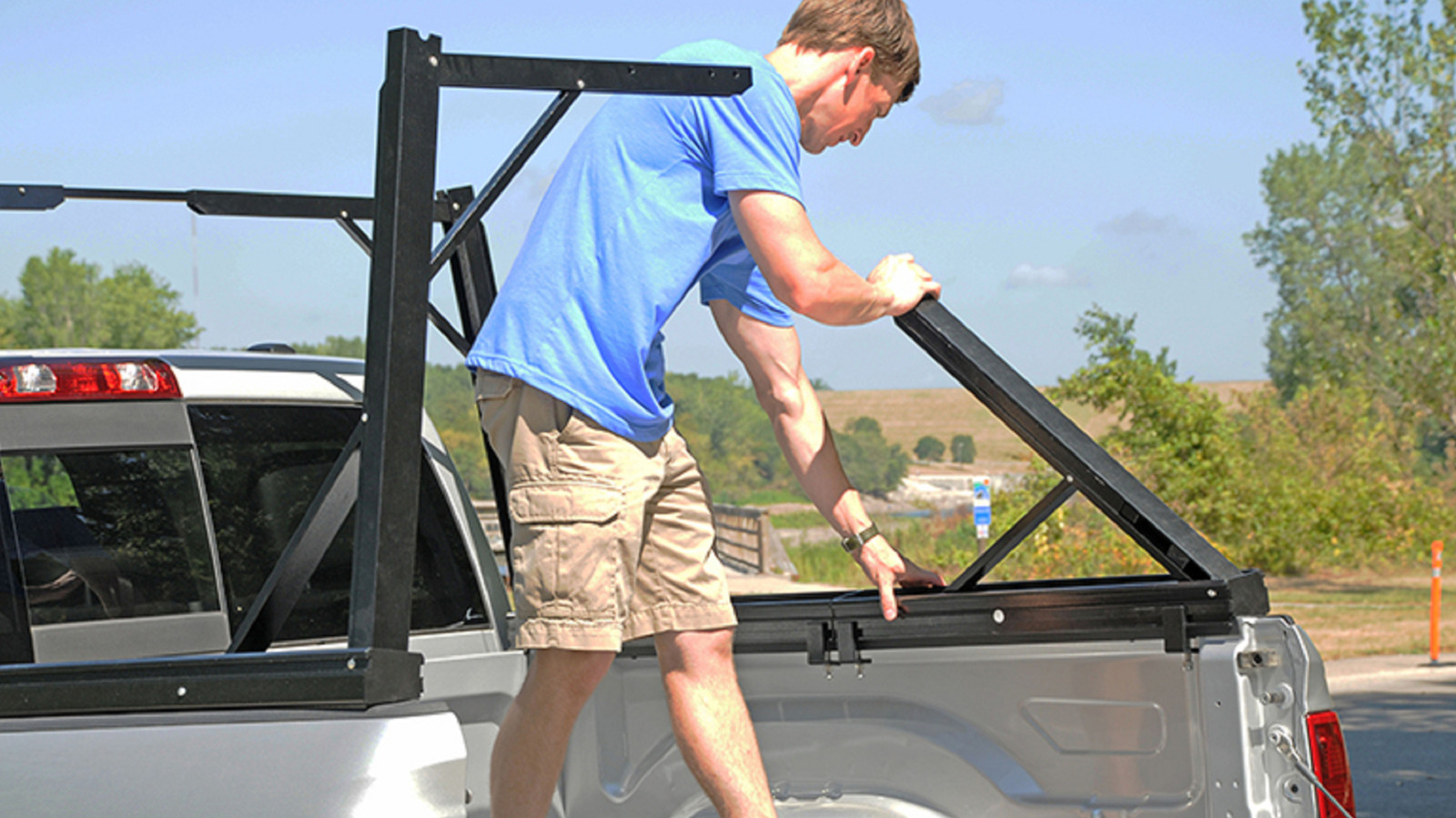

Some business owners arrive at “Shark Tank” aiming to achieve more than mere profits — enterprises such as the anti-bullying application ReThink are also present to convey a message. In Season 3, Episode 2, Donny McCall, the inventor of Invis-A-Rack, presented the Sharks with a collapsible cargo rack designed for truck beds, one of many vehicle-related innovations the show has evaluated, including Zero Pollution Motors in Season 6. With a valuation of $1 million for his company, he was pursuing $100,000 in exchange for 10% equity.
Although Invis-A-Rack, capable of supporting up to 500 pounds and easily assembled or disassembled in moments, is remarkable, McCall emphasized that there was something he valued more than his creation. For him, the principal aspect of his business was producing the item exclusively in the United States. He aimed to generate employment opportunities in his hometown of Sparta, North Carolina, a small community significantly affected by the recession of the late 2000s.
Nevertheless, despite the Sharks being impressed by the invention and (generally) supportive of his admirable ambitions, they expressed apprehensions regarding the business model and McCall’s rigidity. The production cost of Invis-A-Rack was $250, but distributors were willing to pay only about $300 per unit, prompting McCall to consider reducing costs to $150 to achieve profitability. Still, he rejected the idea of outsourcing manufacturing to decrease expenses, even though, as the Sharks indicated, it could facilitate business growth and create additional American jobs in the future. While McCall’s good intentions moved Robert Herjavec, whose father was an immigrant factory worker, to tears, he left without securing a deal for Invis-A-Rack.
What transpired with Invis-A-Rack following its appearance on Shark Tank?
Although the Sharks declined to invest in Invis-A-Rack, the product’s “Shark Tank” showcase resonated with audiences, who encouraged McCall to persist despite the letdown. One such supporter was Scott Moyer, marketing director at Dee Zee, Inc., an Iowa-based manufacturer of light truck accessories committed to producing items in the U.S. using American-sourced components. Several months post-airing of the episode in 2012, Dee Zee obtained the rights to manufacture, market, and distribute Invis-A-Rack. McCall, already familiar with Dee Zee, expressed gratitude for the company’s interest in his innovation and noted that both enterprises shared similar objectives and customer demographics. However, this transition meant relocating production from Sparta to Des Moines.
More than a decade later, Invis-A-Rack remains available through multiple retailers, although the price has surged. Initially priced at $350 during its “Shark Tank” debut, the manufacturer’s suggested retail price is now $1,194.95 on Dee-Zee’s website. This clearly indicates that the Sharks were correct in believing that Invis-A-Rack would struggle with its original profit margins, while also demonstrating that consumers are willing to pay significantly more for the item.
As for Donny McCall, he has held numerous roles since departing from Invis-A-Rack in 2013. Between 2019 and 2025, he owned Pinpoint Local, a web design agency aimed at assisting small businesses in their growth (aligning with the objectives of Apple’s Made for Business series). He currently serves as a real estate broker with Alleghany High Country Realty, operating in his native region. In 2023, he informed the Des Moines Register that he continues to earn a percentage of Invis-A-Rack sales due to the licensing agreement with Dee Zee and that sales experience spikes when the episode is rebroadcast in syndication.