
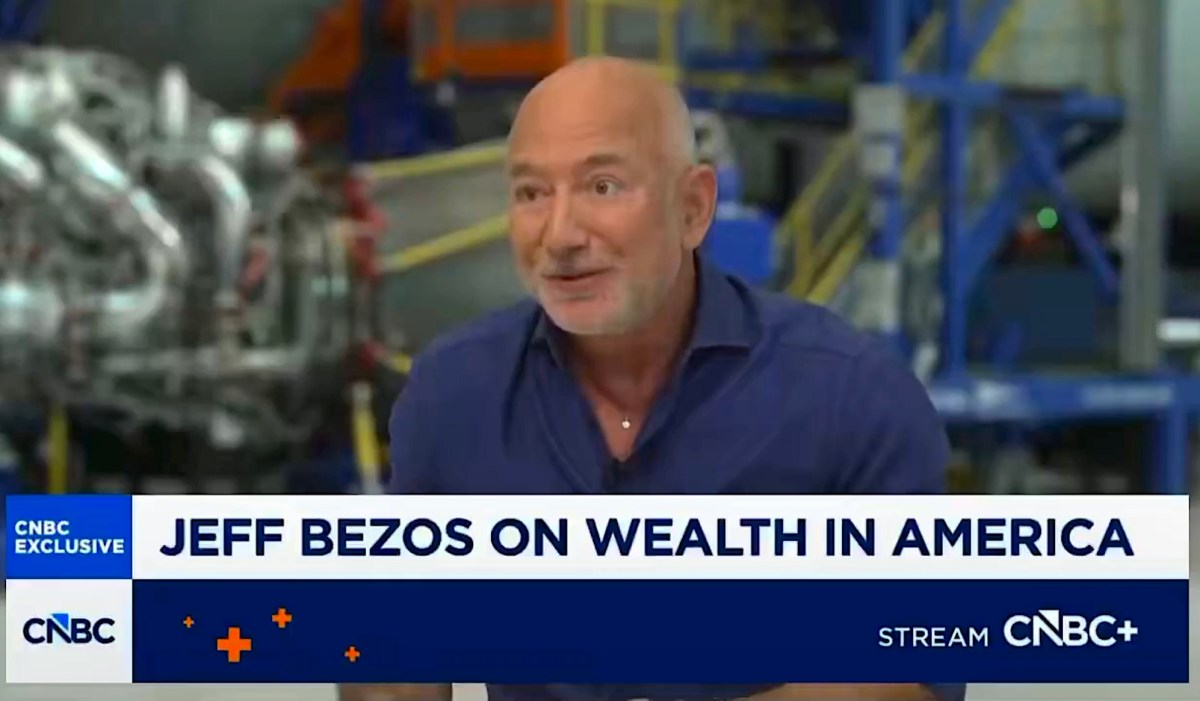

On Wednesday morning, Jeff Bezos stated in a CNBC interview that Americans earning in the bottom half of incomes should not pay taxes.
“Why is a nurse in Queens making $75,000 a year paying more than $1,000 a month in taxes?” Bezos questioned. “That’s $1,000 that could help with rent, groceries, or anything… It’s kind of absurd we’re doing this. We shouldn’t be asking this nurse in Queens to send money to Washington. They should be sending her an apology.”
Bezos highlights that the lower half of earners pay only 3% of total taxes, suggesting that individuals like the nurse struggle to make ends meet while allocating roughly 16% of their salary to taxes, which barely impact federal revenue.
This might be unexpected from Bezos, one of the world’s wealthiest individuals. Billionaires like him exploit tax system loopholes to pay income tax on a small percentage of their earnings. In 2007 and 2011, Bezos didn’t pay income tax. A ProPublica investigation found that from 2006 to 2018, Bezos’ wealth grew by $127 billion, but he reported $6.5 billion in income, resulting in a $1.4 billion tax payment at around a 1% tax rate.
This practice is legal. Americans aren’t taxed on unrealized capital gains, so if Amazon’s stock value increases, Bezos is taxed only when the stock is sold. The ultra-wealthy hold onto investments and live off loans using their stock as collateral, avoiding taxes since loans are classified as debt.
“Senator Elizabeth Warren has pointed out that you and others pay a lower tax rate, despite paying large sums in taxes,” CNBC reporter Andrew Ross Sorkin queried Bezos.
Bezos asserts the US has a spending issue, not a revenue issue. “The top 1 percent of taxpayers pay 40 percent of all tax revenue. The bottom half pay only 3 percent,” Bezos stated.
However, Bezos still pays taxes at a lower rate than most Americans, even after selling Amazon stock to fund Blue Origin, his space company.
“If people want me to pay more billions, then let’s discuss that. But don’t pretend it’s going to solve the problem,” Bezos remarked. “You could double my taxes, and it wouldn’t help the nurse in Queens.”
It’s challenging to believe we couldn’t productively use the billions more in taxes Bezos could pay, even with a $7.4 trillion federal budget.
That nurse in Queens might find it beneficial if she could depend on public transit to get to work or send her children to well-resourced public schools. She’d likely appreciate hospital visits without worrying about hefty medical bills.
These scenarios rely on government effectively using tax dollars to aid citizens.
Bezos added, “For a truly progressive tax system, ensure the money is helping and not just dissolving in administrative bureaucracy.”
Money is tangible—a finite amount in a bank account covering rent, groceries, car payments, and loans.
If it’s naive to dream of what could be achieved if billionaires paid fair taxes, then so be it. It’s also naive to think we can build data centers on the moon.