

Knowledge is power, so here’s how to find power-hungry data centers nearby.
When Oregon resident Isabelle Reksopuro heard that Google was acquiring public land for its data centers in her state, she was uncertain about the truth. “There’s a lot of misinformation about data centers,” she noted, adding that “Google has denied taking that land.” Technically, she clarified, The Dalles, a city near Washington state, was trying to reclaim that land, “and Google is just a big, unnamed power user.” The city indeed sought ownership of a 150-acre portion of Mount Hood National Forest, stating a need for access to Mount Hood’s watershed to meet municipal needs as its population — 16,010 as per the 2020 census — grows. However, critics, including environmentalists, argue that the city is attempting to secure more water for Google, which maintains a vast data center campus in The Dalles consuming about one-third of the city’s water supply.
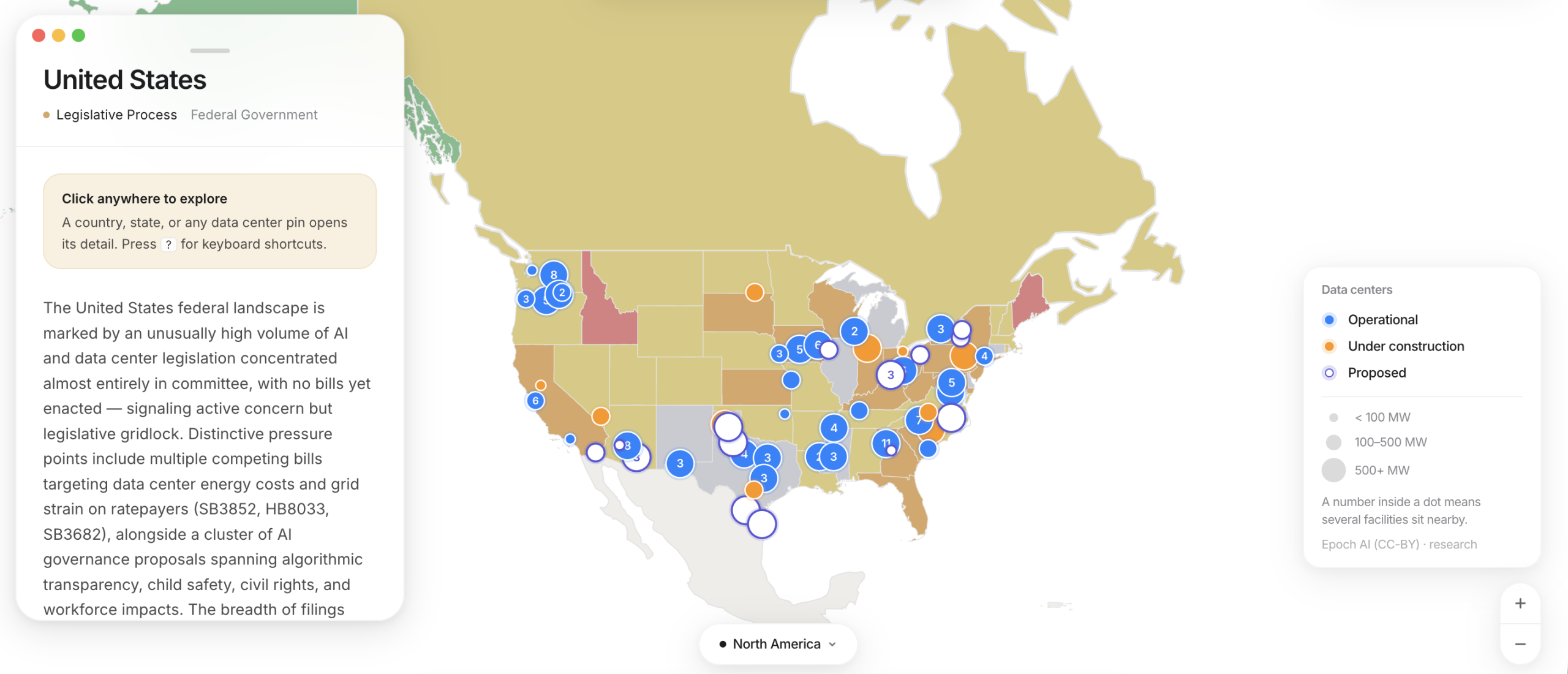
This controversy sparked Reksopuro’s interest in the opposition against data centers in other areas. Hence, Reksopuro, a student at the University of Washington focusing on the intersection of tech and public policy, decided to map it. Utilizing data from Epoch AI and legislation on data centers, she created an interactive map tracking AI policy globally. Her design ensures accessibility, aiming for her younger sisters to explore and comprehend data centers and related activities. She hopes to influence their views in this manner, “instead of like, through TikTok.”
The map updates itself four times daily, seeking new sources and verifying them against the existing database Reksopuro developed. “It writes a new summary, adds it to the news feed and updates the sidebar,” she explained. “I aimed for a self-updating map since I’m also a student.”
Opposition to data centers unites Americans across political lines. Beyond initial construction, data centers bring few permanent jobs and high data consumption often leads to increased utility bills. Though data centers face growing controversy, Reksopuro’s map indicates that public reactions and policies surrounding them are not universally consistent. There’s been a significant backlash in Maine — which briefly established a state-level moratorium on hyperscale data centers, later vetoed by Gov. Janet Mills. In contrast, Texas favors data centers, having enacted tax exemptions contributing over $1 billion annually in tax breaks for them.
Reksopuro isn’t anti-data centers but believes in increased transparency about data center policies from tech giants. “Currently, it’s really opaque — suddenly, a facility appears,” she said. She believes awareness could empower people to negotiate: “ask for job training programs, tax revenue, environmental monitoring, things to improve their community.”